Chenopodium album
Lamb's quarters
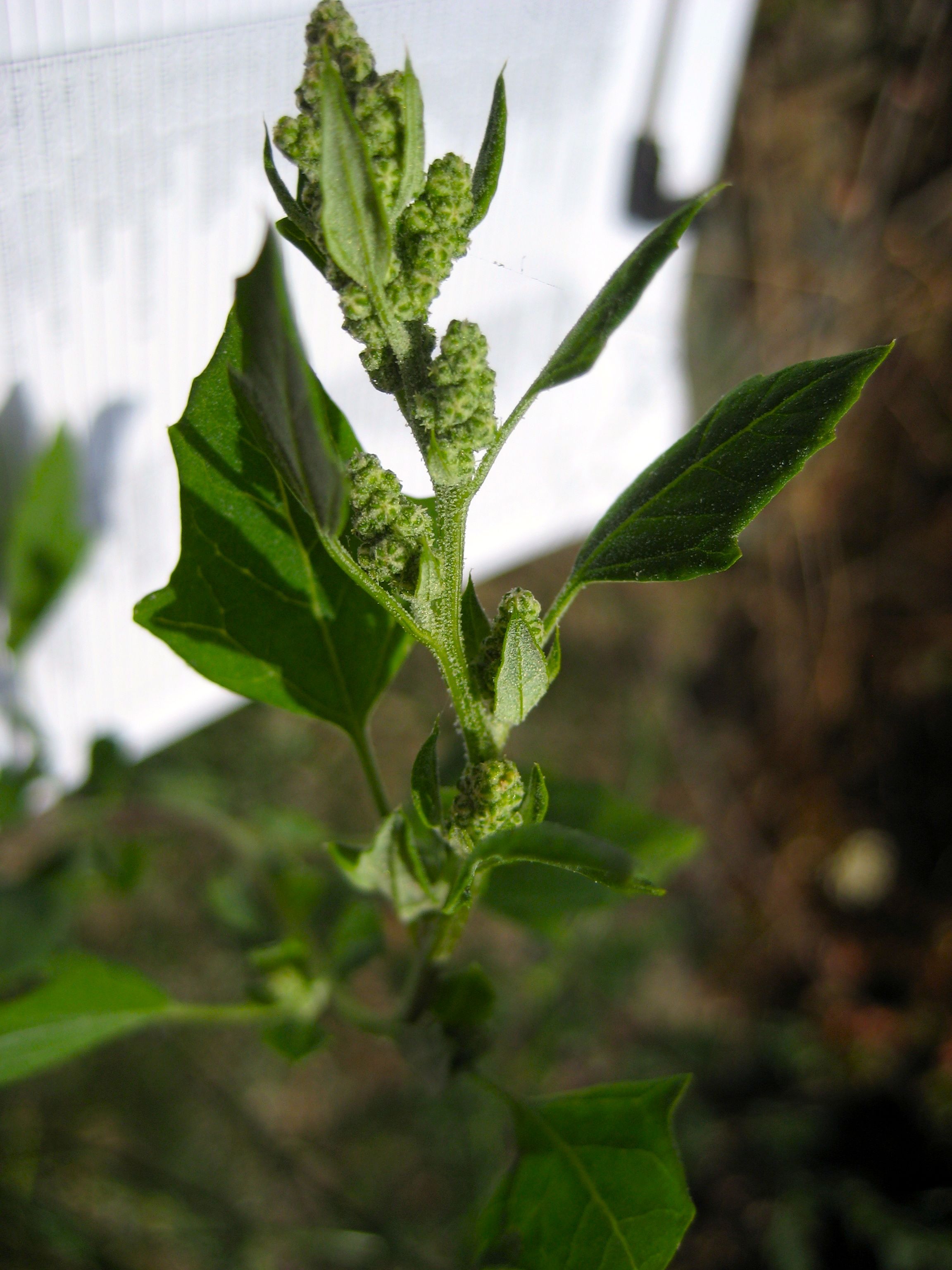
Photo by Chez Brungraber
Family: Chenopodiaceae · Type: Herb · Not Native
Chenopodium album (Lamb's quarters) is a non-native California herb in the Chenopodiaceae family, recognized by most widespread; distinguished by leaf shape, powdery undersides, and disturbed habitat preference.
Lamb's quarters is a naturalized annual herb found throughout California in disturbed areas and fields at elevations below 1,800 meters. Flowering from June to October, this plant produces tiny greenish-white flowers in axillary and terminal branched spikes. Growing with many-branched stems 18 to 100 centimeters tall, it has an upright and spreading growth habit. Its leaves are distinctively ovate to diamond-shaped, 15 to 70 millimeters long, with irregular teeth and a dull green surface that becomes powdery white underneath. The fruit is small, approximately 1 to 1.5 millimeters in diameter, with a wall that becomes free as the plant matures.
Identification and appearance
Key characters: 30 sympatric species - most widespread; distinguished by leaf shape, powdery undersides, and disturbed habitat preference
Habitat and range
Habitat: Common. Disturbed areas, fields
Elevation: < 1800 m
California counties: Santa Barbara, Kern, San Diego, Imperial, Los Angeles, Orange, San Bernardino, Inyo, Mariposa, San Luis Obispo, San Joaquin, San Francisco, Riverside, Santa Clara, Ventura, Lake, Solano, Colusa, Napa, Plumas, Yolo, Alpine, Modoc, Monterey, Sacramento, Butte, Contra Costa, Fresno, Mono, Madera, Sonoma, Kings, Sutter, Tehama, Glenn, Lassen, Nevada, Siskiyou, Shasta, Yuba, Trinity, Tulare, Alameda, Stanislaus, Mendocino, Sierra, Humboldt, Placer, Del Norte, Tuolumne, San Mateo, Merced, El Dorado, Santa Cruz
Outside California: +- temperate worldwide; probably native to Europe.
Bloom period
Chenopodium album blooms Jun-Oct.
How to tell it apart
vs Chenopodiastrum: Chenopodium has mealy coating; Chenopodiastrum is smooth to slightly hairy without mealy texture.; vs Atriplex: Chenopodium has perfect flowers; Atriplex has separate male/female flowers with paired bracts on fruits.; vs Blitum: Chenopodium has dry fruits; Blitum has fleshy, berry-like fruiting calyxes.; vs Amaranthus: Chenopodium has mealy coating; Amaranthus is smooth with dense bristly flower spikes.; vs Rumex: Chenopodium has 5-parted flowers in clusters; Rumex has 6-parted flowers in whorls.
Frequently asked questions
Is Chenopodium album native to California?
No. Chenopodium album is not native to California (recorded as not native).
When does Chenopodium album bloom?
Chenopodium album blooms Jun-Oct.
Where in California does Chenopodium album grow?
Chenopodium album occurs in Santa Barbara, Kern, San Diego, Imperial, Los Angeles, Orange, San Bernardino, Inyo and other counties, at elevations of < 1800 m.
What plant family does Chenopodium album belong to?
Chenopodium album is in the Chenopodiaceae family, genus Chenopodium.
What habitat does Chenopodium album grow in?
Chenopodium album grows in Common. Disturbed areas, fields.
Related species
Other California species in the same genus, family, or bioregion.
Sources: Jepson eFlora · Index of California Plant Names · CalPhotos
Last updated 2026-10-07
Data from The California Species Project — 14,000+ California species with verified data from CNPS, CDFW, USFWS, Cal-IPC, and more.