Chenopodium incanum var. occidentale
Mealy goosefoot
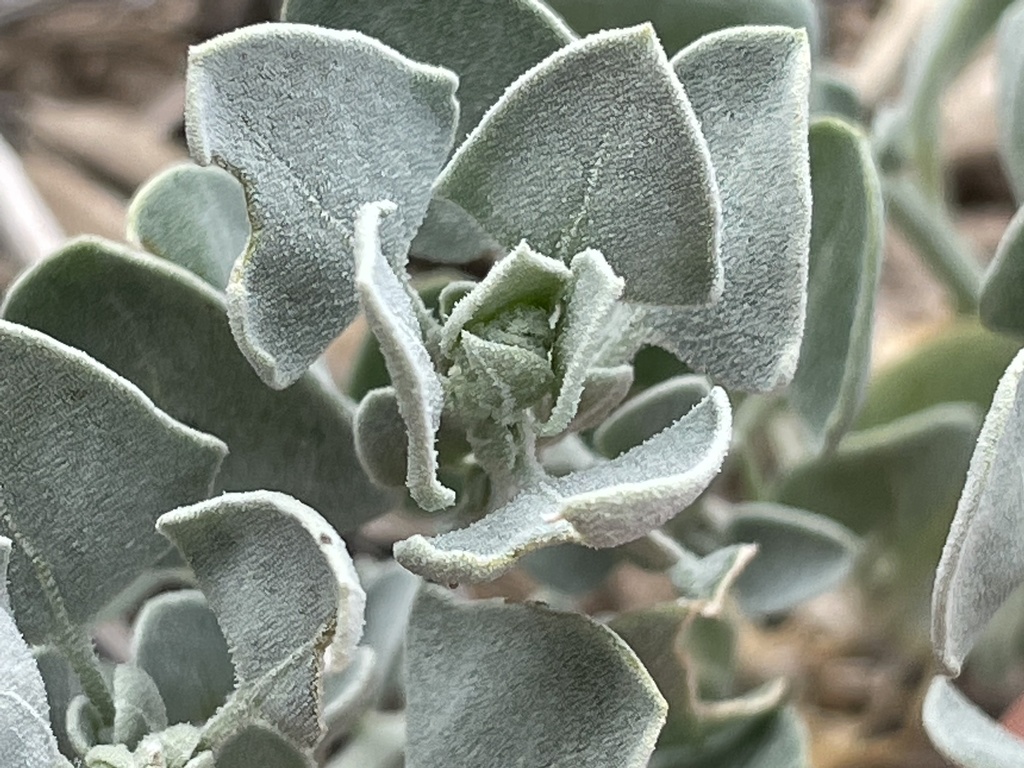
(c) Bobby McCabe, some rights reserved (CC BY), uploaded by Bobby McCabe · licence
Family: Chenopodiaceae · Type: Herb · Native
Chenopodium incanum var. occidentale (Mealy goosefoot) is a native California herb in the Chenopodiaceae family, recognized by eastern Sierra and Great Basin distribution, triangular-diamond leaves.
Mealy goosefoot is a California native annual found in the eastern Sierra Nevada, Great Basin, and Mojave Desert regions in open sandy or gravelly places at elevations of 700 to 2,300 meters. Flowering from April to August, this plant produces small green flowers in widely spaced axillary and terminal panicle clusters. Growing with erect or spreading stems 8 to 60 centimeters tall, it develops a distinctive triangular-diamond-shaped to ovate leaf structure with two-lobed bases. Its leaves are moderately powdery, measuring 6 to 18 millimeters long, with a tapered base and acute or rounded tip that appears whitish-gray due to fine powdery coating. The small fruits are approximately 1 to 1.2 millimeters in diameter, containing horizontal black seeds with obtuse margins.
Identification and appearance
Key characters: 27 sympatric species - eastern Sierra and Great Basin distribution, triangular-diamond leaves
Habitat and range
Habitat: Open places, sandy or gravelly soils
Elevation: 700-2300 m
California counties: San Bernardino, Inyo, Mono, Nevada, Riverside
Outside California: to Idaho, southwestern Utah
Bloom period
Chenopodium incanum var. occidentale blooms Apr-Aug.
How to tell it apart
vs Chenopodiastrum: Chenopodium has mealy coating; Chenopodiastrum is smooth to slightly hairy without mealy texture.; vs Atriplex: Chenopodium has perfect flowers; Atriplex has separate male/female flowers with paired bracts on fruits.; vs Blitum: Chenopodium has dry fruits; Blitum has fleshy, berry-like fruiting calyxes.; vs Amaranthus: Chenopodium has mealy coating; Amaranthus is smooth with dense bristly flower spikes.; vs Rumex: Chenopodium has 5-parted flowers in clusters; Rumex has 6-parted flowers in whorls.
Frequently asked questions
Is Chenopodium incanum var. occidentale native to California?
Yes. Chenopodium incanum var. occidentale is native to California (recorded as native).
When does Chenopodium incanum var. occidentale bloom?
Chenopodium incanum var. occidentale blooms Apr-Aug.
Where in California does Chenopodium incanum var. occidentale grow?
Chenopodium incanum var. occidentale occurs in San Bernardino, Inyo, Mono, Nevada, Riverside, at elevations of 700-2300 m.
What plant family does Chenopodium incanum var. occidentale belong to?
Chenopodium incanum var. occidentale is in the Chenopodiaceae family, genus Chenopodium.
What habitat does Chenopodium incanum var. occidentale grow in?
Chenopodium incanum var. occidentale grows in Open places, sandy or gravelly soils.
Related species
Other California species in the same genus, family, or bioregion.
Sources: Jepson eFlora · Index of California Plant Names · CalPhotos
Last updated 2026-10-07
Data from The California Species Project — 14,000+ California species with verified data from CNPS, CDFW, USFWS, Cal-IPC, and more.