Chenopodium vulvaria
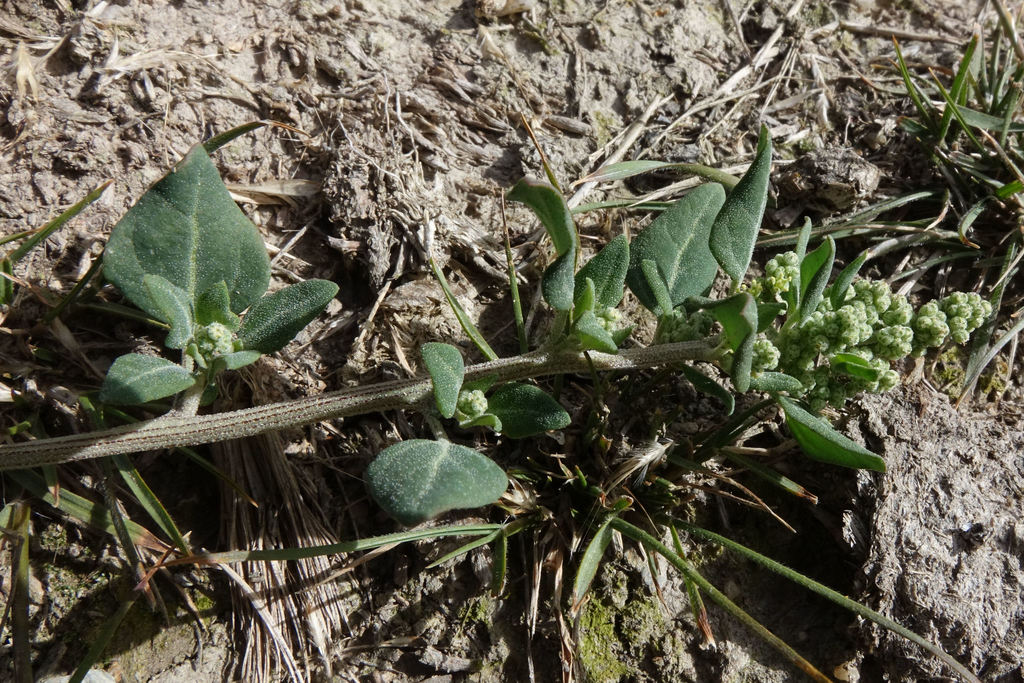
(c) John Barkla, some rights reserved (CC BY) · licence
Family: Chenopodiaceae · Type: Herb · Not Native
Chenopodium vulvaria is a non-native California herb in the Chenopodiaceae family, recognized by distinctive for small size, unpleasant odor, and densely powdery leaf undersides.
Stinking goosefoot is a naturalized annual found in California's Central Valley, southern Sierra Nevada, Central Western, and Western Transverse Ranges in open, disturbed areas at elevations below 1,400 meters. Flowering from June to October, this plant produces small green flowers in compact axillary clusters. Growing with erect or ascending stems 5 to 40 centimeters tall and few branches from the base, it has a distinctively unpleasant odor. Its leaves are small, 3 to 20 millimeters long, ovate to diamond-shaped with an obtuse base and acuminate tip, appearing powdery on both surfaces. The tiny fruit is approximately 1 millimeter in diameter, with a wall attached to a black, wrinkled seed.
Identification and appearance
Key characters: 27 sympatric species; distinctive for small size, unpleasant odor, and densely powdery leaf undersides
Habitat and range
Habitat: Uncommon. Open, disturbed areas
Elevation: < 1400 m
California counties: Kern, Solano, Marin, Siskiyou, Alameda, Yolo, Amador, Calaveras, Napa, Contra Costa, Mendocino, Shasta, Butte, Sutter, Tehama, Alpine, San Mateo, San Luis Obispo, Santa Clara, Stanislaus, Santa Barbara, San Benito
Outside California: to eastern United States, native to Eurasia
Bloom period
Chenopodium vulvaria blooms Jun-Oct.
How to tell it apart
vs Chenopodiastrum: Chenopodium has mealy coating; Chenopodiastrum is smooth to slightly hairy without mealy texture.; vs Atriplex: Chenopodium has perfect flowers; Atriplex has separate male/female flowers with paired bracts on fruits.; vs Blitum: Chenopodium has dry fruits; Blitum has fleshy, berry-like fruiting calyxes.; vs Amaranthus: Chenopodium has mealy coating; Amaranthus is smooth with dense bristly flower spikes.; vs Rumex: Chenopodium has 5-parted flowers in clusters; Rumex has 6-parted flowers in whorls.
Frequently asked questions
Is Chenopodium vulvaria native to California?
No. Chenopodium vulvaria is not native to California (recorded as not native).
When does Chenopodium vulvaria bloom?
Chenopodium vulvaria blooms Jun-Oct.
Where in California does Chenopodium vulvaria grow?
Chenopodium vulvaria occurs in Kern, Solano, Marin, Siskiyou, Alameda, Yolo, Amador, Calaveras and other counties, at elevations of < 1400 m.
What plant family does Chenopodium vulvaria belong to?
Chenopodium vulvaria is in the Chenopodiaceae family, genus Chenopodium.
What habitat does Chenopodium vulvaria grow in?
Chenopodium vulvaria grows in Uncommon. Open, disturbed areas.
Related species
Other California species in the same genus, family, or bioregion.
- Chenopodium wahlii
- Chenopodium watsonii — Watson's goosefoot
- Chenopodium album — Lamb's quarters
- Chenopodium atrovirens — Dark green goosefoot
- Chenopodium aureum
- Chenopodium berlandieri — Pitseed goosefoot
- Corispermum americanum var. americanum — American bugseed
- Corispermum sp. — Bugseed
- Cycloloma sp. — Winged pigweed
Sources: Jepson eFlora · Index of California Plant Names · CalPhotos
Last updated 2026-10-07
Data from The California Species Project — 14,000+ California species with verified data from CNPS, CDFW, USFWS, Cal-IPC, and more.