Cherleria biflora
Mountain sandwort
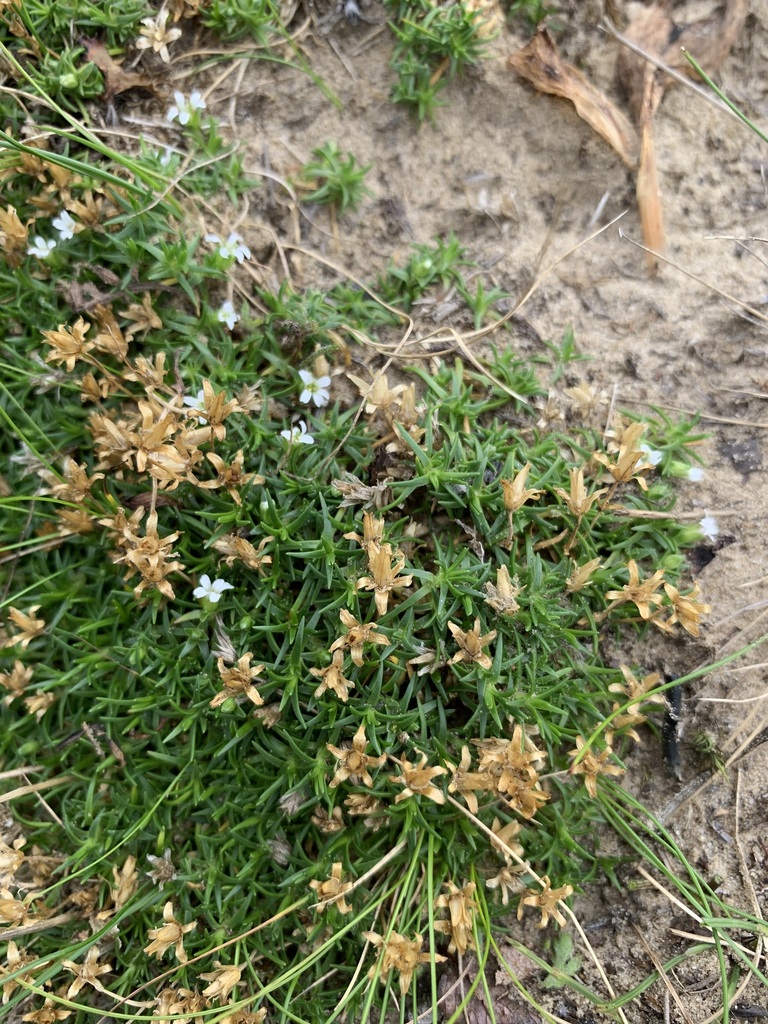
(c) Valerii Glazunov, some rights reserved (CC BY) · licence
Family: Caryophyllaceae · Type: Perennial · Native
Conservation status: CNPS 4.3
Cherleria biflora (Mountain sandwort) is a native California perennial in the Caryophyllaceae family, recognized by Arctic-alpine relict with circumboreal distribution, limited to highest Sierra Nevada peaks.
Mountain sandwort is a native perennial found in the central Sierra Nevada Mountains in alpine habitats among dwarf willows at elevations of 3,150 to 3,700 meters. Flowering during summer, this plant produces small white flowers nestled among dense, mat-like green foliage. Growing as a compact, tightly clustered herb just 1 to 12 centimeters tall, it forms intricate trailing stems up to 20 centimeters long. Its leaves are distinctive needle-shaped, extremely narrow, and evenly spaced, measuring 1.5 to 8 millimeters in length with fine, flexible structures. The plant features an impressive taproot over 3 millimeters in diameter, allowing it to thrive in harsh alpine environments with unglaciated granitic and metamorphic terrain.
Identification and appearance
Key characters: Arctic-alpine relict with circumboreal distribution, limited to highest Sierra Nevada peaks
Habitat and range
Habitat: Among dwarf willows, unglaciated granitics, metamorphics, alpine
Elevation: 3150-3700 m
California counties: Tulare, Fresno, Inyo, Tuolumne, Mono, Mariposa, Alpine
Outside California: to Alaska, Montana, Colorado, New Mexico, also Newfoundland to arctic Eurasia, Altai, Caucasus, European Alps
Bloom period
Cherleria biflora blooms Summer.
Conservation status
CNPS 4.3
How to tell it apart
vs Eremogone: Cherleria forms low glandular-hairy green mats with hood-like, 3-ribbed sepals; Eremogone is glaucous and mat-forming with rigid, sharp-tipped leaves and unribbed sepals.; vs Arenaria: Cherleria has needle- to awl-shaped, flexible leaves crowded on cushiony stems; Arenaria has broader, flat green leaves on trailing, looser stems.; vs Cerastium: Cherleria petals are entire and unnotched; Cerastium (mouse-ear chickweeds) has petals cleft into 2 lobes and denser, softer hairiness.; vs Moehringia: Cherleria seeds lack any appendage; Moehringia seeds bear a fleshy white outgrowth (strophiole) and its leaves are wider and flatter.; vs Sagina: Cherleria is a stout-rooted alpine cushion with 3 styles and glandular herbage; Sagina (pearlworts) are tiny glabrous tufts with awl leaves and often 4-parted flowers.
Frequently asked questions
Is Cherleria biflora native to California?
Yes. Cherleria biflora is native to California (recorded as native).
When does Cherleria biflora bloom?
Cherleria biflora blooms Summer.
Where in California does Cherleria biflora grow?
Cherleria biflora occurs in Tulare, Fresno, Inyo, Tuolumne, Mono, Mariposa, Alpine, at elevations of 3150-3700 m.
What plant family does Cherleria biflora belong to?
Cherleria biflora is in the Caryophyllaceae family, genus Cherleria.
Is Cherleria biflora rare or endangered?
Cherleria biflora carries California Rare Plant Rank 4.3, state rank S4.
Related species
Other California species in the same genus, family, or bioregion.
Sources: Jepson eFlora · CalPhotos · CDFW CNDDB
Last updated 2026-09-30
Data from The California Species Project — 14,000+ California species with verified data from CNPS, CDFW, USFWS, Cal-IPC, and more.