Chimaphila umbellata
Prince's pine, Prince's Pine
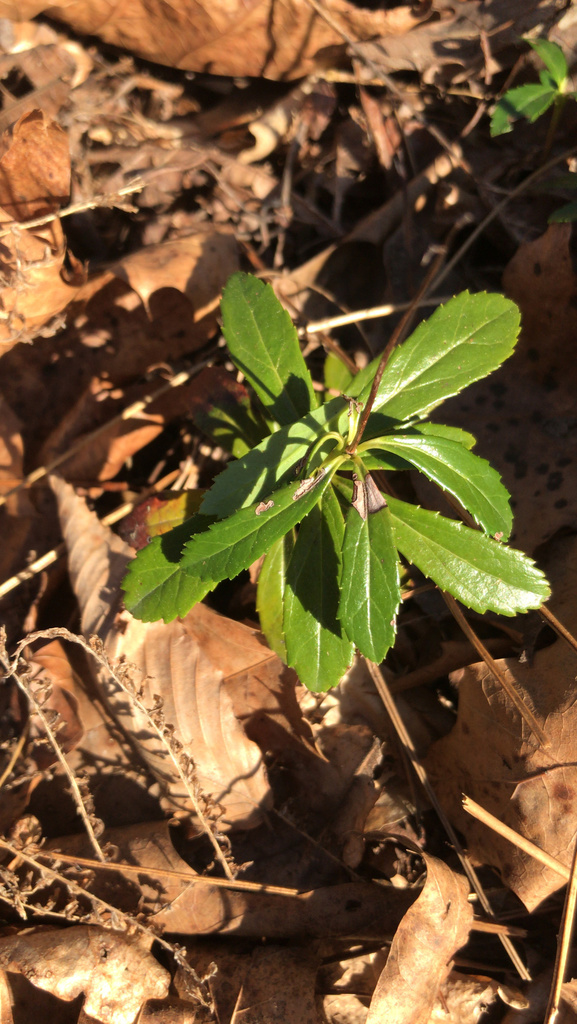
(c) Nick Newberry, some rights reserved (CC BY) · licence
Family: Ericaceae · Type: Subshrub · Native
Chimaphila umbellata (Prince's pine) is a native California subshrub in the Ericaceae family, recognized by . Key differences: overall size, leaf arrangement and venation, flower color.
Prince's pine is a California native perennial found in the Klamath Ranges, northern Coast Ranges, Cascade Range, Sierra Nevada, San Bernardino Mountains, San Jacinto Mountains, and Modoc Plateau in dry conifer forests at elevations of 300 to 2,900 meters. Flowering from June to August, this plant produces distinctive pink to red flowers with hairy filament bases. Growing with stout stems less than 30 centimeters tall, it forms compact clusters of leaves. Its leaves are arranged with several per node, measuring 3 to 7 centimeters long, with prominent toothed edges toward the leaf tips. The plant's glandular-hairy inflorescence and delicate pink-red blossoms make it a charming understory species in coniferous woodland habitats.
Identification and appearance
Key characters: 1 sympatric species. Key differences: overall size, leaf arrangement and venation, flower color
Habitat and range
Habitat: Common. Dry conifer forest
Elevation: 300-2900 m
California counties: Humboldt, Siskiyou, Nevada, Plumas, San Bernardino, Riverside, Trinity, Modoc, El Dorado, Lake, Placer, Shasta, Sierra, Tuolumne, Butte, Del Norte, Mendocino, Lassen, Tehama, Glenn, Tulare, Mariposa
Outside California: to eastern North America, Central America, Eurasia
Bloom period
Chimaphila umbellata blooms Jun-Aug.
How to tell it apart
vs Pyrola: Chimaphila has thick whorled stem leaves; Pyrola has thin leaves clustered at base only.; vs Moneses: Chimaphila has multiple flowers in flat-topped clusters; Moneses has a single nodding flower per stem.; vs Orthilia: Chimaphila flowers cluster flat-topped; Orthilia flowers line one side of curved stalk.; vs Lythrum: Chimaphila has thick evergreen leaves in whorls; Lythrum has thin opposite leaves on tall spikes.; vs Whipplea: Chimaphila has whorled leaves and nodding flowers; Whipplea has opposite leaves and upright flowers.
Frequently asked questions
Is Chimaphila umbellata native to California?
Yes. Chimaphila umbellata is native to California (recorded as native).
When does Chimaphila umbellata bloom?
Chimaphila umbellata blooms Jun-Aug.
Where in California does Chimaphila umbellata grow?
Chimaphila umbellata occurs in Humboldt, Siskiyou, Nevada, Plumas, San Bernardino, Riverside, Trinity, Modoc and other counties, at elevations of 300-2900 m.
What plant family does Chimaphila umbellata belong to?
Chimaphila umbellata is in the Ericaceae family, genus Chimaphila.
What habitat does Chimaphila umbellata grow in?
Chimaphila umbellata grows in Common. Dry conifer forest.
Related species
Other California species in the same genus, family, or bioregion.
Sources: Jepson eFlora · Index of California Plant Names · CalPhotos
Last updated 2026-10-07
Data from The California Species Project — 14,000+ California species with verified data from CNPS, CDFW, USFWS, Cal-IPC, and more.