Chloris truncata
Black windmill grass, Black Windmill Grass
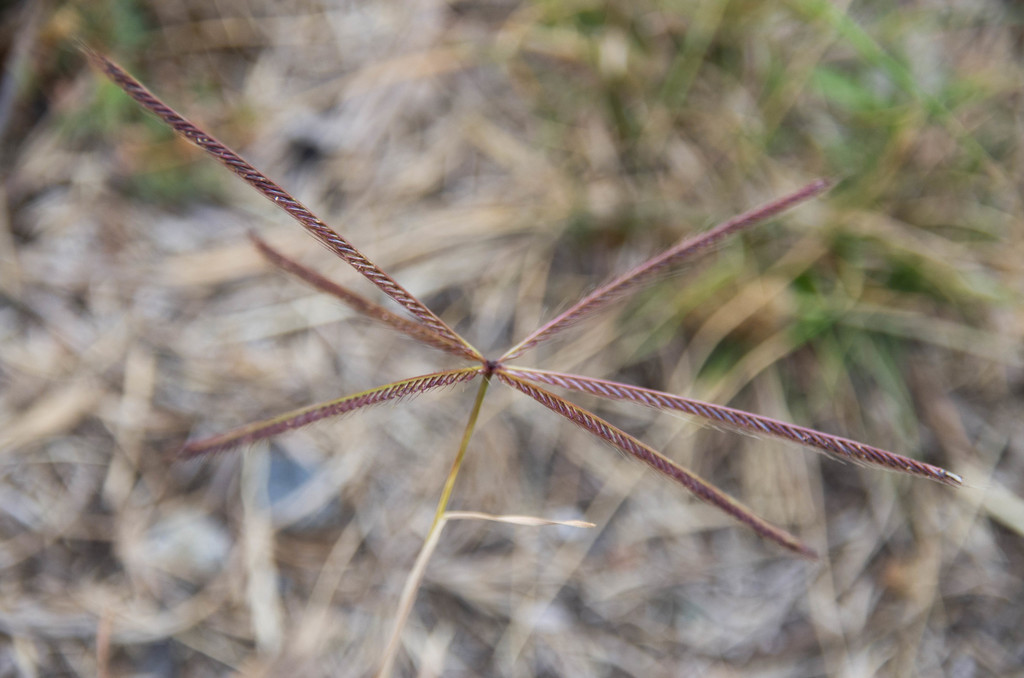
(c) Terra Occ, some rights reserved (CC BY) · licence
Family: Poaceae · Type: Grass · Not Native
Chloris truncata (Black windmill grass) is a non-native California grass in the Poaceae family, recognized by Sympatric with 2 species; distinctive dark brown to black spikelets.
Black windmill grass is a naturalized perennial found in the Great Valley, Peninsular Ranges, and Mojave Desert regions in disturbed areas and cultivation fields at elevations below 500 meters. Flowering from April to November, this grass produces dark brown to black spikelets in distinctive digitate inflorescences with 5 to 13 nearly erect branches. Growing 30 to 50 centimeters tall with spreading stolons, it forms clumps of slender, glabrous stems. Its leaf blades are narrow, 2 to 3 millimeters wide and 5 to 20 centimeters long, with short membranous ligules. The spikelets feature lower and upper florets with lemma awns ranging from 3 to 12 millimeters long, with the lower awn typically longer than the upper.
Identification and appearance
Key characters: Sympatric with 2 species; distinctive dark brown to black spikelets are diagnostic
Habitat and range
Habitat: Disturbed areas; weed of cultivation fields
Elevation: < 500 m
Outside California: South Carolina, native to Australia
Bloom period
Chloris truncata blooms Apr-Nov.
How to tell it apart
vs Spinus: Unable to generate comparison - Spinus is not a grass genus.; vs Spartina: Windmill grass has multiple branches per node; cordgrass has single unbranched spikes.; vs Festuca: Windmill grass has radiating finger spikes; fescue has single elongated panicles.; vs Sclerochloa: Windmill grass has long radiating spikes; hardgrass is a tiny rigid tuft.; vs Leptochloa: Windmill grass has multiple branches per node; sprangletop has single branches per node.
Frequently asked questions
Is Chloris truncata native to California?
No. Chloris truncata is not native to California (recorded as not native).
When does Chloris truncata bloom?
Chloris truncata blooms Apr-Nov.
What plant family does Chloris truncata belong to?
Chloris truncata is in the Poaceae family, genus Chloris.
What habitat does Chloris truncata grow in?
Chloris truncata grows in Disturbed areas; weed of cultivation fields.
Related species
Other California species in the same genus, family, or bioregion.
Sources: Jepson eFlora · CalPhotos
Last updated 2026-10-07
Data from The California Species Project — 14,000+ California species with verified data from CNPS, CDFW, USFWS, Cal-IPC, and more.