Chlorogalum grandiflorum
Red hills soaproot
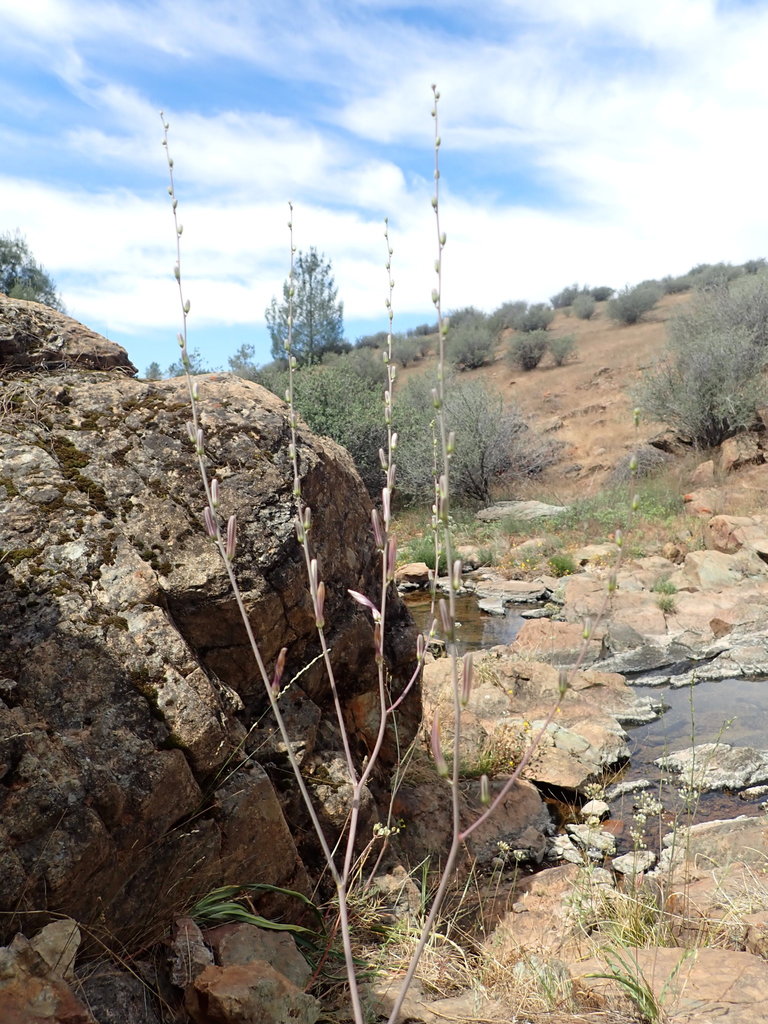
no rights reserved · CC0
Family: Agavaceae · Type: Herb · Native
Conservation status: CNPS 4.2
Chlorogalum grandiflorum (Red hills soaproot) is a native California herb in the Agavaceae family, recognized by no sympatric species.
Red hills soaproot is a rare (CNPS 1B.2) California native perennial found in northern and central Sierra Nevada Foothills in Placer, El Dorado, and Tuolumne counties, occurring on serpentine outcrops and open shrubby hills at elevations of 300 to 500 meters. Flowering from May to June, this plant produces white flowers with a subtle purple midvein, linear and recurved, 15 to 30 millimeters long, emerging from tall inflorescences 30 to 100 centimeters high. Growing with a distinctive bulb 5 to 7 centimeters wide, covered in a reddish-brown membranous coat with delicate outer fibers, it develops ascending branch structures. Its basal leaves are 4 to 12 millimeters wide with distinctively wavy margins, spreading from the base of the plant. The fruit develops as a small capsule 5 to 8 millimeters long, complementing the plant's elegant, sparse structure.
Identification and appearance
Key characters: Geographically isolated; no sympatric species
Habitat and range
Habitat: Serpentine outcrops, open shrubby or wooded hills
Elevation: 300-500 m
California counties: El Dorado, Placer, Tuolumne, Calaveras
Bloom period
Chlorogalum grandiflorum blooms May-Jun.
Conservation status
CNPS 4.2
How to tell it apart
vs Hooveria: Chlorogalum has branching flower clusters; Hooveria has unbranched racemes.; vs Toxicoscordion: Chlorogalum petals twist together after flowering; death camas petals remain separate.; vs Iris: Chlorogalum has small white flowers in branching clusters; iris has large showy flowers with three drooping petals.; vs Yucca: Chlorogalum has thin wavy-edged leaves and open branching clusters; yucca has stiff sword-leaves and dense clusters.; vs Asparagus: Chlorogalum has wavy-edged leaves from a bulb; asparagus has needle-like leaf scales on branching stems.
Frequently asked questions
Is Chlorogalum grandiflorum native to California?
Yes. Chlorogalum grandiflorum is native to California (recorded as native).
When does Chlorogalum grandiflorum bloom?
Chlorogalum grandiflorum blooms May-Jun.
Where in California does Chlorogalum grandiflorum grow?
Chlorogalum grandiflorum occurs in El Dorado, Placer, Tuolumne, Calaveras, at elevations of 300-500 m.
What plant family does Chlorogalum grandiflorum belong to?
Chlorogalum grandiflorum is in the Agavaceae family, genus Chlorogalum.
Is Chlorogalum grandiflorum rare or endangered?
Chlorogalum grandiflorum carries California Rare Plant Rank 4.2, state rank S3.
Related species
Other California species in the same genus, family, or bioregion.
Sources: Jepson eFlora · CNPS Rare Plant Inventory · Index of California Plant Names · CalPhotos · CDFW CNDDB
Last updated 2026-10-07
Data from The California Species Project — 14,000+ California species with verified data from CNPS, CDFW, USFWS, Cal-IPC, and more.