Chloropyron maritimum subsp. palustre
Point reyes salty bird's-beak, Point Reyes Salty Bird's-Beak
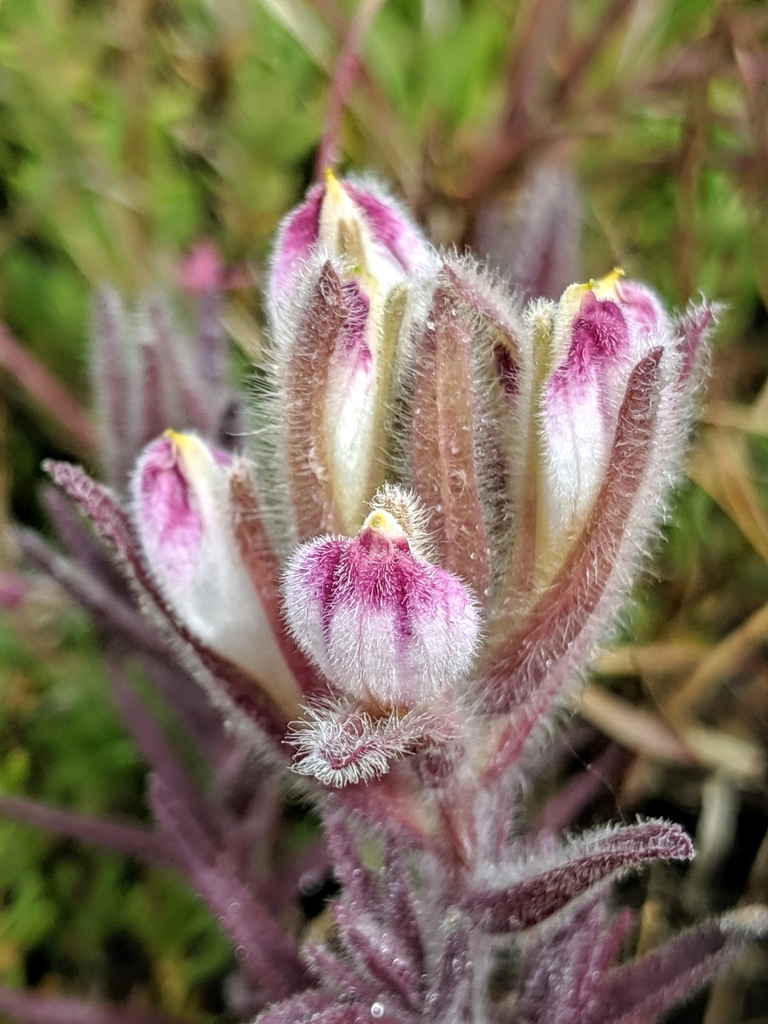
no rights reserved, uploaded by Alex Heyman · CC0
Family: Orobanchaceae · Type: Herb · Native
Conservation status: CNPS 1B.2
Chloropyron maritimum subsp. palustre (Point reyes salty bird's-beak) is a native California herb in the Orobanchaceae family, recognized by branching pattern and geography diagnostic.
Point reyes salty bird's-beak is a rare (CNPS 1B.2) California native annual found in northern Coast Ranges including Humboldt, Marin, and Sonoma counties in coastal salt marshes at elevations below 10 meters. Flowering from May to October, this plant produces small white to pale yellow flowers in dense, compact spikes with inner bracts slightly notched at the tips. Growing with few ascending branches around a central spike, it reaches a compact size typical of salt marsh adaptations. Its leaves are slender and closely arranged along the stems, contributing to the plant's delicate and distinctive marsh habitat profile. The plant produces 10 to 20 small seeds, each 2 to 3 millimeters long, which help ensure its survival in the challenging coastal salt marsh environment.
Identification and appearance
Key characters: 4 sympatric species; branching pattern and geography diagnostic
Habitat and range
Habitat: Coastal salt marsh
Elevation: < 10 m
California counties: Marin, Humboldt, Alameda, San Luis Obispo, San Mateo, Santa Clara, San Francisco, Sonoma
Outside California: southwestern Oregon
Bloom period
Chloropyron maritimum subsp. palustre blooms May-Oct.
Conservation status
CNPS 1B.2
How to tell it apart
vs Castilleja: Leaves completely unlobed and smooth-edged, not lobed or divided.; vs Cordylanthus: Found exclusively in saline or alkaline habitats like salt marshes.; vs Cressa: Has typical Orobanchaceae hooded flowers, not small white tubular Convolvulaceae blooms.; vs Triphysaria: Calyx barely notched at tip (~1 mm), not deeply divided.; vs Orthocarpus: Leaves entirely unlobed, not lobed or divided in any way.
Frequently asked questions
Is Chloropyron maritimum subsp. palustre native to California?
Yes. Chloropyron maritimum subsp. palustre is native to California (recorded as native).
When does Chloropyron maritimum subsp. palustre bloom?
Chloropyron maritimum subsp. palustre blooms May-Oct.
Where in California does Chloropyron maritimum subsp. palustre grow?
Chloropyron maritimum subsp. palustre occurs in Marin, Humboldt, Alameda, San Luis Obispo, San Mateo, Santa Clara, San Francisco, Sonoma, at elevations of < 10 m.
What plant family does Chloropyron maritimum subsp. palustre belong to?
Chloropyron maritimum subsp. palustre is in the Orobanchaceae family, genus Chloropyron.
Is Chloropyron maritimum subsp. palustre rare or endangered?
Chloropyron maritimum subsp. palustre carries California Rare Plant Rank 1B.2, state rank S2.
Related species
Other California species in the same genus, family, or bioregion.
Sources: Jepson eFlora · CNPS Rare Plant Inventory · Index of California Plant Names · CalPhotos · CDFW CNDDB
Last updated 2026-10-07
Data from The California Species Project — 14,000+ California species with verified data from CNPS, CDFW, USFWS, Cal-IPC, and more.