Chloropyron molle subsp. hispidum
Hispid salty bird's-beak, Hispid Salty Bird's-Beak
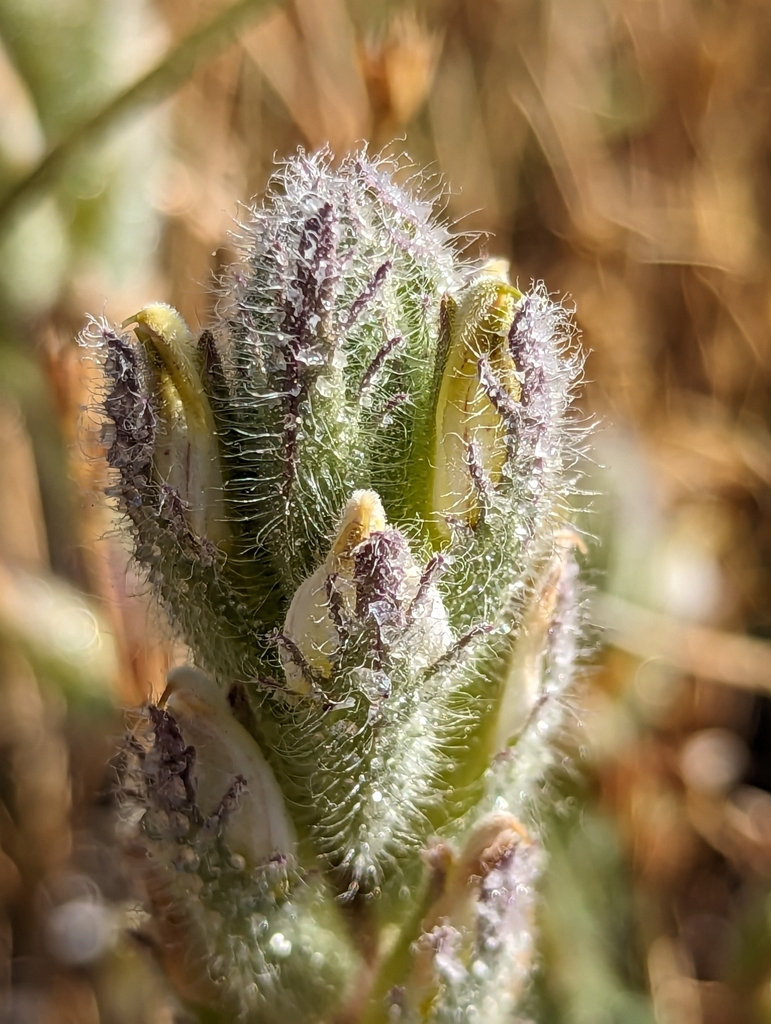
Photo: parent species Chloropyron molle · no rights reserved · CC0
Family: Orobanchaceae · Type: Herb · Native
Conservation status: CNPS 1B.1
Chloropyron molle subsp. hispidum (Hispid salty bird's-beak) is a native California herb in the Orobanchaceae family, recognized by texture and seed size diagnostic.
Hispid salty bird's-beak is a rare (CNPS 1B.1) California native annual found in the Great Valley in saline marshes and flats at elevations below 130 meters. Flowering from June to July, this plant produces delicate white to pale yellow flowers with a distinctive pouched corolla. Growing with multiple branches spreading from near the base, it develops bristly stems typically 15 to 25 centimeters tall. Its leaves and stems are notably bristly, with branches emerging in a widespread pattern across the plant's compact form. The small seeds measure 1 to 1.5 millimeters long, contributing to its distinctive adaptation to saline habitats.
Identification and appearance
Key characters: 1 sympatric species; texture and seed size diagnostic
Habitat and range
Habitat: Saline marshes and flats
Elevation: < 130 m
California counties: Solano, Merced, Kern, Placer
Bloom period
Chloropyron molle subsp. hispidum blooms Jun-Jul.
Conservation status
CNPS 1B.1
How to tell it apart
vs Castilleja: Leaves completely unlobed and smooth-edged, not lobed or divided.; vs Cordylanthus: Found exclusively in saline or alkaline habitats like salt marshes.; vs Cressa: Has typical Orobanchaceae hooded flowers, not small white tubular Convolvulaceae blooms.; vs Triphysaria: Calyx barely notched at tip (~1 mm), not deeply divided.; vs Orthocarpus: Leaves entirely unlobed, not lobed or divided in any way.
Frequently asked questions
Is Chloropyron molle subsp. hispidum native to California?
Yes. Chloropyron molle subsp. hispidum is native to California (recorded as native).
When does Chloropyron molle subsp. hispidum bloom?
Chloropyron molle subsp. hispidum blooms Jun-Jul.
Where in California does Chloropyron molle subsp. hispidum grow?
Chloropyron molle subsp. hispidum occurs in Solano, Merced, Kern, Placer, at elevations of < 130 m.
What plant family does Chloropyron molle subsp. hispidum belong to?
Chloropyron molle subsp. hispidum is in the Orobanchaceae family, genus Chloropyron.
Is Chloropyron molle subsp. hispidum rare or endangered?
Chloropyron molle subsp. hispidum carries California Rare Plant Rank 1B.1, state rank S1.
Related species
Other California species in the same genus, family, or bioregion.
Sources: Jepson eFlora · CNPS Rare Plant Inventory · Index of California Plant Names · CalPhotos · CDFW CNDDB
Last updated 2026-10-07
Data from The California Species Project — 14,000+ California species with verified data from CNPS, CDFW, USFWS, Cal-IPC, and more.