Chondrilla juncea
Skeleton weed, Skeleton Weed
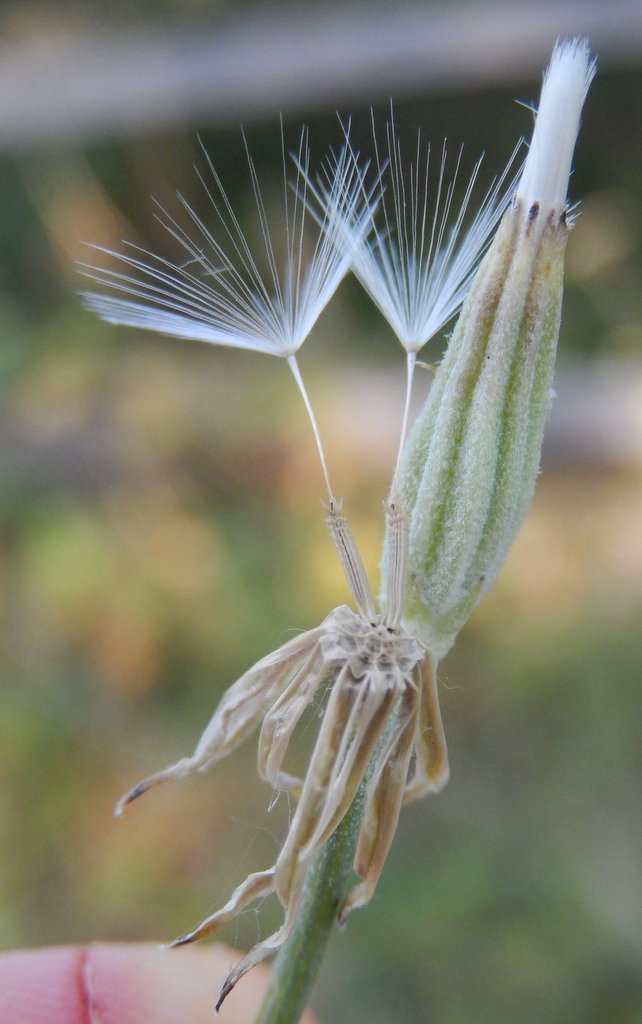
(c) Luca Fornasari, some rights reserved (CC BY), uploaded by Luca Fornasari · licence
Family: Asteraceae · Type: Herb · Not Native
Conservation status: Cal-IPC Yes
Chondrilla juncea (Skeleton weed) is a non-native California herb in the Asteraceae family, recognized by Mediterranean introduction with extreme leaf reduction and specialized desert adaptation strategies.
Skeleton weed is a naturalized perennial found in the Klamath Ranges, Cascade Range, Sierra Nevada, Great Valley, central western California, northern southern California, southern Transverse Ranges, and Warner Mountains in pastures and disturbed areas at elevations below 600 meters. Flowering from June to January, this plant produces yellow flowers in small, interrupted spike-like clusters with heads 9 to 12 millimeters long. Growing with coarse stems 40 to 150 centimeters tall, it has bristly stems with downward-pointing hairs in the lower 10 to 15 centimeters. Its basal and lower leaves are wing-petioled, oblong to obovate with irregularly toothed, reflexed lobes, while upper leaves become linear and thread-like. The fruit is cylindrical, 8 to 10 millimeters long, with 5 or more ribs and a 5 to 6 millimeter beak.
Identification and appearance
Key characters: Mediterranean introduction with extreme leaf reduction and specialized desert adaptation strategies
Habitat and range
Habitat: Pastures, disturbed areas
Elevation: < 600 m
Outside California: to British Columbia, Montana, also eastern Canada, eastern United States, native western Eurasia, Mediterranean, northwestern Africa, naturalized southern South America, Australia, New Zealand
Bloom period
Chondrilla juncea blooms Jun-Jan.
Conservation status
Cal-IPC Yes
How to tell it apart
vs Stephanomeria: Stephanomeria has only 3-9 flowers per head, Chondrilla has 6-60 flowers per head.; vs Lactuca: Lactuca has leafy stems, Chondrilla has virtually leafless wiry stems creating skeleton appearance.; vs Hypochaeris: Hypochaeris has basal rosettes with obvious leaves, Chondrilla has sparse leaves on wiry branches.; vs Eriogonum: Eriogonum has small clustered flowers with papery bracts (Polygonaceae), not composite yellow ray flowers.; vs Pleiacanthus: Pleiacanthus has thorny stems and pink-purple flowers, Chondrilla has smooth stems and yellow flowers.
Frequently asked questions
Is Chondrilla juncea native to California?
No. Chondrilla juncea is not native to California (recorded as not native).
When does Chondrilla juncea bloom?
Chondrilla juncea blooms Jun-Jan.
What plant family does Chondrilla juncea belong to?
Chondrilla juncea is in the Asteraceae family, genus Chondrilla.
Is Chondrilla juncea invasive in California?
Chondrilla juncea is listed by Cal-IPC with an invasiveness rating of Yes.
What habitat does Chondrilla juncea grow in?
Chondrilla juncea grows in Pastures, disturbed areas.
Related species
Other California species in the same genus, family, or bioregion.
Sources: Jepson eFlora · Index of California Plant Names · CalPhotos
Last updated 2026-10-07
Data from The California Species Project — 14,000+ California species with verified data from CNPS, CDFW, USFWS, Cal-IPC, and more.