Chorispora tenella
Crossflower
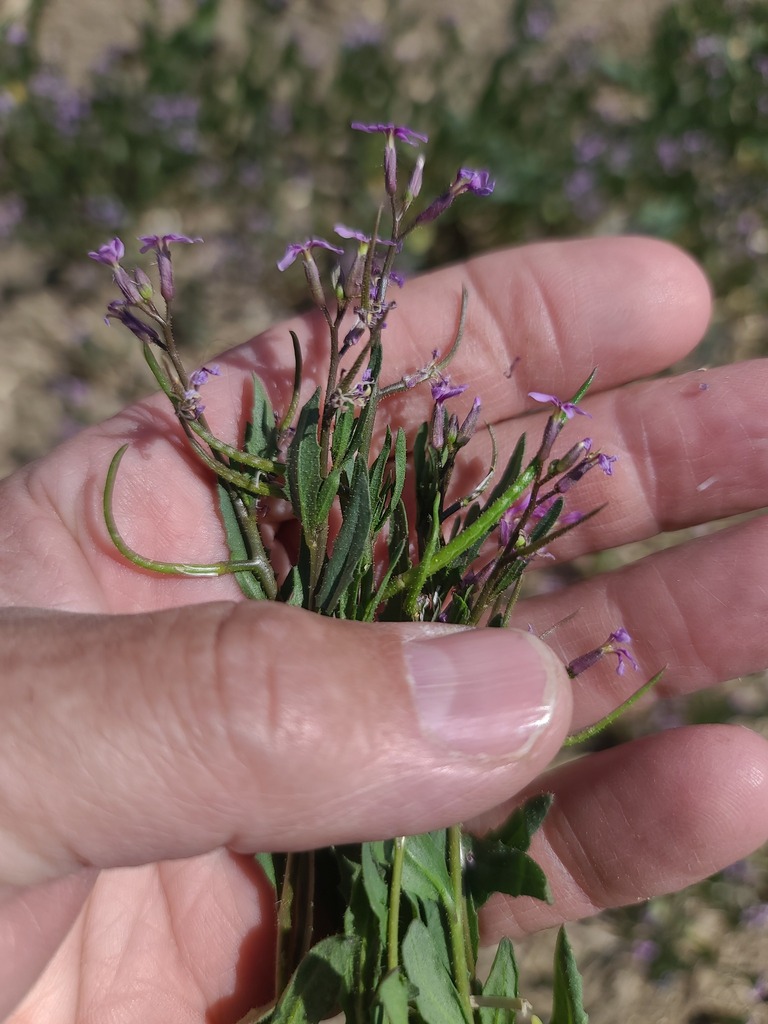
no rights reserved · CC0
Family: Brassicaceae · Type: Herb · Not Native
Chorispora tenella (Crossflower) is a non-native California herb in the Brassicaceae family, recognized by Eurasian genus with limited North American distribution; this is a naturalized introduction representing the genus's only foothold in….
Crossflower is a naturalized annual found in the California Ranges, Great Valley, Southern California Coast, and Great Basin in disturbed areas and pastures at elevations below 2,300 meters. Flowering from April to July, this plant produces purple to lavender (occasionally white) flowers with oblanceolate petals 8 to 10 millimeters long. Growing with erect to ascending stems 20 to 40 centimeters tall, the plant can be simple or branched and is often glandular or occasionally hairy. Its leaves are oblong to oblanceolate, coarsely dentate, with basal and lower cauline leaves 2.5 to 8 centimeters long. The fruit is spreading to ascending, 1.8 to 2.5 centimeters long with 10 to 24 small oblong seeds.
Identification and appearance
Key characters: Eurasian genus with limited North American distribution; this is a naturalized introduction representing the genus's only foothold in California
Habitat and range
Habitat: Disturbed areas, pastures
Elevation: < 2300 m
California counties: San Bernardino, Kern, Los Angeles, Inyo, Mono, San Luis Obispo, Ventura, Riverside, Modoc, Siskiyou, Fresno, Yolo, Lassen, Plumas, Sierra, Shasta, Madera, Tulare, Monterey, Sacramento, San Joaquin
Outside California: widespread in Canada, United States, native to Eurasia
Bloom period
Chorispora tenella blooms Apr-Jul.
How to tell it apart
vs Raphanus: Chorispora is a small glandular annual with lavender-purple petals and slender jointed fruits that break crosswise; Raphanus (wild radish) is coarse with larger flowers and thick, constricted pods.; vs Hesperis: Chorispora is a low glandular annual whose fruit segments transversely; Hesperis (dame's rocket) is a tall biennial or perennial with long, non-jointed siliques.; vs Malcolmia: Chorispora fruit is beaked and breaks transversely into one-seeded segments; Malcolmia has a continuous, non-segmenting linear silique.; vs Matthiola: Chorispora is glandular with jointed, breaking fruit; Matthiola (stock) is gray-tomentose with flattened, non-jointed siliques.; vs Sisymbrium: Chorispora has purple petals and jointed fruit; Sisymbrium (hedge mustard) has yellow petals and continuous, non-jointed siliques.
Frequently asked questions
Is Chorispora tenella native to California?
No. Chorispora tenella is not native to California (recorded as not native).
When does Chorispora tenella bloom?
Chorispora tenella blooms Apr-Jul.
Where in California does Chorispora tenella grow?
Chorispora tenella occurs in San Bernardino, Kern, Los Angeles, Inyo, Mono, San Luis Obispo, Ventura, Riverside and other counties, at elevations of < 2300 m.
What plant family does Chorispora tenella belong to?
Chorispora tenella is in the Brassicaceae family, genus Chorispora.
What habitat does Chorispora tenella grow in?
Chorispora tenella grows in Disturbed areas, pastures.
Related species
Other California species in the same genus, family, or bioregion.
Sources: Jepson eFlora · Index of California Plant Names · CalPhotos
Last updated 2026-10-07
Data from The California Species Project — 14,000+ California species with verified data from CNPS, CDFW, USFWS, Cal-IPC, and more.