Chorizanthe brevicornu var. spathulata
Great basin brittle spineflower, Great Basin Brittle Spineflower
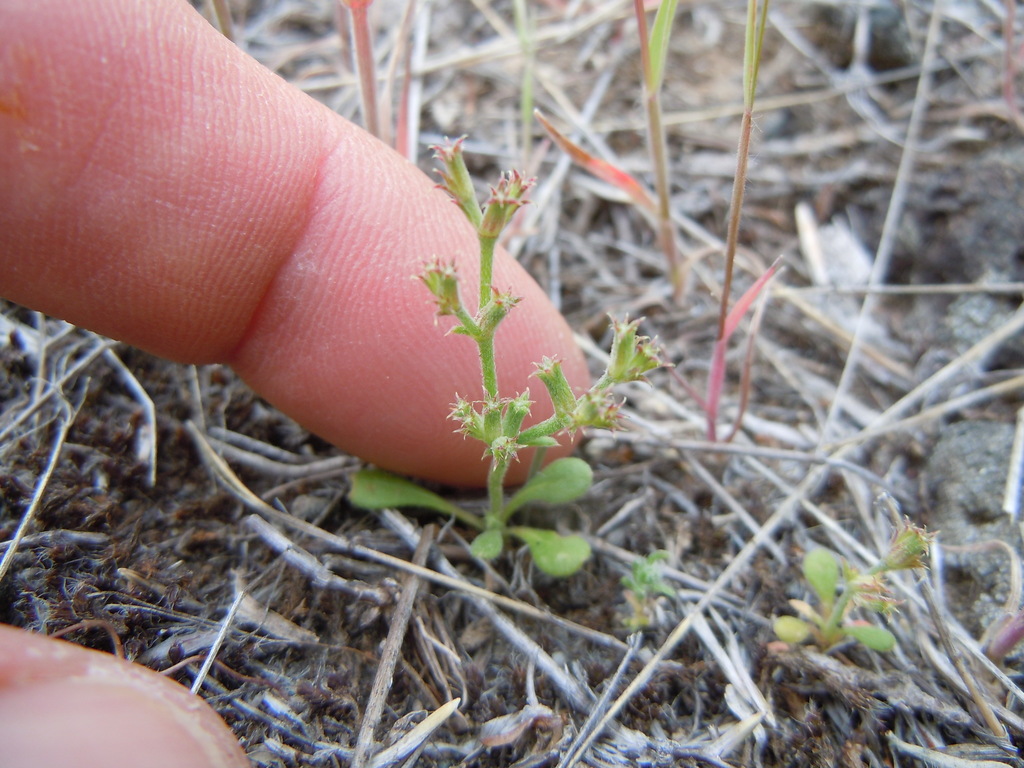
(c) Matt Lavin, some rights reserved (CC BY-SA) · licence
Family: Polygonaceae · Type: Herb · Native
Chorizanthe brevicornu var. spathulata (Great basin brittle spineflower) is a native California herb in the Polygonaceae family, recognized by spoon-shaped leaves and obscurely ribbed involucres distinguish from var. brevicornu.
Great basin brittle spineflower is a native perennial found in the southeastern Great Basin desert region in sandy and gravelly habitats at elevations of 700 to 2,900 meters. Flowering from April to July, this plant produces small white to pale pink flowers in delicate involucres with obscurely ribbed structures. Growing with compact stems 5 to 20 centimeters tall, it forms low, spreading clusters characteristic of desert spineflowers. Its leaves are distinctively oblanceolate to spoon-shaped, 1 to 2 centimeters long and 0.5 to 1 centimeter wide, with rounded tips that give the plant a soft, understated appearance. The fruit develops within its characteristically textured involucre, adapted to harsh desert conditions.
Identification and appearance
Key characters: 6 sympatric species; spoon-shaped leaves and obscurely ribbed involucres distinguish from var. brevicornu
Habitat and range
Habitat: Sand, gravel
Elevation: 700-2900 m
California counties: Inyo, Mono, Lake
Outside California: to northern and central Nevada, also southeastern Oregon, southern Idaho
Bloom period
Chorizanthe brevicornu var. spathulata blooms Apr-Jul.
How to tell it apart
vs Eriogonum: Chorizanthe has 1 flower per involucre; Eriogonum has multiple flowers per involucre.; vs Eremothera: Chorizanthe has 6-parted flowers in spiny cups; Eremothera has 4-petaled evening-primrose flowers.; vs Calyptridium: Chorizanthe has flowers in awned involucres; Calyptridium has naked flowers with papery sepals.; vs Lastarriaea: Chorizanthe has thin papery flowers; Lastarriaea has distinctly thick, leathery-textured flowers.; vs Navarretia: Chorizanthe is in Polygonaceae with 6-parted flowers; Navarretia is in Polemoniaceae with 5-lobed tubular flowers.
Frequently asked questions
Is Chorizanthe brevicornu var. spathulata native to California?
Yes. Chorizanthe brevicornu var. spathulata is native to California (recorded as native).
When does Chorizanthe brevicornu var. spathulata bloom?
Chorizanthe brevicornu var. spathulata blooms Apr-Jul.
Where in California does Chorizanthe brevicornu var. spathulata grow?
Chorizanthe brevicornu var. spathulata occurs in Inyo, Mono, Lake, at elevations of 700-2900 m.
What plant family does Chorizanthe brevicornu var. spathulata belong to?
Chorizanthe brevicornu var. spathulata is in the Polygonaceae family, genus Chorizanthe.
What habitat does Chorizanthe brevicornu var. spathulata grow in?
Chorizanthe brevicornu var. spathulata grows in Sand, gravel.
Related species
Other California species in the same genus, family, or bioregion.
- Chorizanthe breweri — Brewer's spineflower
- Chorizanthe clevelandii — Cleveland's spineflower
- Chorizanthe corrugata — Wrinkled spineflower
- Chorizanthe cuspidata — San francisco spineflower
- Chorizanthe cuspidata var. cuspidata — San francisco bay spineflower
- Chorizanthe cuspidata var. villosa — Woolly-headed spineflower
Sources: Jepson eFlora · Index of California Plant Names · CalPhotos
Last updated 2026-10-07
Data from The California Species Project — 14,000+ California species with verified data from CNPS, CDFW, USFWS, Cal-IPC, and more.