Chorizanthe membranacea
Pink spineflower
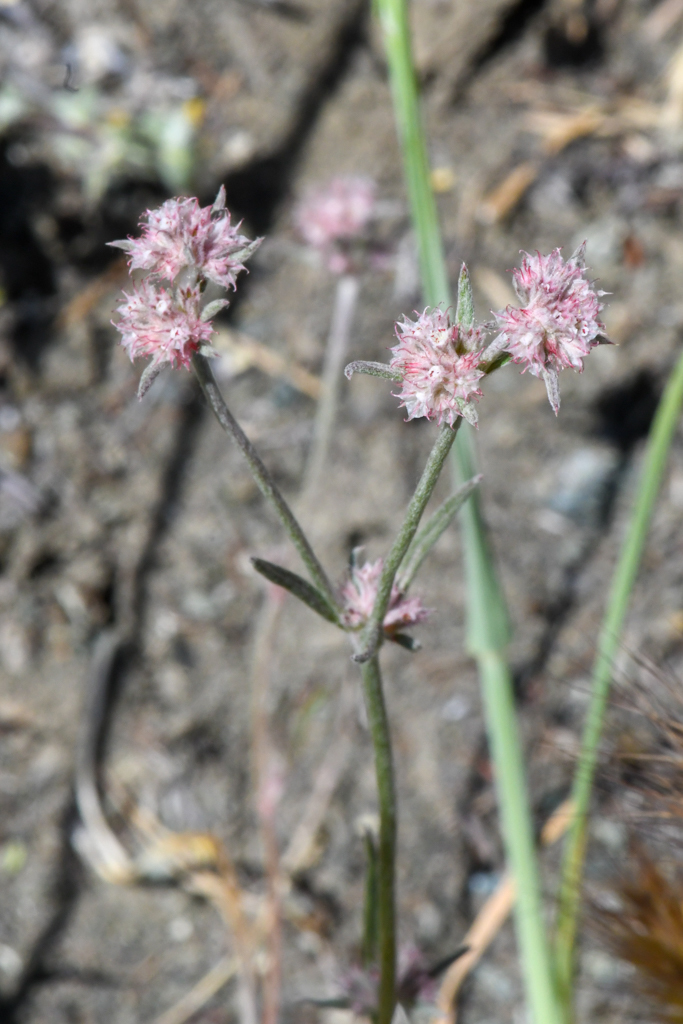
(c) Trevor Van Loon, some rights reserved (CC BY) · licence
Family: Polygonaceae · Type: Herb · Native
Chorizanthe membranacea (Pink spineflower) is a native California herb in the Polygonaceae family, recognized by tall erect habit and disk-like scarious membranes connecting lobes.
Pink spineflower is a California native perennial found in northwestern California, Cascade Range, Sierra Nevada foothills, Tehama County, Central Valley, central western California, and northern Western Transverse Ranges in sandy, gravelly, or rocky habitats at elevations of 40 to 1,400 meters. Flowering from April to July, this plant produces white to rose-colored flowers in dense, rounded clusters with distinctive disk-like membranes connecting flower lobes. Growing with erect stems 10 to 60 centimeters tall and densely hairy branches that ascend from the main stem, it has a distinctive branching structure. Its narrow linear to oblanceolate leaves are 1.5 to 5 centimeters long, with a woolly texture on the underside. The plant's unique involucre features six equal lobes with scarious margins, creating an intricate white to pink membrane between flower clusters.
Identification and appearance
Key characters: 33 sympatric species; tall erect habit and disk-like scarious membranes connecting lobes
Habitat and range
Habitat: Common. Sand, gravel or rocks
Elevation: 40-1400 m
California counties: San Luis Obispo, Fresno, Tehama, Kern, Tuolumne, Butte, Tulare, San Benito, Madera, Santa Barbara, Lake, Trinity, Stanislaus, Monterey, Santa Clara, Yolo, Mariposa, Siskiyou, Contra Costa, Marin, San Mateo, Napa, Sutter, Merced, Santa Cruz, Ventura, Solano, El Dorado, Colusa, Placer, Alameda, Amador, Calaveras, Mendocino, Sacramento, Shasta, Nevada, Sonoma, Glenn, San Diego
Outside California: south-central Oregon
Bloom period
Chorizanthe membranacea blooms Apr-Jul.
How to tell it apart
vs Eriogonum: Chorizanthe has 1 flower per involucre; Eriogonum has multiple flowers per involucre.; vs Eremothera: Chorizanthe has 6-parted flowers in spiny cups; Eremothera has 4-petaled evening-primrose flowers.; vs Calyptridium: Chorizanthe has flowers in awned involucres; Calyptridium has naked flowers with papery sepals.; vs Lastarriaea: Chorizanthe has thin papery flowers; Lastarriaea has distinctly thick, leathery-textured flowers.; vs Navarretia: Chorizanthe is in Polygonaceae with 6-parted flowers; Navarretia is in Polemoniaceae with 5-lobed tubular flowers.
Frequently asked questions
Is Chorizanthe membranacea native to California?
Yes. Chorizanthe membranacea is native to California (recorded as native).
When does Chorizanthe membranacea bloom?
Chorizanthe membranacea blooms Apr-Jul.
Where in California does Chorizanthe membranacea grow?
Chorizanthe membranacea occurs in San Luis Obispo, Fresno, Tehama, Kern, Tuolumne, Butte, Tulare, San Benito and other counties, at elevations of 40-1400 m.
What plant family does Chorizanthe membranacea belong to?
Chorizanthe membranacea is in the Polygonaceae family, genus Chorizanthe.
What habitat does Chorizanthe membranacea grow in?
Chorizanthe membranacea grows in Common. Sand, gravel or rocks.
Related species
Other California species in the same genus, family, or bioregion.
Sources: Jepson eFlora · Index of California Plant Names · CalPhotos
Last updated 2026-10-07
Data from The California Species Project — 14,000+ California species with verified data from CNPS, CDFW, USFWS, Cal-IPC, and more.