Chorizanthe palmeri
Palmer's spineflower
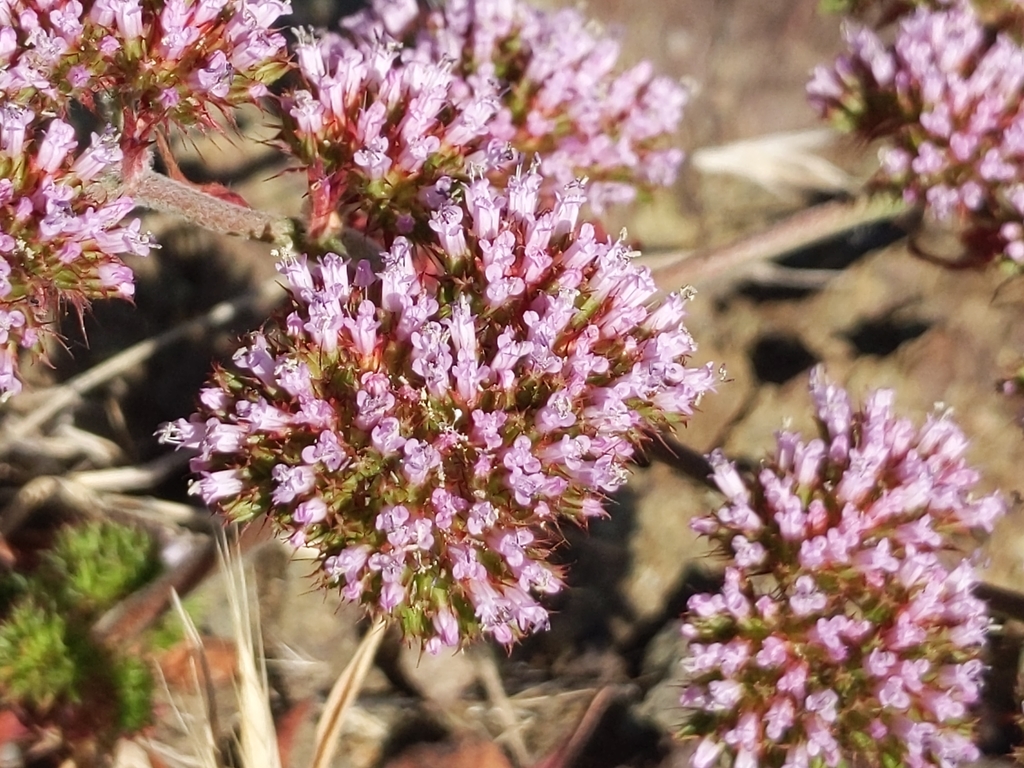
no rights reserved, uploaded by Alex Heyman · CC0
Family: Polygonaceae · Type: Herb · Native
Conservation status: CNPS 4.2
Chorizanthe palmeri (Palmer's spineflower) is a native California herb in the Polygonaceae family, recognized by serpentine habitat and two-toned flowers.
Palmer's spineflower is a rare (CNPS 4.2) California native perennial found in western Monterey and San Luis Obispo counties in serpentine habitats at elevations of 60 to 700 meters. Flowering from May to August, this plant produces white to yellow flowers with light to dark purple perianth lobes in dense, rounded clusters. Growing with erect stems 10 to 30 centimeters tall that branch from the main stem in an ascending pattern, it has a distinctively hairy appearance. Its leaves are primarily basal, with oblanceolate blades 1 to 3 centimeters long and 0.4 to 0.8 centimeters wide. The plant features a unique involucre with six-ribbed, three-angled tubes and distinctive flower clusters with alternating longer and shorter lobes.
Identification and appearance
Key characters: 14 sympatric species; diagnostic serpentine habitat and two-toned flowers
Habitat and range
Habitat: Serpentine
Elevation: 60-700 m
California counties: Monterey, San Luis Obispo, Santa Barbara, Kern
Bloom period
Chorizanthe palmeri blooms May-Aug.
Conservation status
CNPS 4.2
How to tell it apart
vs Eriogonum: Chorizanthe has 1 flower per involucre; Eriogonum has multiple flowers per involucre.; vs Eremothera: Chorizanthe has 6-parted flowers in spiny cups; Eremothera has 4-petaled evening-primrose flowers.; vs Calyptridium: Chorizanthe has flowers in awned involucres; Calyptridium has naked flowers with papery sepals.; vs Lastarriaea: Chorizanthe has thin papery flowers; Lastarriaea has distinctly thick, leathery-textured flowers.; vs Navarretia: Chorizanthe is in Polygonaceae with 6-parted flowers; Navarretia is in Polemoniaceae with 5-lobed tubular flowers.
Frequently asked questions
Is Chorizanthe palmeri native to California?
Yes. Chorizanthe palmeri is native to California (recorded as native).
When does Chorizanthe palmeri bloom?
Chorizanthe palmeri blooms May-Aug.
Where in California does Chorizanthe palmeri grow?
Chorizanthe palmeri occurs in Monterey, San Luis Obispo, Santa Barbara, Kern, at elevations of 60-700 m.
What plant family does Chorizanthe palmeri belong to?
Chorizanthe palmeri is in the Polygonaceae family, genus Chorizanthe.
Is Chorizanthe palmeri rare or endangered?
Chorizanthe palmeri carries California Rare Plant Rank 4.2, state rank S4.
Related species
Other California species in the same genus, family, or bioregion.
- Chorizanthe parryi — Parry's spineflower
- Chorizanthe parryi var. fernandina — San fernando valley spineflower
- Chorizanthe parryi var. parryi — Parry's spineflower
- Chorizanthe polygonoides — Knotweed spineflower
- Chorizanthe polygonoides var. longispina — Long-spined spineflower
- Chorizanthe polygonoides var. polygonoides — Knotweed spineflower
Sources: Jepson eFlora · CNPS Rare Plant Inventory · Index of California Plant Names · CalPhotos · CDFW CNDDB
Last updated 2026-10-07
Data from The California Species Project — 14,000+ California species with verified data from CNPS, CDFW, USFWS, Cal-IPC, and more.