Chrysanthemoides monilifera subsp. monilifera
Bitou bush, Bitou Bush
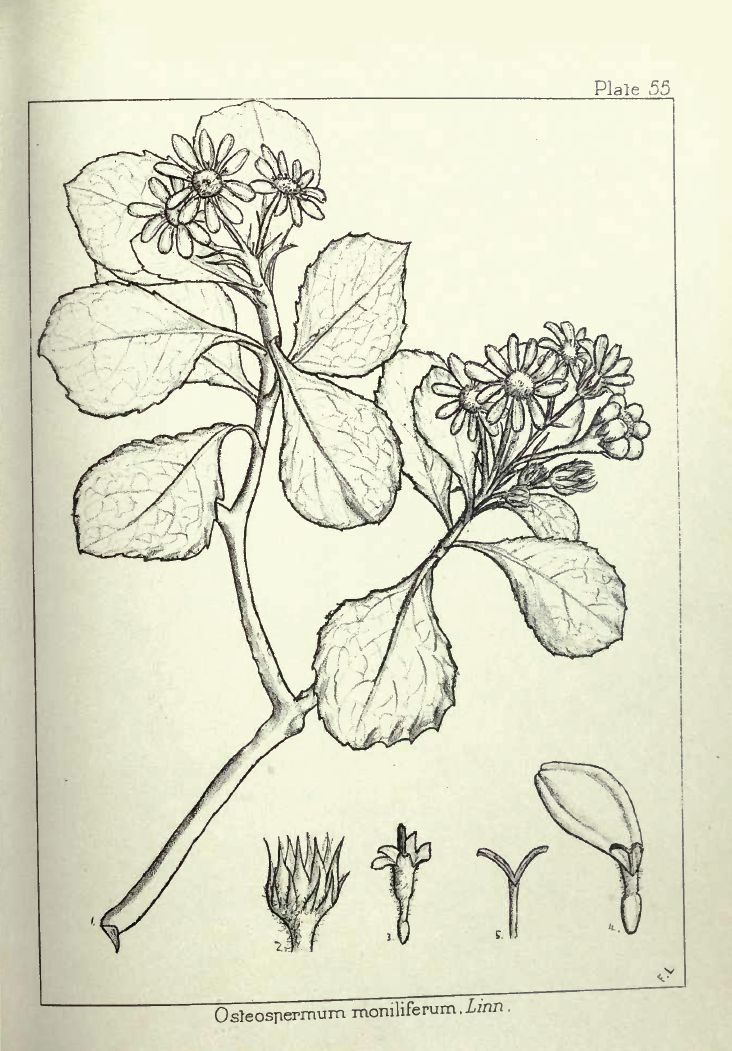
John Medley Wood (1827-1915), Frieda Lauth (1879-1949) (via Wikimedia Commons) · CC0
Family: Asteraceae · Type: Shrub · Not Native
Conservation status: Cal-IPC Yes
Chrysanthemoides monilifera subsp. monilifera (Bitou bush) is a non-native California shrub in the Asteraceae family, recognized by South African genus; this represents a limited naturalized population in coastal Southern California.
Bitou bush is a naturalized shrub found in San Diego County in coastal sage scrub at elevations up to 200 meters. Flowering from March to May, this plant produces yellow ray flowers 4 to 14 millimeters long with white disk centers in small clusters. Growing 1 to 3 meters tall with ascending to erect branches that are widely spread throughout the plant, it develops elliptic to oblanceolate leaves 3 to 6 centimeters long. Its leaves are toothed, initially covered in soft white hairs when young but quickly becoming smooth and dark green. The fruit is a black, slightly ribbed berry about 6 to 10 millimeters in diameter with a sweet flesh.
Identification and appearance
Key characters: South African genus; this represents a limited naturalized population in coastal Southern California
Habitat and range
Habitat: Coastal sage scrub
Elevation: <= 200 m
Outside California: native to southern Africa
Bloom period
Chrysanthemoides monilifera subsp. monilifera blooms Mar-May.
Conservation status
Cal-IPC Yes
How to tell it apart
vs Baccharis: Chrysanthemoides has showy yellow ray florets and a fleshy black berry-like fruit; Baccharis lacks ray florets (disk-only, dioecious) and has dry wind-borne achenes with pappus.; vs Encelia: Chrysanthemoides produces a fleshy black drupe-like fruit; Encelia (brittlebush) has dry flattened achenes without pappus.; vs Ericameria: Chrysanthemoides has broad toothed leaves and fleshy fruit; Ericameria (goldenbush) has narrow resinous leaves and dry achenes with bristly pappus.; vs Senecio: Chrysanthemoides fruit is a fleshy black body; shrubby Senecio and Jacobaea have dry achenes topped by a white pappus.; vs Grindelia: Chrysanthemoides has tomentose (soon glabrous) toothed leaves and berry-like fruit; Grindelia (gumweed) has resin-gummy involucres with strongly recurved phyllaries and dry achenes.
Frequently asked questions
Is Chrysanthemoides monilifera subsp. monilifera native to California?
No. Chrysanthemoides monilifera subsp. monilifera is not native to California (recorded as not native).
When does Chrysanthemoides monilifera subsp. monilifera bloom?
Chrysanthemoides monilifera subsp. monilifera blooms Mar-May.
What plant family does Chrysanthemoides monilifera subsp. monilifera belong to?
Chrysanthemoides monilifera subsp. monilifera is in the Asteraceae family, genus Chrysanthemoides.
Is Chrysanthemoides monilifera subsp. monilifera invasive in California?
Chrysanthemoides monilifera subsp. monilifera is listed by Cal-IPC with an invasiveness rating of Yes.
What habitat does Chrysanthemoides monilifera subsp. monilifera grow in?
Chrysanthemoides monilifera subsp. monilifera grows in Coastal sage scrub.
Related species
Other California species in the same genus, family, or bioregion.
Sources: Jepson eFlora · CalPhotos
Last updated 2026-09-30
Data from The California Species Project — 14,000+ California species with verified data from CNPS, CDFW, USFWS, Cal-IPC, and more.