Chrysolepis sempervirens
Bush chinquapin
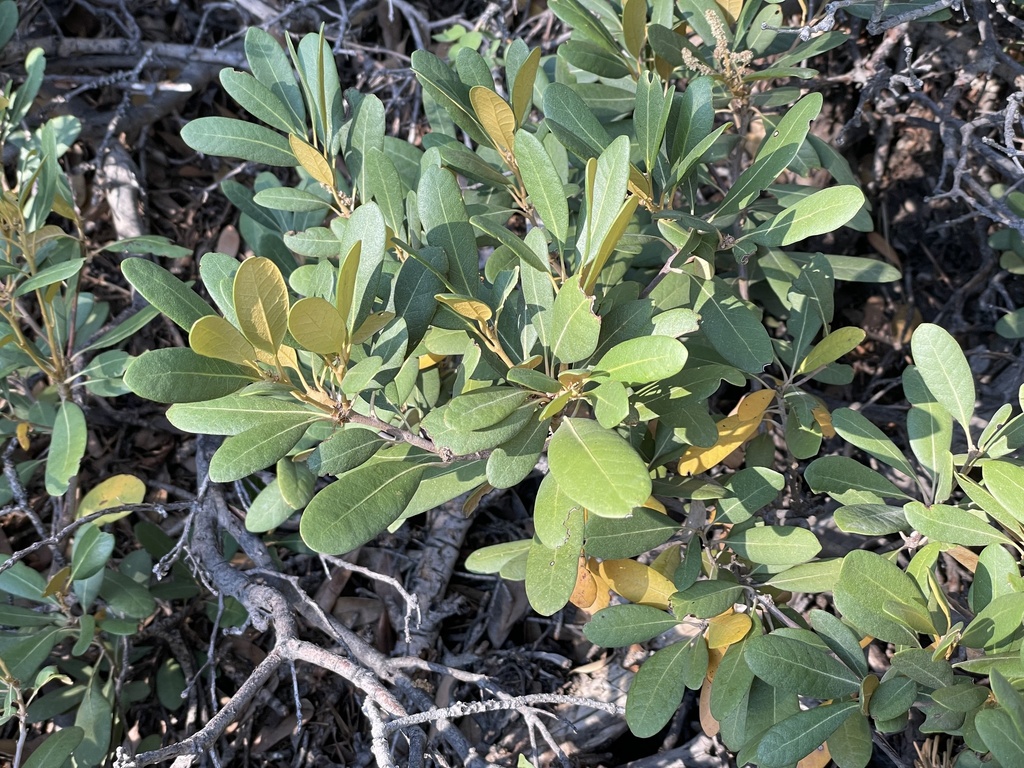
(c) Miguel Vieira, some rights reserved (CC BY) · licence
Family: Fagaceae · Type: Shrub · Native
Chrysolepis sempervirens (Bush chinquapin) is a native California shrub in the Fagaceae family, recognized by higher elevation, smaller rounded leaves, and shrub habit.
Bush chinquapin is a California native shrub found in the Klamath Ranges, northern Coast Ranges, northern California Ranges, Sierra Nevada, southern California mountains, San Bernardino Mountains, Peninsular Ranges, and western Modoc Plateau in rocky slopes, conifer forest, and chaparral at elevations of 700 to 3,300 meters. Flowering from July to August, this plant produces golden-rusty colored flowers in small burrs approximately 2 to 3.5 centimeters in diameter. Growing as a shrub up to 3 meters tall with a rounded top and relatively smooth, thin bark, it develops a distinctive rounded crown. Its leaves are elliptic, 2 to 8 centimeters long, with dull green upper surfaces and golden to rusty undersides, featuring a tapered to rounded base and obtuse to rounded tips. The fruits form spiny burrs containing nuts 8 to 13 millimeters long, offering a distinctive seed dispersal mechanism.
Identification and appearance
Key characters: 2 sympatric species; distinguished by higher elevation, smaller rounded leaves, and shrub habit
Habitat and range
Habitat: Rocky slopes, conifer forest, chaparral
Elevation: 700-3300 m
California counties: Los Angeles, San Bernardino, Plumas, El Dorado, Riverside, Siskiyou, Fresno, Inyo, Kern, Tulare, Trinity, Mono, Tuolumne, Placer, Butte, Nevada, Shasta, Alpine, Modoc, Mariposa, Madera, Amador, Yuba, Humboldt, Tehama, Sierra, Calaveras, Lassen, Del Norte, Contra Costa, San Mateo, Marin, Lake
Outside California: southern Oregon
Bloom period
Chrysolepis sempervirens blooms Jul-Aug.
How to tell it apart
vs Quercus: Chrysolepis nuts are completely enclosed in spiny burs; oak acorns sit in open cups.; vs Notholithocarpus: Chrysolepis has spiny burs enclosing nuts; tanoak has cup-scaled acorns like oaks.; vs Frangula: Chrysolepis has spiny burrs with nuts; Frangula has smooth berry-like fruits.; vs Castanopsis: Both have spiny burs, but Castanopsis doesn't occur wild in California.; vs Heteromeles: Chrysolepis has spiny burs; toyon has clusters of red berries.
Frequently asked questions
Is Chrysolepis sempervirens native to California?
Yes. Chrysolepis sempervirens is native to California (recorded as native).
When does Chrysolepis sempervirens bloom?
Chrysolepis sempervirens blooms Jul-Aug.
Where in California does Chrysolepis sempervirens grow?
Chrysolepis sempervirens occurs in Los Angeles, San Bernardino, Plumas, El Dorado, Riverside, Siskiyou, Fresno, Inyo and other counties, at elevations of 700-3300 m.
What plant family does Chrysolepis sempervirens belong to?
Chrysolepis sempervirens is in the Fagaceae family, genus Chrysolepis.
What habitat does Chrysolepis sempervirens grow in?
Chrysolepis sempervirens grows in Rocky slopes, conifer forest, chaparral.
Related species
Other California species in the same genus, family, or bioregion.
- Chrysolepis sp. — Chinquapin
- Chrysolepis chrysophylla — Giant chinquapin
- Chrysolepis chrysophylla var. chrysophylla — Giant chinquapin
- Chrysolepis chrysophylla var. minor — Bush chinquapin
- Fagaceae sp. — Oak family
- Notholithocarpus densiflorus — Tanoak
- Notholithocarpus densiflorus var. densiflorus — Tanoak
Sources: Jepson eFlora · Index of California Plant Names · CalPhotos
Last updated 2026-10-07
Data from The California Species Project — 14,000+ California species with verified data from CNPS, CDFW, USFWS, Cal-IPC, and more.