Chrysothamnus viscidiflorus subsp. viscidiflorus
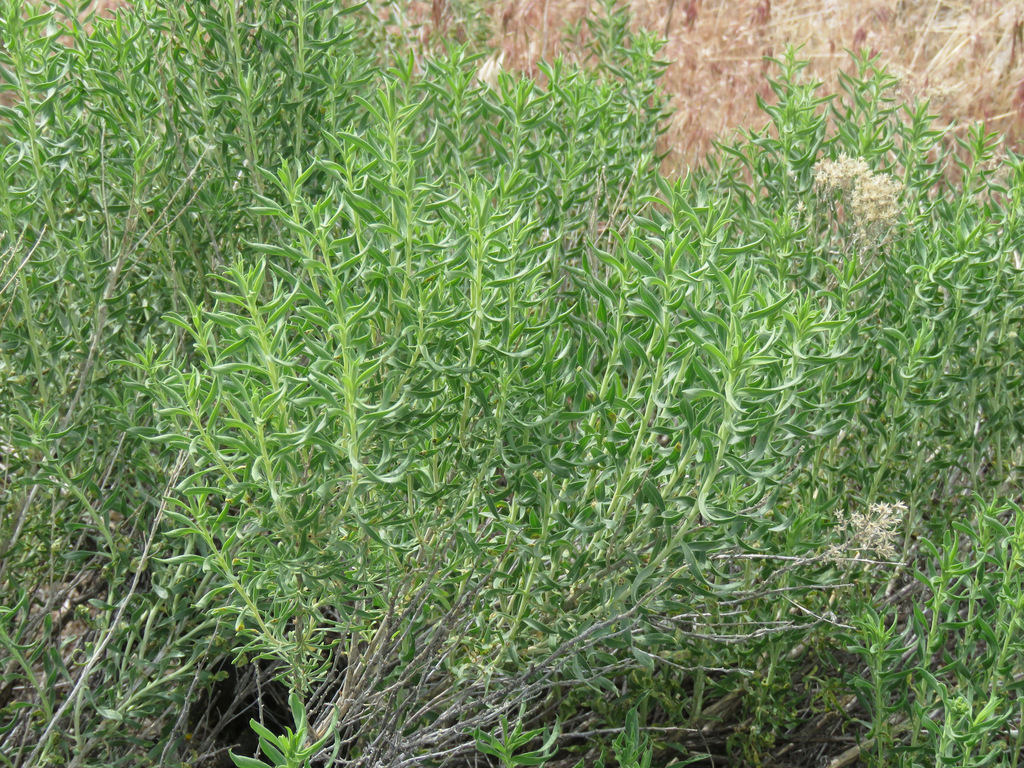
Photo: parent species Chrysothamnus viscidiflorus · no rights reserved · CC0
Family: Asteraceae · Type: Shrub · Native
Chrysothamnus viscidiflorus subsp. viscidiflorus is a native California shrub in the Asteraceae family, recognized by glabrous stems and twisted ciliate-margined leaves.
Sticky rabbitbrush is a California native shrub found in the Klamath Ranges, Cascade Range, Sierra Nevada, northern Transverse Ranges, San Bernardino Mountains, Great Basin, and southern Desert Mountains in sagebrush, pinyon-juniper woodlands, and alpine talus at elevations of 900 to 4,000 meters. Flowering from July to September, this plant produces yellow flowers in narrow cylindric heads with 4 to 14 individual flowers, each 4 to 7.5 millimeters long. Growing with upright branches 30 to 100 centimeters tall, it forms an open, somewhat twisted shrub with smooth, glabrous stems. Its leaves are linear to lance-shaped, 0.5 to 7.5 centimeters long and 1 to 10 millimeters wide, generally twisted and with slightly fringed margins. The plant is notably adaptable, occurring across a wide range of high-elevation habitats from sagebrush scrublands to alpine environments.
Identification and appearance
Key characters: 6 sympatric species; diagnostic glabrous stems and twisted ciliate-margined leaves
Habitat and range
Habitat: Common. Sagebrush, pinyon/juniper, alpine talus
Elevation: 900-4000 m
Outside California: to Washington, Montana, South Dakota, New Brunswick, Colorado, New Mexico
Bloom period
Chrysothamnus viscidiflorus subsp. viscidiflorus blooms Jul-Sep.
How to tell it apart
vs Ericameria: Chrysothamnus has smooth/slightly fuzzy stems; Ericameria has densely woolly young stems.; vs Isocoma: Chrysothamnus has bracts in 5 vertical rows; Isocoma has randomly arranged bracts.; vs Gutierrezia: Chrysothamnus has only disk flowers per head; Gutierrezia has both ray and disk flowers.; vs Tetradymia: Chrysothamnus has 5 rows of many bracts; Tetradymia has only 4-6 bracts in 1-2 rows.; vs Cuniculotinus: Chrysothamnus has flower heads 5-10mm; Cuniculotinus has notably larger heads 10-17.5mm.
Frequently asked questions
Is Chrysothamnus viscidiflorus subsp. viscidiflorus native to California?
Yes. Chrysothamnus viscidiflorus subsp. viscidiflorus is native to California (recorded as native).
When does Chrysothamnus viscidiflorus subsp. viscidiflorus bloom?
Chrysothamnus viscidiflorus subsp. viscidiflorus blooms Jul-Sep.
What plant family does Chrysothamnus viscidiflorus subsp. viscidiflorus belong to?
Chrysothamnus viscidiflorus subsp. viscidiflorus is in the Asteraceae family, genus Chrysothamnus.
What habitat does Chrysothamnus viscidiflorus subsp. viscidiflorus grow in?
Chrysothamnus viscidiflorus subsp. viscidiflorus grows in Common. Sagebrush, pinyon/juniper, alpine talus.
Related species
Other California species in the same genus, family, or bioregion.
- Chrysothamnus depressus — Long flowered rabbitbrush
- Chrysothamnus greenei — Greene's rabbitbrush
- Chrysothamnus humilis — Truckee rabbitbrush
- Chrysothamnus sp. — Rabbitbrush
- Chrysothamnus viscidiflorus — Yellow rabbitbrush
- Chrysothamnus viscidiflorus subsp. axillaris
- Cichorium intybus — Chicory
- Cichorium sp. — Chicory
- Cirsium andersonii — Anderson's thistle
- Cirsium andrewsii — Franciscan thistle
Sources: Jepson eFlora · Index of California Plant Names · CalPhotos
Last updated 2026-10-07
Data from The California Species Project — 14,000+ California species with verified data from CNPS, CDFW, USFWS, Cal-IPC, and more.