Chylismia walkeri subsp. tortilis
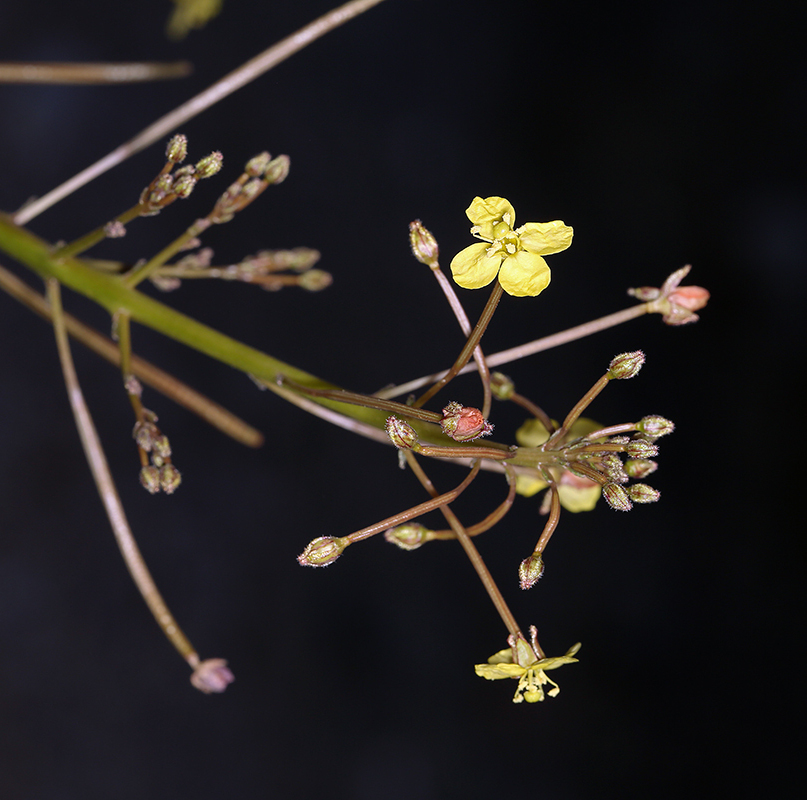
(c) Steve Matson, some rights reserved (CC BY), uploaded by Steve Matson · licence
Family: Onagraceae · Type: Herb · Native
Chylismia walkeri subsp. tortilis is a native California herb in the Onagraceae family, recognized by perennial habit, purple-dotted leaves, twisted fruit valves.
Walker's sun cup is a California native perennial found in western Inyo and northeastern San Bernardino counties, growing in rocky places near cliffs and ephemeral streams from creosote-bush scrub to pinyon and juniper woodland at elevations of 600 to 1,800 meters. Flowering from April to June, this plant produces bright yellow flowers 3 to 6 millimeters long that open at dawn, with distinctive purple-dotted sepals. Growing 10 to 60 centimeters tall with spreading hairs and an erect habit, it forms a short-lived perennial herb with generally basal leaves. Its leaves are simple to twice-pinnate, typically 30 to 220 millimeters long and marked with distinctive purple dots, with lateral leaflets less than 30 millimeters in length. The fruit is an ascending or spreading cylindric capsule 10 to 45 millimeters long, often with slightly twisted valves.
Identification and appearance
Key characters: 7 sympatric species; key features are perennial habit, purple-dotted leaves, twisted fruit valves
Habitat and range
Habitat: Rocky places near cliffs, along ephemeral streams, creosote-bush scrub to pinyon/juniper woodland
Elevation: 600-1800 m
California counties: Inyo, San Bernardino, Mono, Mariposa, Riverside
Outside California: to southwestern Utah
Bloom period
Chylismia walkeri subsp. tortilis blooms Apr-Jun.
How to tell it apart
vs Eremothera: Chylismia has yellow flowers; Eremothera has white, pink, or red flowers that open at night.; vs Camissonia: Chylismia leaves are mostly basal and dandelion-like; Camissonia has narrow leaves up the stem.; vs Camissoniopsis: Chylismia has dandelion-like basal leaves; Camissoniopsis has lance-shaped leaves along the stem.; vs Eulobus: Chylismia has basal dandelion-like leaves; Eulobus has elegant wand-like stems with red-flecked petals.; vs Oenothera: Chylismia has dandelion-like basal leaves; Oenothera is typically a robust tall plant with 4-lobed stigma.
Frequently asked questions
Is Chylismia walkeri subsp. tortilis native to California?
Yes. Chylismia walkeri subsp. tortilis is native to California (recorded as native).
When does Chylismia walkeri subsp. tortilis bloom?
Chylismia walkeri subsp. tortilis blooms Apr-Jun.
Where in California does Chylismia walkeri subsp. tortilis grow?
Chylismia walkeri subsp. tortilis occurs in Inyo, San Bernardino, Mono, Mariposa, Riverside, at elevations of 600-1800 m.
What plant family does Chylismia walkeri subsp. tortilis belong to?
Chylismia walkeri subsp. tortilis is in the Onagraceae family, genus Chylismia.
What habitat does Chylismia walkeri subsp. tortilis grow in?
Chylismia walkeri subsp. tortilis grows in Rocky places near cliffs, along ephemeral streams, creosote-bush scrub to pinyon/juniper woodland.
Related species
Other California species in the same genus, family, or bioregion.
- Chylismia arenaria — Sand evening-primrose
- Chylismia brevipes — Yellow cups
- Chylismia brevipes subsp. arizonica
- Chylismia brevipes subsp. brevipes
- Chylismia brevipes subsp. pallidula
- Chylismia cardiophylla — Heart leaved primrose
- Chylismiella pterosperma — Wing fruit sun cup
- Chylismiella sp.
- Circaea alpina subsp. pacifica
- Circaea sp. — Enchanter's nightshade
Sources: Jepson eFlora · Index of California Plant Names · CalPhotos
Last updated 2026-10-07
Data from The California Species Project — 14,000+ California species with verified data from CNPS, CDFW, USFWS, Cal-IPC, and more.