Cicuta douglasii
Western water hemlock
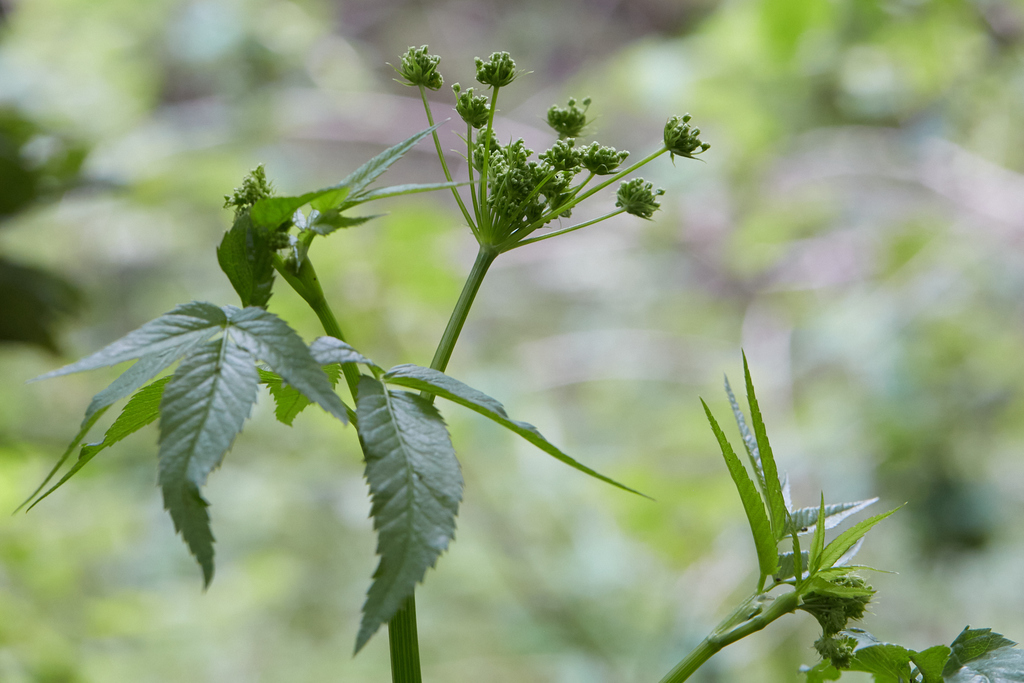
(c) Ken-ichi Ueda, some rights reserved (CC BY) · licence
Family: Apiaceae · Type: Herb · Native
Cicuta douglasii (Western water hemlock) is a native California herb in the Apiaceae family, recognized by Overlaps with 2 varieties of C. maculata. Key features: round fruit with wide ribs, large elongate veinlet areas.
Western water hemlock is a California native perennial found in the Klamath Ranges, northern Coast Ranges, Sierra Nevada, and Great Basin in wet places and aquatic habitats at elevations below 2,800 meters. Flowering from June to September, this plant produces small white flowers in compound umbels with 15 to 30 delicate rays. Growing 1.5 to 3 meters tall with erect, hollow stems, it develops a robust and branching structure. Its large leaves are intricately divided, with narrow to lance-shaped leaflets that range from 1 to 10 centimeters long and have finely toothed edges. The fruit is small, approximately 2 to 4 millimeters in diameter, with prominent ribs that distinguish this potentially toxic wetland species.
Identification and appearance
Key characters: Overlaps with 2 varieties of C. maculata. Key features: round fruit with wide ribs, large elongate veinlet areas
Habitat and range
Habitat: Wet places, generally aquatic
Elevation: < 2800 m
California counties: Monterey, Shasta, Mono, San Joaquin, Nevada, Marin, Inyo, Modoc, El Dorado, Plumas, San Bernardino, Sonoma, Santa Cruz, Siskiyou, Kern, Tulare, Alpine, Solano, Lassen, Sierra, Humboldt, Butte, Colusa, Alameda, Madera, Lake, Tuolumne, Napa, Mariposa, Del Norte, San Luis Obispo, Trinity, Mendocino, Ventura, Santa Barbara, Placer, Calaveras, Riverside
Outside California: to British Columbia, Montana
Bloom period
Cicuta douglasii blooms Jun-Sep.
How to tell it apart
vs Conium: Cicuta has green stems and sap that turns red-brown; Conium has purple-spotted stems.; vs Angelica: Cicuta sap turns reddish-brown in air; Angelica lacks this color-changing sap.; vs Oenanthe: Cicuta spreads from rhizomes with color-changing sap; Oenanthe has tuberous roots with crowned fruits.; vs Sambucus: Sambucus is a woody shrub with compound leaves; Cicuta is an herbaceous wetland plant.; vs Perideridia: Cicuta grows in wetlands from rhizomes; Perideridia grows in dry grasslands from tubers.
Frequently asked questions
Is Cicuta douglasii native to California?
Yes. Cicuta douglasii is native to California (recorded as native).
When does Cicuta douglasii bloom?
Cicuta douglasii blooms Jun-Sep.
Where in California does Cicuta douglasii grow?
Cicuta douglasii occurs in Monterey, Shasta, Mono, San Joaquin, Nevada, Marin, Inyo, Modoc and other counties, at elevations of < 2800 m.
What plant family does Cicuta douglasii belong to?
Cicuta douglasii is in the Apiaceae family, genus Cicuta.
What habitat does Cicuta douglasii grow in?
Cicuta douglasii grows in Wet places, generally aquatic.
Related species
Other California species in the same genus, family, or bioregion.
Sources: Jepson eFlora · Index of California Plant Names · CalPhotos
Last updated 2026-10-07
Data from The California Species Project — 14,000+ California species with verified data from CNPS, CDFW, USFWS, Cal-IPC, and more.