Cicuta maculata var. bolanderi
Bolander's water-hemlock, Bolander's Water-Hemlock
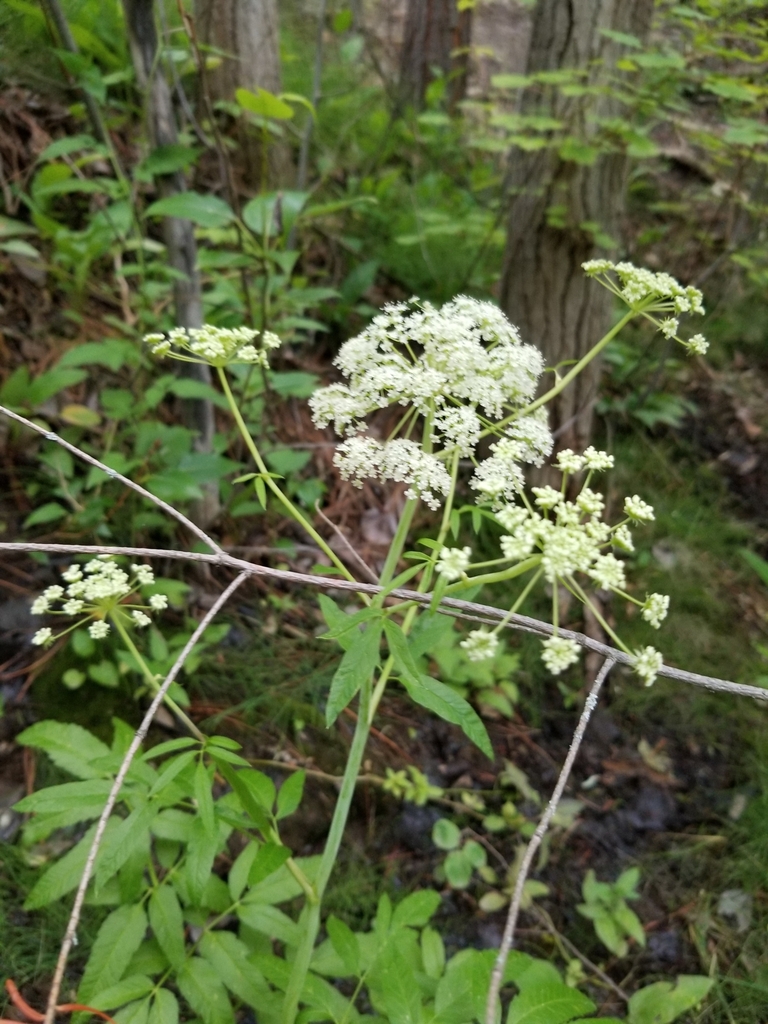
no rights reserved, uploaded by Megan Blackmore · CC0
Family: Apiaceae · Type: Herb · Native
Conservation status: CNPS 2B.1
Cicuta maculata var. bolanderi (Bolander's water-hemlock) is a native California herb in the Apiaceae family, recognized by Overlaps with C. douglasii. Key features: coastal wetland habitat <200m, ovate fruit with narrow ribs.
Bolander's water-hemlock is a rare (CNPS 2B.1) California native perennial found in southern Sacramento Valley (Suisun marshes), central Coast, and southern Coast regions in coastal wetlands at elevations below 200 meters. Flowering from July to September, this plant produces white flowers in compound umbels characteristic of the water-hemlock family. Growing with tall, hollow stems that are often marked with distinctive purple-red streaks, it develops a robust and striking presence in wet habitats. Its leaves are complex, generally arranged in a two-times pinnate pattern with finely divided leaflets that provide intricate textural detail. This plant is critically important to understand, as all parts are highly toxic and can be fatal if ingested.
Identification and appearance
Key characters: Overlaps with C. douglasii. Key features: coastal wetland habitat <200m, ovate fruit with narrow ribs
Habitat and range
Habitat: Coastal wetlands
Elevation: < 200 m
California counties: Solano, Contra Costa, Santa Barbara, Orange, San Luis Obispo, Napa, Los Angeles, Sacramento, Marin, Ventura
Bloom period
Cicuta maculata var. bolanderi blooms Jul-Sep.
Conservation status
CNPS 2B.1
How to tell it apart
vs Conium: Cicuta has green stems and sap that turns red-brown; Conium has purple-spotted stems.; vs Angelica: Cicuta sap turns reddish-brown in air; Angelica lacks this color-changing sap.; vs Oenanthe: Cicuta spreads from rhizomes with color-changing sap; Oenanthe has tuberous roots with crowned fruits.; vs Sambucus: Sambucus is a woody shrub with compound leaves; Cicuta is an herbaceous wetland plant.; vs Perideridia: Cicuta grows in wetlands from rhizomes; Perideridia grows in dry grasslands from tubers.
Frequently asked questions
Is Cicuta maculata var. bolanderi native to California?
Yes. Cicuta maculata var. bolanderi is native to California (recorded as native).
When does Cicuta maculata var. bolanderi bloom?
Cicuta maculata var. bolanderi blooms Jul-Sep.
Where in California does Cicuta maculata var. bolanderi grow?
Cicuta maculata var. bolanderi occurs in Solano, Contra Costa, Santa Barbara, Orange, San Luis Obispo, Napa, Los Angeles, Sacramento and other counties, at elevations of < 200 m.
What plant family does Cicuta maculata var. bolanderi belong to?
Cicuta maculata var. bolanderi is in the Apiaceae family, genus Cicuta.
Is Cicuta maculata var. bolanderi rare or endangered?
Cicuta maculata var. bolanderi carries California Rare Plant Rank 2B.1, state rank S2?.
Related species
Other California species in the same genus, family, or bioregion.
Sources: Jepson eFlora · CNPS Rare Plant Inventory · Index of California Plant Names · CalPhotos · CDFW CNDDB
Last updated 2026-10-07
Data from The California Species Project — 14,000+ California species with verified data from CNPS, CDFW, USFWS, Cal-IPC, and more.