Cinnamomum camphora
Camphor tree, Camphor Tree
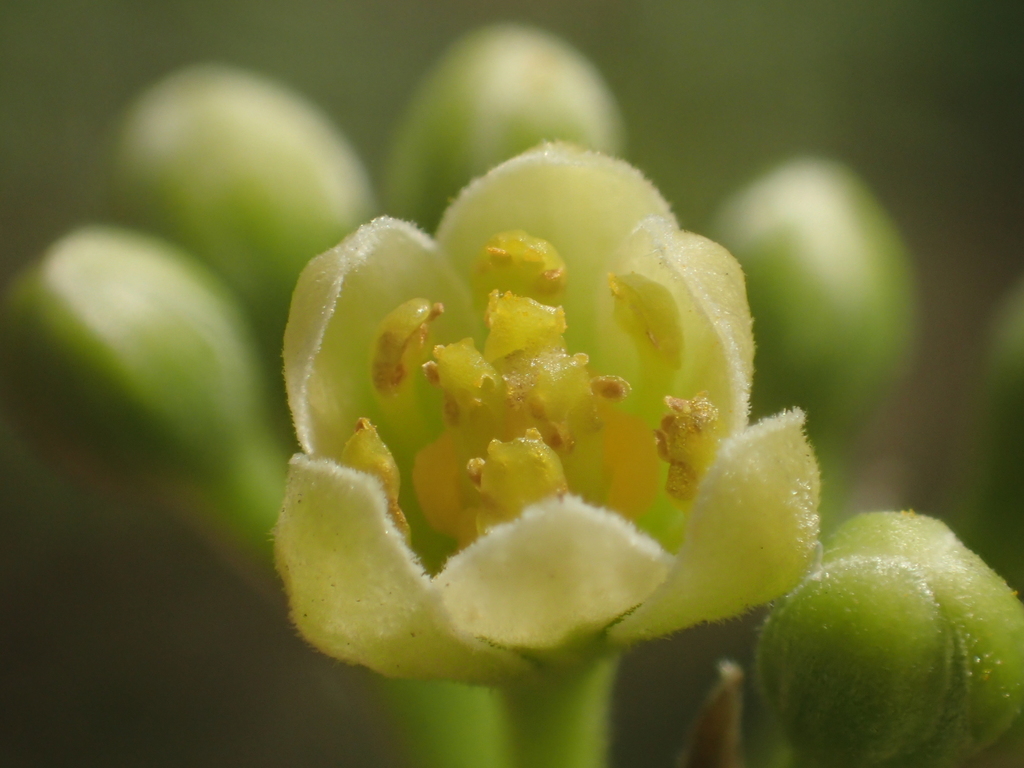
no rights reserved, uploaded by 葉子 · CC0
Family: Lauraceae · Type: Tree · Not Native
Cinnamomum camphora (Camphor tree) is a non-native California tree in the Lauraceae family, recognized by 0 congeners; naturalized aromatic (camphor) evergreen tree; ovate-elliptic leaves with strong basal vein pair + axillary pit (domatia),….
Camphor tree is a naturalized shrub found in southwestern California coastal regions, San Joaquin Valley's Antioch Dunes, and southwestern Peninsula Ranges in moist places at elevations below 150 meters. Flowering from April to May, this plant produces small greenish-white flowers clustered in inflorescences 3 to 7 centimeters long. Growing to heights up to 30 meters with smooth, spreading branches, it develops a broad, rounded canopy. Its leaves are distinctive, measuring 6 to 12 centimeters long and 2.5 to 5.5 centimeters wide, with an ovate-elliptic shape and prominent basal lateral veins. The mature tree produces small purple fruits approximately 6 to 9 millimeters in diameter.
Identification and appearance
Key characters: 0 congeners; naturalized aromatic (camphor) evergreen tree; ovate-elliptic leaves with strong basal vein pair + axillary pit (domatia), purple fruit
Habitat and range
Habitat: Moist places
Elevation: < 150 m
Outside California: native to tropical, subtropical eastern Asia
Bloom period
Cinnamomum camphora blooms Apr-May.
How to tell it apart
vs Umbellularia: Cinnamomum leaves smell of camphor and have a triple-veined base with tiny axillary pits (domatia); Umbellularia (California bay) leaves smell pungent and headache-inducing and are pinnately veined without basal pits.; vs Laurus: Cinnamomum has camphor-scented, glossy, 3-veined leaves and purple-black fruit; Laurus (bay) has pinnately veined leaves with a wavy margin and a culinary bay scent.; vs Persea: Cinnamomum leaves are small (6-12 cm), camphor-scented, and triple-veined; Persea (avocado) leaves are much larger, pinnately veined, and essentially unscented.; vs Ficus: Cinnamomum has camphor-scented leaves and no milky sap; Ficus (fig) leaves exude white latex when broken.; vs Prunus: Cinnamomum leaves smell of camphor with a 3-veined base; evergreen cherry-laurels (Prunus) smell of almond when crushed and are pinnately veined.
Frequently asked questions
Is Cinnamomum camphora native to California?
No. Cinnamomum camphora is not native to California (recorded as not native).
When does Cinnamomum camphora bloom?
Cinnamomum camphora blooms Apr-May.
What plant family does Cinnamomum camphora belong to?
Cinnamomum camphora is in the Lauraceae family, genus Cinnamomum.
What habitat does Cinnamomum camphora grow in?
Cinnamomum camphora grows in Moist places.
Related species
Other California species in the same genus, family, or bioregion.
Sources: Jepson eFlora · CalPhotos
Last updated 2026-10-07
Data from The California Species Project — 14,000+ California species with verified data from CNPS, CDFW, USFWS, Cal-IPC, and more.