Cirsium crassicaule
Slough thistle
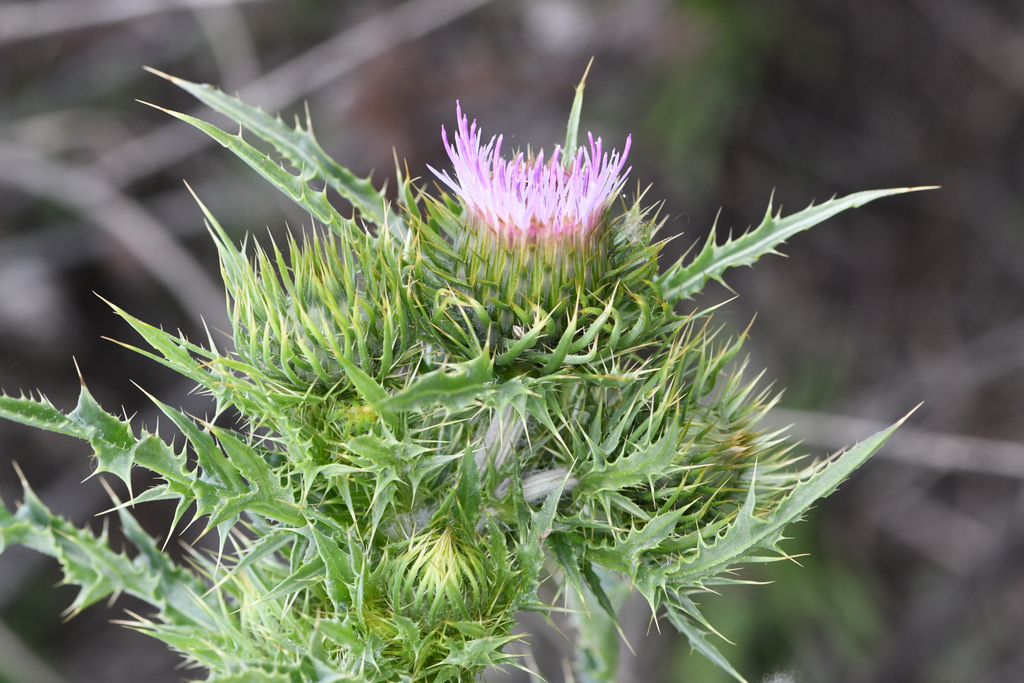
(c) Trevor Van Loon, some rights reserved (CC BY), uploaded by Trevor Van Loon · licence
Family: Asteraceae · Type: Herb · Native
Conservation status: CNPS 1B.1
Cirsium crassicaule (Slough thistle) is a native California herb in the Asteraceae family, recognized by San Joaquin Valley endemic with distinctive thick hollow stem base.
Slough thistle is a rare (CNPS 1B.1) California native annual found in the San Joaquin Valley in freshwater marshes at elevations below 100 meters. Flowering from March to June, this thistle produces pale rose-purple to white flowers in heads 1.5 to 3 centimeters wide, forming loose flat-topped clusters. Growing 6 to 10 meters tall with a single, openly branched stem that is notably hollow at the base and thinly cobwebby, it develops distinctive spiny characteristics. Its leaves are elliptic to widely oblanceolate, gray-tomentose underneath, with proximal leaves featuring spiny-lobed petioles and blades that are 1 to 2 times lobed with main spines 3 to 8 millimeters long. The fruit is small, measuring 5 to 5.5 millimeters long with a pappus 1.5 to 2 centimeters in length.
Identification and appearance
Key characters: 1 sympatric species; San Joaquin Valley endemic with distinctive thick hollow stem base
Habitat and range
Habitat: Freshwater marshes
Elevation: < 100 m
Bloom period
Cirsium crassicaule blooms Mar-Jun.
Conservation status
CNPS 1B.1
How to tell it apart
vs Carduus: Cirsium has fluffy, feathery seed tufts; Carduus has rough bristles or no pappus and continuous spiny wings down the stem.; vs Silybum: Cirsium leaves are plain green; Silybum has bright white marbling along the leaf veins.; vs Sonchus: Cirsium has thistle-type flowers with spine-tipped bracts; Sonchus has dandelion-like flowers and milky sap.; vs Cynara: Cirsium heads are 1-6 cm across; Cynara heads are massive (4-15 cm, tennis ball sized) with fleshy bases.; vs Centaurea: Cirsium has linear bracts without appendages; Centaurea bracts have fringed or comb-like tips.
Frequently asked questions
Is Cirsium crassicaule native to California?
Yes. Cirsium crassicaule is native to California (recorded as native).
When does Cirsium crassicaule bloom?
Cirsium crassicaule blooms Mar-Jun.
What plant family does Cirsium crassicaule belong to?
Cirsium crassicaule is in the Asteraceae family, genus Cirsium.
Is Cirsium crassicaule rare or endangered?
Cirsium crassicaule carries California Rare Plant Rank 1B.1, state rank S1.
What habitat does Cirsium crassicaule grow in?
Cirsium crassicaule grows in Freshwater marshes.
Related species
Other California species in the same genus, family, or bioregion.
Sources: Jepson eFlora · CalPhotos · CDFW CNDDB
Last updated 2026-10-07
Data from The California Species Project — 14,000+ California species with verified data from CNPS, CDFW, USFWS, Cal-IPC, and more.