Cirsium cymosum var. cymosum
Peregrine thistle
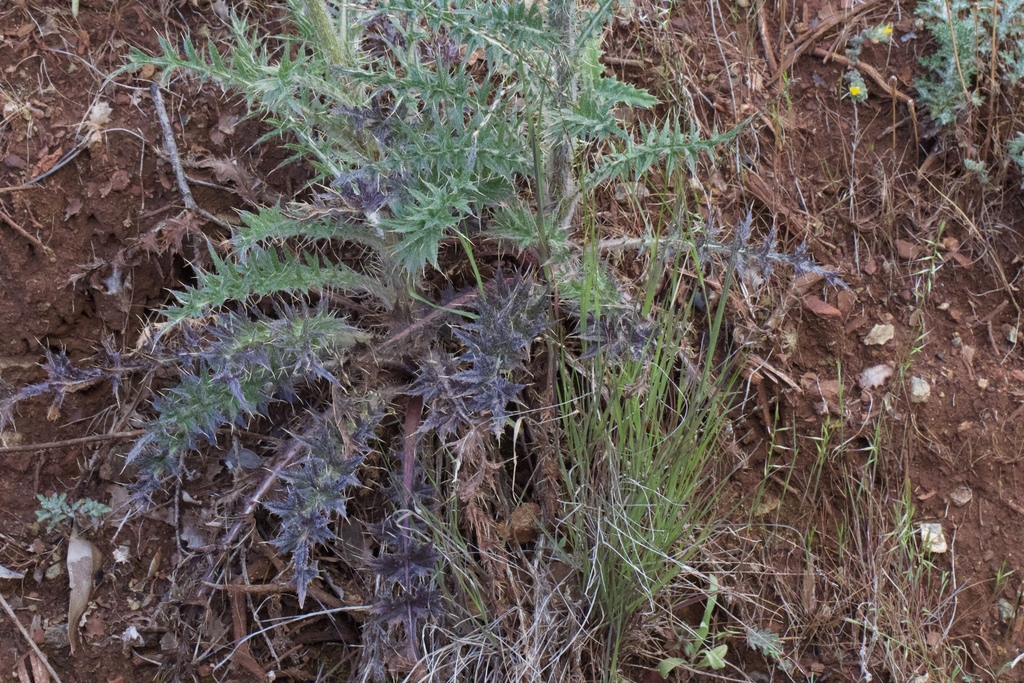
(c) Arvel Hernandez, some rights reserved (CC BY), uploaded by Arvel Hernandez · licence
Family: Asteraceae · Type: Perennial · Native
Cirsium cymosum var. cymosum (Peregrine thistle) is a native California perennial in the Asteraceae family, recognized by creeping rootstock, white corollas, and long outer phyllaries distinguish it.
Peregrine thistle is a California native perennial herb found in the Klamath Ranges, northern Coast Ranges, Cascade Range, northern and central Sierra Nevada, San Francisco Bay Area, and northern Santa Cruz Mountains in scrubland, woodland, and open forest at elevations of 100 to 2,100 meters. Flowering from April to July, this plant produces white to pale purple flowers in large heads 20 to 35 millimeters wide with distinctively long outer phyllaries. Growing with stems emerging from a creeping rootstock, it develops robust plants with sticky-resinous characteristics. Its leaves are deeply lobed and prickly, typical of thistles, with a complex texture that provides structural defense. The plant shows notable variation in chromosome count, with populations displaying either 30 or 34 chromosomes.
Identification and appearance
Key characters: 26 sympatric species; creeping rootstock, white corollas, and long outer phyllaries distinguish it
Habitat and range
Habitat: Scrubland, woodland, open forest, meadows, occasionally on serpentine
Elevation: 100-2100 m
California counties: Stanislaus, Alameda, Lassen, Contra Costa, Lake, Modoc, Shasta, Colusa, Kern, Siskiyou, Tehama, Trinity, Santa Clara, Napa, Merced, San Benito, Sierra, Plumas, Glenn, Yolo, Humboldt, Mono, Monterey
Outside California: to southern Oregon, northern Nevada
Bloom period
Cirsium cymosum var. cymosum blooms Apr-Jul.
How to tell it apart
vs Carduus: Cirsium has fluffy, feathery seed tufts; Carduus has rough bristles or no pappus and continuous spiny wings down the stem.; vs Silybum: Cirsium leaves are plain green; Silybum has bright white marbling along the leaf veins.; vs Sonchus: Cirsium has thistle-type flowers with spine-tipped bracts; Sonchus has dandelion-like flowers and milky sap.; vs Cynara: Cirsium heads are 1-6 cm across; Cynara heads are massive (4-15 cm, tennis ball sized) with fleshy bases.; vs Centaurea: Cirsium has linear bracts without appendages; Centaurea bracts have fringed or comb-like tips.
Frequently asked questions
Is Cirsium cymosum var. cymosum native to California?
Yes. Cirsium cymosum var. cymosum is native to California (recorded as native).
When does Cirsium cymosum var. cymosum bloom?
Cirsium cymosum var. cymosum blooms Apr-Jul.
Where in California does Cirsium cymosum var. cymosum grow?
Cirsium cymosum var. cymosum occurs in Stanislaus, Alameda, Lassen, Contra Costa, Lake, Modoc, Shasta, Colusa and other counties, at elevations of 100-2100 m.
What plant family does Cirsium cymosum var. cymosum belong to?
Cirsium cymosum var. cymosum is in the Asteraceae family, genus Cirsium.
What habitat does Cirsium cymosum var. cymosum grow in?
Cirsium cymosum var. cymosum grows in Scrubland, woodland, open forest, meadows, occasionally on serpentine.
Related species
Other California species in the same genus, family, or bioregion.
Sources: Jepson eFlora · Index of California Plant Names · CalPhotos
Last updated 2026-09-30
Data from The California Species Project — 14,000+ California species with verified data from CNPS, CDFW, USFWS, Cal-IPC, and more.