Cirsium occidentale var. californicum
California thistle, California Thistle
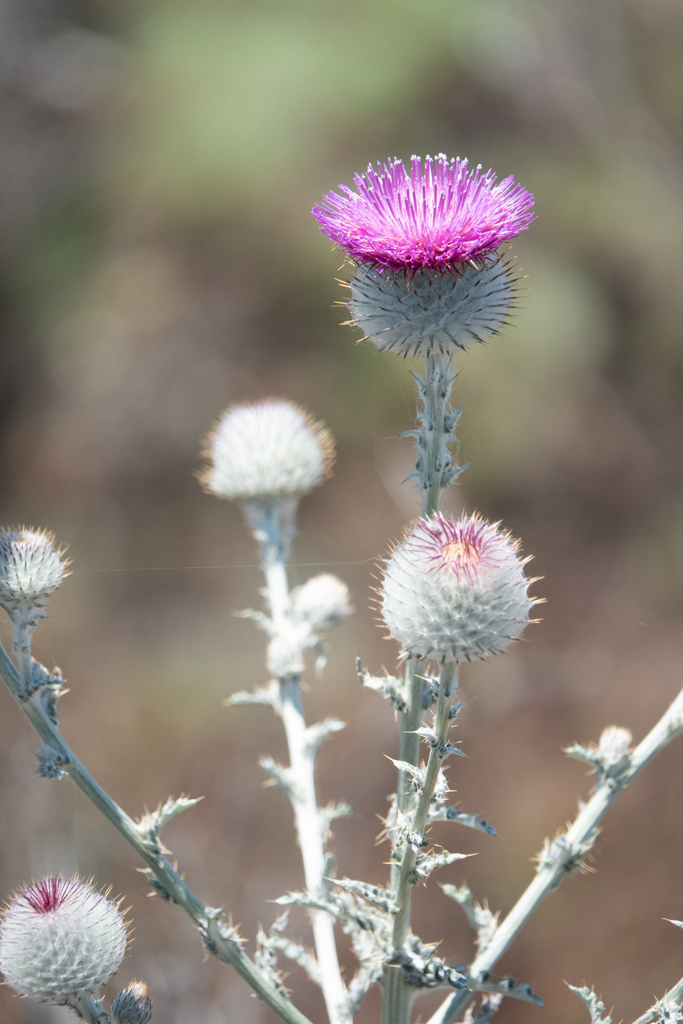
no rights reserved, uploaded by Kyle Nessen · CC0
Family: Asteraceae · Type: Herb · Native
Cirsium occidentale var. californicum (California thistle) is a native California herb in the Asteraceae family, recognized by distinguished mainly by growth form and spine size.
California thistle is a native biennial found in the central Sierra Nevada, southern Coast Ranges, and southwestern California in woodland, open forest, and disturbed sites at elevations below 2,300 meters. Flowering from April to July, this plant produces white to purple or rose flowers in heads 1.5 to 5 centimeters in diameter, emerging from loosely clustered inflorescences. Growing 50 to 200 centimeters tall with an erect habit, the plant has distinctively colored leaves that are green to gray on the upper surface and gray underneath. Its leaves are characterized by variable coloration and texture, ranging from nearly glabrous to cobwebby, with middle leaf segments that can vary in width and spread. The plant's involucre features phyllaries with occasional sticky-resinous ridges and tip-spines that are typically 1 to 3 millimeters long.
Identification and appearance
Key characters: 19 sympatric species; distinguished mainly by growth form and spine size
Habitat and range
Habitat: Woodland, open forest, disturbed sites
Elevation: < 2300 m
California counties: Los Angeles, Riverside, San Bernardino, Amador, Fresno, Kern, Madera, Mariposa, Monterey, Orange, San Diego, San Luis Obispo, Santa Barbara, Tulare, Tuolumne, Ventura, Placer, Mono, Alpine, Merced, Nevada, Santa Clara, Sierra, El Dorado, Napa, Mendocino, Siskiyou, Trinity, Contra Costa, Calaveras, Stanislaus, Lassen, Butte
Bloom period
Cirsium occidentale var. californicum blooms Apr-Jul.
How to tell it apart
vs Carduus: Cirsium has fluffy, feathery seed tufts; Carduus has rough bristles or no pappus and continuous spiny wings down the stem.; vs Silybum: Cirsium leaves are plain green; Silybum has bright white marbling along the leaf veins.; vs Sonchus: Cirsium has thistle-type flowers with spine-tipped bracts; Sonchus has dandelion-like flowers and milky sap.; vs Cynara: Cirsium heads are 1-6 cm across; Cynara heads are massive (4-15 cm, tennis ball sized) with fleshy bases.; vs Centaurea: Cirsium has linear bracts without appendages; Centaurea bracts have fringed or comb-like tips.
Frequently asked questions
Is Cirsium occidentale var. californicum native to California?
Yes. Cirsium occidentale var. californicum is native to California (recorded as native).
When does Cirsium occidentale var. californicum bloom?
Cirsium occidentale var. californicum blooms Apr-Jul.
Where in California does Cirsium occidentale var. californicum grow?
Cirsium occidentale var. californicum occurs in Los Angeles, Riverside, San Bernardino, Amador, Fresno, Kern, Madera, Mariposa and other counties, at elevations of < 2300 m.
What plant family does Cirsium occidentale var. californicum belong to?
Cirsium occidentale var. californicum is in the Asteraceae family, genus Cirsium.
What habitat does Cirsium occidentale var. californicum grow in?
Cirsium occidentale var. californicum grows in Woodland, open forest, disturbed sites.
Related species
Other California species in the same genus, family, or bioregion.
- Cirsium occidentale var. candidissimum — Snowy thistle
- Cirsium occidentale var. compactum — Compact cobwebby thistle
- Cirsium occidentale var. coulteri — Coulter's thistle
- Cirsium occidentale var. lucianum — Cuesta ridge thistle
- Cirsium occidentale var. occidentale — Cobwebby thistle
- Cirsium occidentale var. venustum — Venus thistle
Sources: Jepson eFlora · Index of California Plant Names · CalPhotos
Last updated 2026-10-07
Data from The California Species Project — 14,000+ California species with verified data from CNPS, CDFW, USFWS, Cal-IPC, and more.