Cirsium occidentale var. lucianum
Cuesta ridge thistle, Cuesta Ridge Thistle
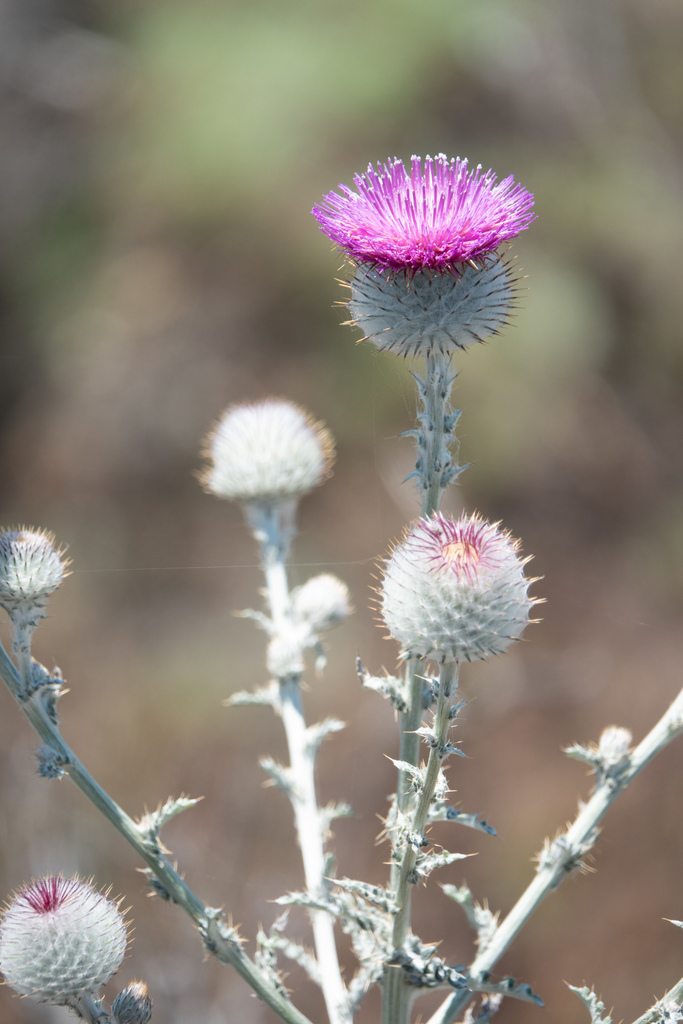
no rights reserved, uploaded by Kyle Nessen · CC0
Family: Asteraceae · Type: Biennial · Native
Conservation status: CNPS 1B.2
Cirsium occidentale var. lucianum (Cuesta ridge thistle) is a native California biennial in the Asteraceae family, recognized by small heads and short phyllary tips diagnostic.
Cuesta ridge thistle is a rare (CNPS 1B.2) California native biennial found in the southern Santa Lucia Range in San Luis Obispo County, inhabiting chaparral and woodland openings, often on serpentine at elevations of 500 to 750 meters. Flowering from April to July, this plant produces striking red to dark red-purple flowers in large heads 2 to 4 centimeters in diameter, elevated well above the leaves. Growing with erect stems 30 to 200 centimeters tall, it develops an impressive, widely ovoid thistle structure with long-stalked flower heads. Its leaves are thinly cobwebby, with phyllary tips 5 to 8 millimeters long that are either straight or gently curved at the tips. The plant's distinctive red flowers and serpentine habitat make it a remarkable example of California's unique botanical diversity.
Identification and appearance
Key characters: 8 sympatric species; small heads and short phyllary tips diagnostic
Habitat and range
Habitat: Chaparral, woodland or forest openings, often on serpentine
Elevation: 500-750 m
California counties: San Luis Obispo
Bloom period
Cirsium occidentale var. lucianum blooms Apr-Jul.
Conservation status
CNPS 1B.2
How to tell it apart
vs Carduus: Cirsium has fluffy, feathery seed tufts; Carduus has rough bristles or no pappus and continuous spiny wings down the stem.; vs Silybum: Cirsium leaves are plain green; Silybum has bright white marbling along the leaf veins.; vs Sonchus: Cirsium has thistle-type flowers with spine-tipped bracts; Sonchus has dandelion-like flowers and milky sap.; vs Cynara: Cirsium heads are 1-6 cm across; Cynara heads are massive (4-15 cm, tennis ball sized) with fleshy bases.; vs Centaurea: Cirsium has linear bracts without appendages; Centaurea bracts have fringed or comb-like tips.
Frequently asked questions
Is Cirsium occidentale var. lucianum native to California?
Yes. Cirsium occidentale var. lucianum is native to California (recorded as native).
When does Cirsium occidentale var. lucianum bloom?
Cirsium occidentale var. lucianum blooms Apr-Jul.
Where in California does Cirsium occidentale var. lucianum grow?
Cirsium occidentale var. lucianum occurs in San Luis Obispo, at elevations of 500-750 m.
What plant family does Cirsium occidentale var. lucianum belong to?
Cirsium occidentale var. lucianum is in the Asteraceae family, genus Cirsium.
Is Cirsium occidentale var. lucianum rare or endangered?
Cirsium occidentale var. lucianum carries California Rare Plant Rank 1B.2, state rank S2.
Related species
Other California species in the same genus, family, or bioregion.
Sources: Jepson eFlora · CNPS Rare Plant Inventory · Index of California Plant Names · CalPhotos · CDFW CNDDB
Last updated 2026-09-30
Data from The California Species Project — 14,000+ California species with verified data from CNPS, CDFW, USFWS, Cal-IPC, and more.