Cirsium occidentale var. venustum
Venus thistle, Venus Thistle
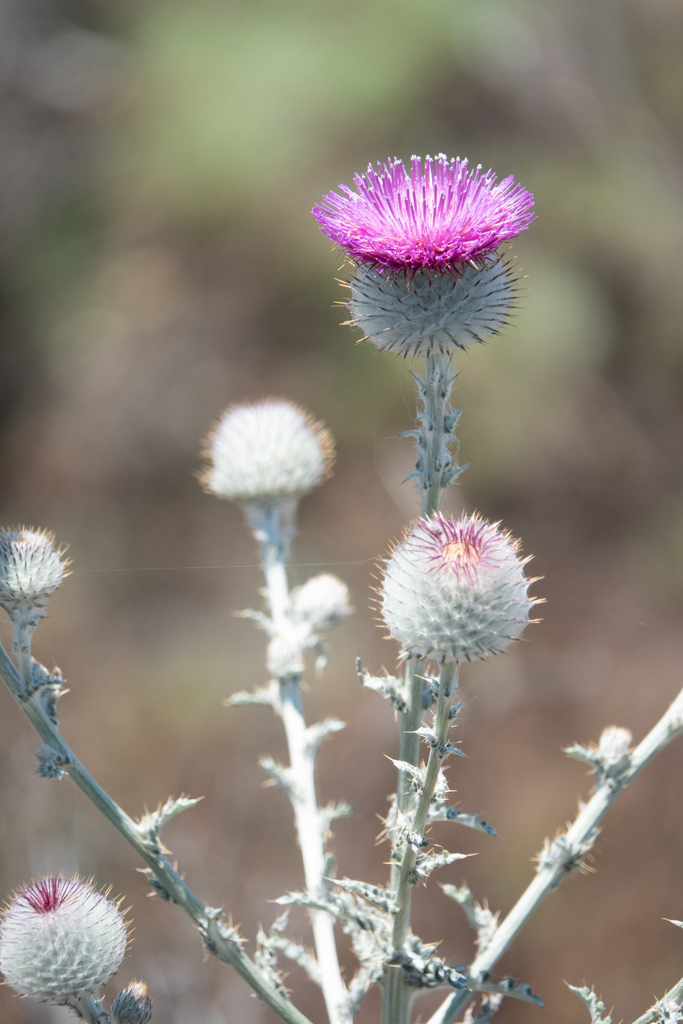
no rights reserved, uploaded by Kyle Nessen · CC0
Family: Asteraceae · Type: Herb · Native
Cirsium occidentale var. venustum (Venus thistle) is a native California herb in the Asteraceae family, recognized by red-pink flowers and long spreading phyllaries.
Venus thistle is a California native biennial found in northern California bioregions including the Sierra Nevada, Central Valley, San Francisco Bay Area, and western desert mountains in disturbed areas, grassland, and woodland at elevations up to 3,600 meters. Flowering from May to July, this plant produces bright red-pink to red flowers in large heads 2 to 6 centimeters in diameter, occasionally clustered at the ends of long peduncles. Growing 50 to 300 centimeters tall with erect stems, it develops an impressive vertical structure that stands out in its habitat. Its involucre is notable for graduated phyllary tips that are 5 to 20 millimeters long, ascending to rigidly spreading or reflexed. The flower's distinctive bright red-pink coloration and tall, upright form make it a striking presence in grassland and woodland environments.
Identification and appearance
Key characters: 35 sympatric species; red-pink flowers and long spreading phyllaries help distinguish
Habitat and range
Habitat: Disturbed areas, grassland, woodland
Elevation: < 3600 m
California counties: Kern, Alameda, Butte, Contra Costa, Fresno, Glenn, Humboldt, Inyo, Lake, Los Angeles, Mendocino, Merced, Mono, Monterey, Napa, Riverside, San Benito, San Bernardino, San Luis Obispo, San Mateo, Santa Barbara, Santa Clara, Santa Cruz, Shasta, Siskiyou, Solano, Sonoma, Sutter, Tehama, Trinity, Tulare, Tuolumne, Ventura, San Francisco, San Joaquin, Stanislaus, Colusa, Madera, Yolo, Marin, Nevada, Plumas, Mariposa, Placer, Sierra, Amador, Yuba, Kings
Bloom period
Cirsium occidentale var. venustum blooms May-Jul.
How to tell it apart
vs Carduus: Cirsium has fluffy, feathery seed tufts; Carduus has rough bristles or no pappus and continuous spiny wings down the stem.; vs Silybum: Cirsium leaves are plain green; Silybum has bright white marbling along the leaf veins.; vs Sonchus: Cirsium has thistle-type flowers with spine-tipped bracts; Sonchus has dandelion-like flowers and milky sap.; vs Cynara: Cirsium heads are 1-6 cm across; Cynara heads are massive (4-15 cm, tennis ball sized) with fleshy bases.; vs Centaurea: Cirsium has linear bracts without appendages; Centaurea bracts have fringed or comb-like tips.
Frequently asked questions
Is Cirsium occidentale var. venustum native to California?
Yes. Cirsium occidentale var. venustum is native to California (recorded as native).
When does Cirsium occidentale var. venustum bloom?
Cirsium occidentale var. venustum blooms May-Jul.
Where in California does Cirsium occidentale var. venustum grow?
Cirsium occidentale var. venustum occurs in Kern, Alameda, Butte, Contra Costa, Fresno, Glenn, Humboldt, Inyo and other counties, at elevations of < 3600 m.
What plant family does Cirsium occidentale var. venustum belong to?
Cirsium occidentale var. venustum is in the Asteraceae family, genus Cirsium.
What habitat does Cirsium occidentale var. venustum grow in?
Cirsium occidentale var. venustum grows in Disturbed areas, grassland, woodland.
Related species
Other California species in the same genus, family, or bioregion.
Sources: Jepson eFlora · Index of California Plant Names · CalPhotos
Last updated 2026-10-07
Data from The California Species Project — 14,000+ California species with verified data from CNPS, CDFW, USFWS, Cal-IPC, and more.