Cirsium vulgare
Bull thistle
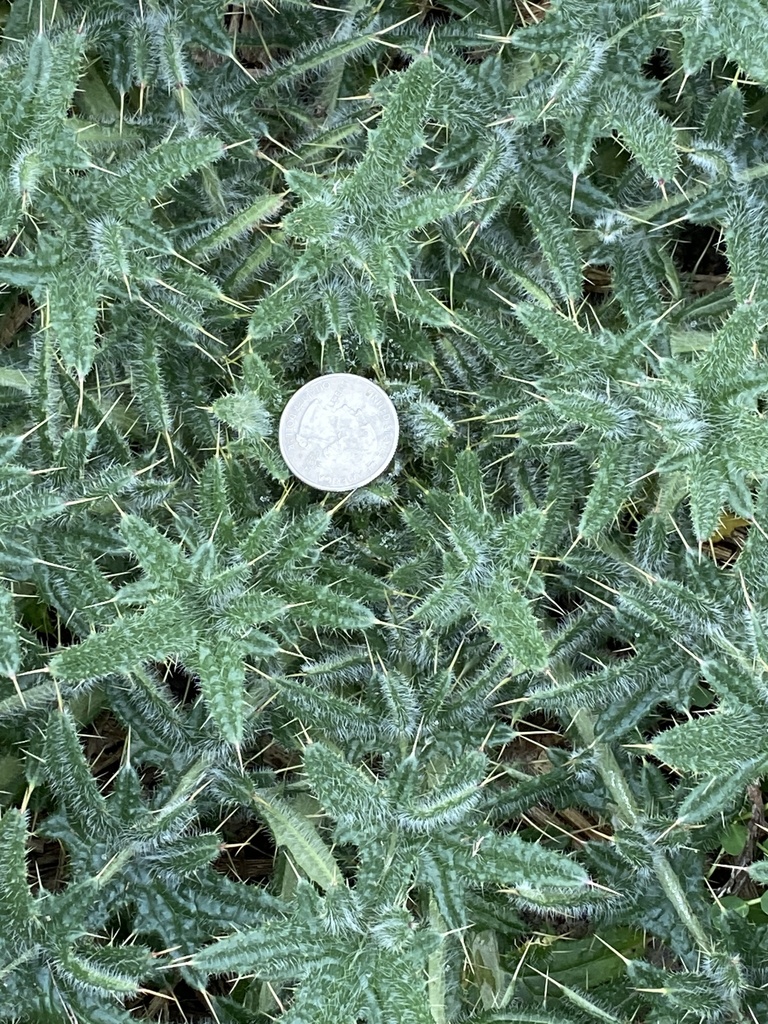
(c) Sandy Wolkenberg, some rights reserved (CC BY), uploaded by Sandy Wolkenberg · licence
Family: Asteraceae · Type: Herb · Not Native
Conservation status: Cal-IPC Yes
Cirsium vulgare (Bull thistle) is a non-native California herb in the Asteraceae family, recognized by non-native status, prominent raised abaxial leaf veins, and strongly decurrent spiny wings.
Bull thistle is a naturalized biennial found in California Floristic Province and Great Basin regions in disturbed areas at elevations below 2,350 meters. Flowering from May to October, this aggressive plant produces purple flowers in clustered heads 3 to 4 centimeters wide with distinctive spiny involucres. Growing with tall stems 30 to 200 centimeters high that are loosely tomentose and often glandular-hairy, it spreads widely in open landscapes. Its large leaves are deeply lobed with rigidly spreading spine-margined segments, becoming progressively spinier toward the stem tips with main spines up to 15 millimeters long. The fruit is small, 3 to 4.5 millimeters in length, with a pappus 20 to 30 millimeters long that aids in wind dispersal.
Identification and appearance
Key characters: 46 sympatric species; key features are non-native status, prominent raised abaxial leaf veins, and strongly decurrent spiny wings
Habitat and range
Habitat: Common. Disturbed areas
Elevation: < 2350 m
Outside California: North America, native to Europe
Bloom period
Cirsium vulgare blooms May-Oct.
Conservation status
Cal-IPC Yes
How to tell it apart
vs Carduus: Cirsium has fluffy, feathery seed tufts; Carduus has rough bristles or no pappus and continuous spiny wings down the stem.; vs Silybum: Cirsium leaves are plain green; Silybum has bright white marbling along the leaf veins.; vs Sonchus: Cirsium has thistle-type flowers with spine-tipped bracts; Sonchus has dandelion-like flowers and milky sap.; vs Cynara: Cirsium heads are 1-6 cm across; Cynara heads are massive (4-15 cm, tennis ball sized) with fleshy bases.; vs Centaurea: Cirsium has linear bracts without appendages; Centaurea bracts have fringed or comb-like tips.
Frequently asked questions
Is Cirsium vulgare native to California?
No. Cirsium vulgare is not native to California (recorded as not native).
When does Cirsium vulgare bloom?
Cirsium vulgare blooms May-Oct.
What plant family does Cirsium vulgare belong to?
Cirsium vulgare is in the Asteraceae family, genus Cirsium.
Is Cirsium vulgare invasive in California?
Cirsium vulgare is listed by Cal-IPC with an invasiveness rating of Yes.
What habitat does Cirsium vulgare grow in?
Cirsium vulgare grows in Common. Disturbed areas.
Related species
Other California species in the same genus, family, or bioregion.
- Cirsium andersonii — Anderson's thistle
- Cirsium andrewsii — Franciscan thistle
- Cirsium arizonicum — Arizona thistle
- Cirsium arizonicum var. arizonicum — Arizona thistle
- Cirsium arizonicum var. tenuisectum — Desert mountain thistle
- Cirsium arvense — Canada thistle
- Cleomella arborea var. globosa — Bladderpod
- Constancea nevinii — Nevin's woolly sunflower
- Constancea sp.
- Coreopsis lanceolata — Garden coreopsis
Sources: Jepson eFlora · Index of California Plant Names · CalPhotos
Last updated 2026-10-07
Data from The California Species Project — 14,000+ California species with verified data from CNPS, CDFW, USFWS, Cal-IPC, and more.