Cistus incanus
Hairy rockrose
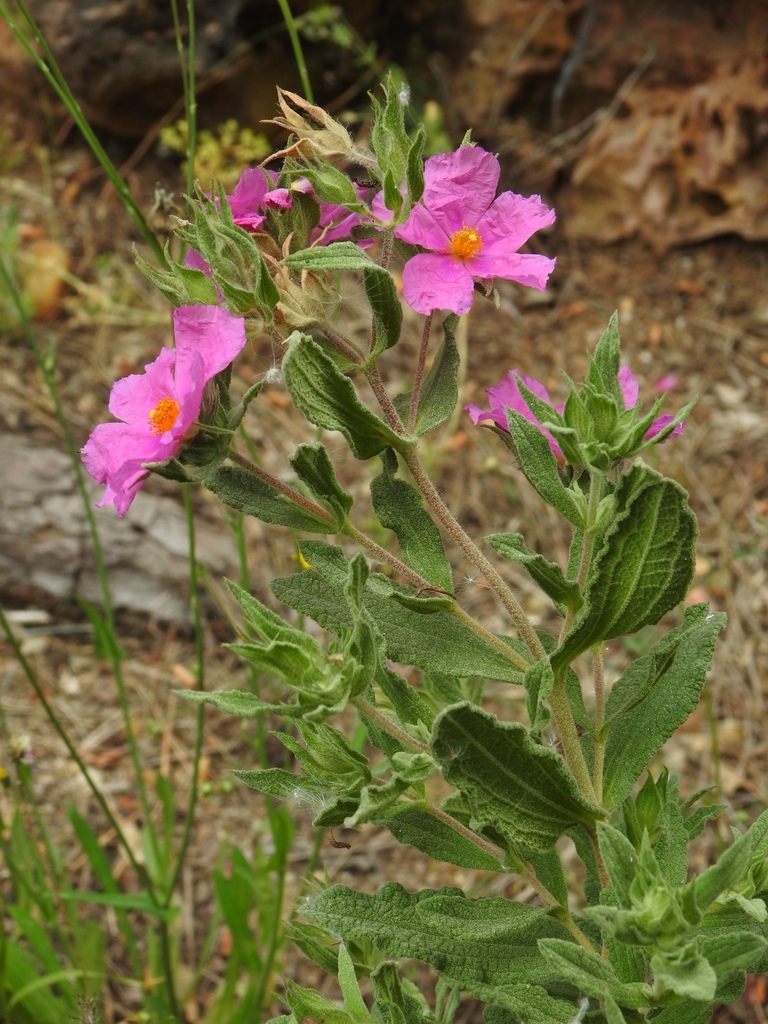
(c) Duarte Frade, some rights reserved (CC BY) · licence
Family: Cistaceae · Type: Shrub · Not Native
Cistus incanus (Hairy rockrose) is a non-native California shrub in the Cistaceae family, recognized by unique flower color diagnostic.
Hairy rockrose is a naturalized shrub found in northern California Coast Ranges, northern Southern California, San Gabriel Mountains, western Transverse Ranges (Liebre Mountains), and Peninsular Ranges in disturbed places at elevations below 1,000 meters. Flowering from January to August, this plant produces rose to purple flowers 2 to 3 centimeters wide with delicate, wrinkled petals. Growing up to 1.3 meters tall with stems covered in both glandular and nonglandular hairs, it has a distinctive spreading habit. Its elliptic leaves are slightly wrinkled, with wavy margins and a single prominent vein emerging from the base. The fruit develops with 5 distinctive valves, adding structural interest to this Mediterranean landscape plant.
Identification and appearance
Key characters: 2 sympatric species; unique flower color diagnostic
Habitat and range
Habitat: Uncommon. Disturbed places
Elevation: < 1000 m
California counties: Shasta, Los Angeles, San Francisco, Santa Barbara, San Diego, San Bernardino, Riverside, Marin, Santa Clara, Monterey, San Luis Obispo, Napa, San Mateo, Ventura
Outside California: native to southern Europe
Bloom period
Cistus incanus blooms Jan-Aug.
How to tell it apart
vs Rosa: Cistus petals have no notch and leaves lack stipules; Rosa petals are notched and have leafy stipules at leaf base.; vs Carpenteria: Cistus has 5-12 capsule segments when fruit opens; Carpenteria has 5-7 segments and pointed evergreen leaves.; vs Romneya: Cistus is a shrub with small opposite leaves; Romneya has large divided gray-green leaves and huge white flowers.; vs Salvia: Cistus has 5 separate rounded petals; Salvia has fused tubular flowers with upper and lower lips.; vs Oenothera: Cistus has opposite leaves and 5-12 capsule segments; Oenothera has alternate leaves and 4-celled capsules.
Frequently asked questions
Is Cistus incanus native to California?
No. Cistus incanus is not native to California (recorded as not native).
When does Cistus incanus bloom?
Cistus incanus blooms Jan-Aug.
Where in California does Cistus incanus grow?
Cistus incanus occurs in Shasta, Los Angeles, San Francisco, Santa Barbara, San Diego, San Bernardino, Riverside, Marin and other counties, at elevations of < 1000 m.
What plant family does Cistus incanus belong to?
Cistus incanus is in the Cistaceae family, genus Cistus.
What habitat does Cistus incanus grow in?
Cistus incanus grows in Uncommon. Disturbed places.
Related species
Other California species in the same genus, family, or bioregion.
Sources: Jepson eFlora · Index of California Plant Names · CalPhotos
Last updated 2026-10-07
Data from The California Species Project — 14,000+ California species with verified data from CNPS, CDFW, USFWS, Cal-IPC, and more.