Clarkia mildrediae subsp. mildrediae
Mildred's clarkia, Mildred's Clarkia
(c) Matt Berger, some rights reserved (CC BY), uploaded by Matt Berger · licence
Family: Onagraceae · Type: Herb · Native
Conservation status: CNPS 1B.3
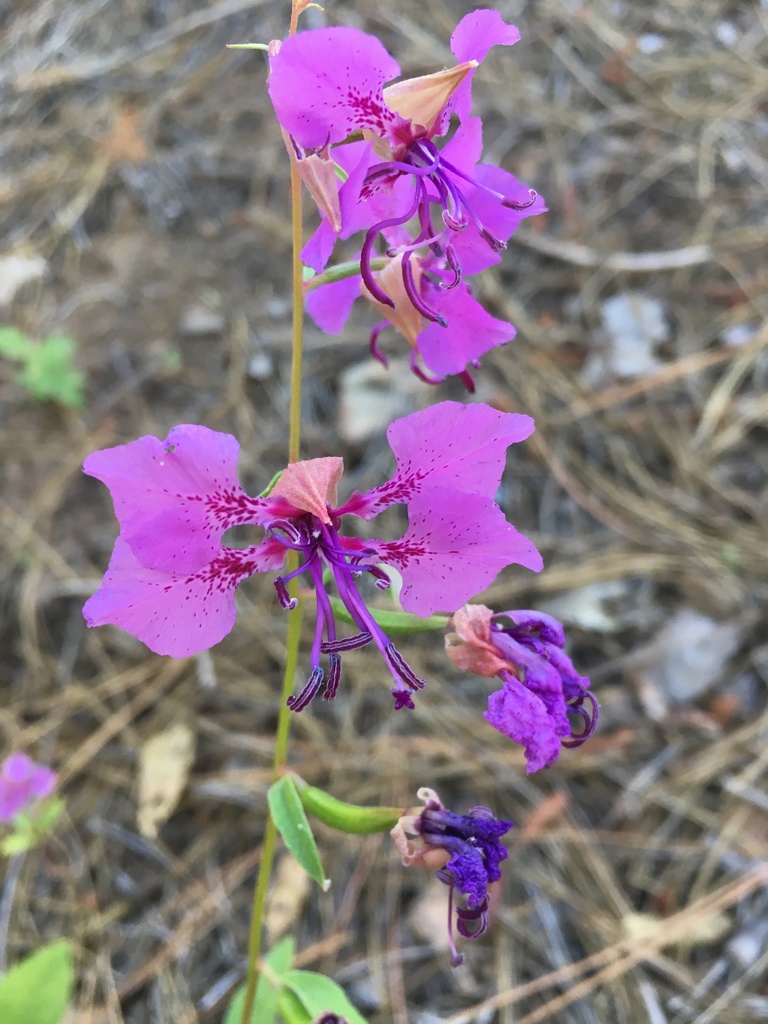
Clarkia mildrediae subsp. mildrediae (Mildred's clarkia) is a native California herb in the Onagraceae family, recognized by magenta anthers with blue-gray pollen highly distinctive.
Mildred's clarkia is a rare (CNPS 1B.3) California native annual found in southern Cascade Range and northern Sierra Nevada mountains, specifically in the Feather River drainage, in yellow-pine forest at elevations of 450 to 1,700 meters. Flowering from June to July, this plant produces delicate flowers with wide petals 12 to 18 millimeters across, featuring distinctive magenta anthers and fresh pollen that is uniquely blue-gray in color. Growing with slender stems typical of its genus, the clarkia reaches heights characteristic of annual wildflowers in mountain woodland settings. Its leaves are arranged in a pattern supporting the delicate flowering structure, complementing the plant's elegant botanical form. The subtle color contrasts of magenta, blue-gray, and soft petal tones make this rare clarkia a distinctive member of its mountain forest ecosystem.
Identification and appearance
Key characters: 40 sympatric species; magenta anthers with blue-gray pollen highly distinctive
Habitat and range
Habitat: Yellow-pine forest
Elevation: 450-1700 m
Bloom period
Clarkia mildrediae subsp. mildrediae blooms Jun-Jul.
Conservation status
CNPS 1B.3
How to tell it apart
vs Epilobium: Clarkia seeds lack a hair tuft and its petals are broad, often clawed or lobed; Epilobium and Chamerion have seeds bearing a tuft of silky hairs and long, thin capsules.; vs Oenothera: Clarkia flowers are pink to lavender-purple and its buds nod before opening; Oenothera flowers are generally yellow (or white), larger, and open at dusk.; vs Camissonia: Clarkia petals are pink-purple, often fan-shaped or lobed with a distinct claw; Camissonia and Camissoniopsis have yellow, unlobed petals.; vs Sidalcea: Clarkia has 4 petals, an inferior ovary, and a 4-lobed stigma; Sidalcea (checkerbloom) has 5 petals, a superior ovary, and a central mallow staminal column.; vs Gayophytum: Clarkia is showy with petals 10-35 mm; Gayophytum has minute white-to-pink flowers only a few mm across on thread-like branches.
Frequently asked questions
Is Clarkia mildrediae subsp. mildrediae native to California?
Yes. Clarkia mildrediae subsp. mildrediae is native to California (recorded as native).
When does Clarkia mildrediae subsp. mildrediae bloom?
Clarkia mildrediae subsp. mildrediae blooms Jun-Jul.
What plant family does Clarkia mildrediae subsp. mildrediae belong to?
Clarkia mildrediae subsp. mildrediae is in the Onagraceae family, genus Clarkia.
Is Clarkia mildrediae subsp. mildrediae rare or endangered?
Clarkia mildrediae subsp. mildrediae carries California Rare Plant Rank 1B.3, state rank S3?.
What habitat does Clarkia mildrediae subsp. mildrediae grow in?
Clarkia mildrediae subsp. mildrediae grows in Yellow-pine forest.
Related species
Other California species in the same genus, family, or bioregion.
Sources: Jepson eFlora · CalPhotos · CDFW CNDDB
Last updated 2026-10-07
Data from The California Species Project — 14,000+ California species with verified data from CNPS, CDFW, USFWS, Cal-IPC, and more.