Clarkia prostrata
Prostrate clarkia
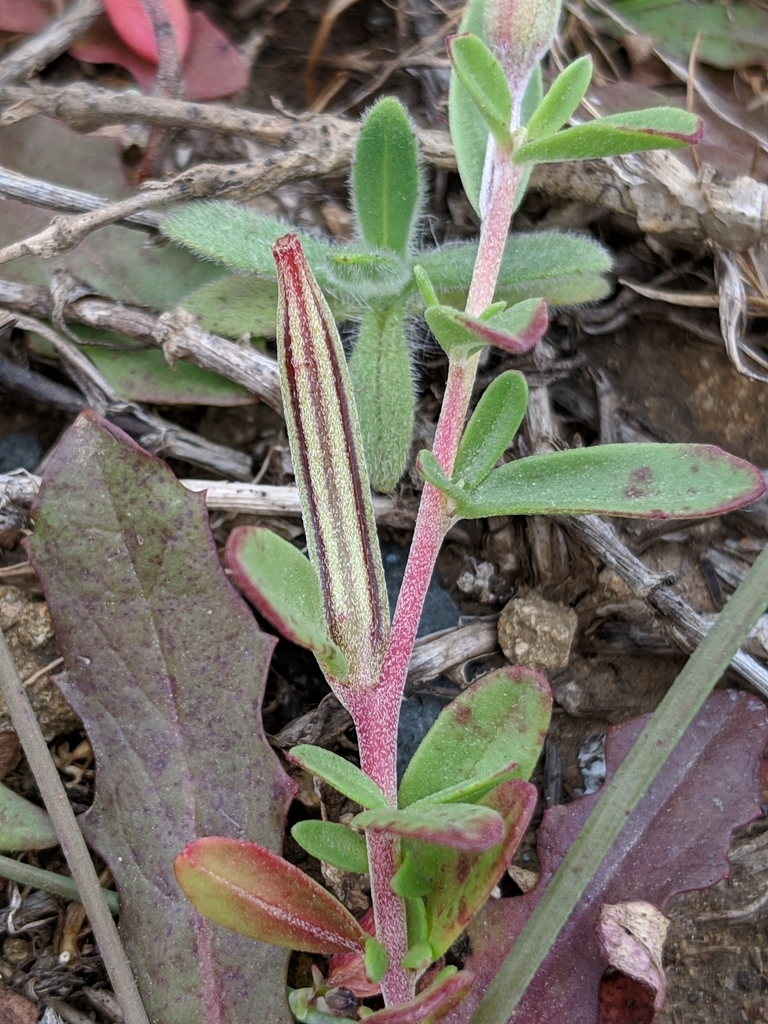
no rights reserved · CC0
Family: Onagraceae · Type: Herb · Native
Conservation status: CNPS PPD
Clarkia prostrata (Prostrate clarkia) is a native California herb in the Onagraceae family, recognized by prostrate growth habit unique among clarkias.
Prostrate clarkia is a California native annual found in southern Central Coast bioregion coastal bluffs in grassland and closed-cone pine forest at elevations below 100 meters. Flowering from May to July, this plant produces lavender-pink to pale yellow flowers with distinctive red spots, 10 to 15 millimeters long in bowl-shaped corollas. Growing with prostrate to decumbent stems less than 5 decimeters long and sparsely puberulent, it spreads low across the ground. Its leaves are nearly sessile, 1 to 2.5 centimeters long, with elliptic to oblanceolate blades and generally obtuse tips. The plant's delicate flowers and low-spreading growth make it a subtle but charming addition to coastal grassland environments.
Identification and appearance
Key characters: 16 sympatric species; prostrate growth habit unique among clarkias
Habitat and range
Habitat: Coastal bluffs in grassland, closed-cone-pine forest
Elevation: < 100 m
California counties: San Luis Obispo, Santa Cruz, Santa Barbara, Monterey, Nevada
Bloom period
Clarkia prostrata blooms May-Jul.
Conservation status
CNPS PPD
How to tell it apart
vs Epilobium: Clarkia seeds lack a hair tuft and its petals are broad, often clawed or lobed; Epilobium and Chamerion have seeds bearing a tuft of silky hairs and long, thin capsules.; vs Oenothera: Clarkia flowers are pink to lavender-purple and its buds nod before opening; Oenothera flowers are generally yellow (or white), larger, and open at dusk.; vs Camissonia: Clarkia petals are pink-purple, often fan-shaped or lobed with a distinct claw; Camissonia and Camissoniopsis have yellow, unlobed petals.; vs Sidalcea: Clarkia has 4 petals, an inferior ovary, and a 4-lobed stigma; Sidalcea (checkerbloom) has 5 petals, a superior ovary, and a central mallow staminal column.; vs Gayophytum: Clarkia is showy with petals 10-35 mm; Gayophytum has minute white-to-pink flowers only a few mm across on thread-like branches.
Frequently asked questions
Is Clarkia prostrata native to California?
Yes. Clarkia prostrata is native to California (recorded as native).
When does Clarkia prostrata bloom?
Clarkia prostrata blooms May-Jul.
Where in California does Clarkia prostrata grow?
Clarkia prostrata occurs in San Luis Obispo, Santa Cruz, Santa Barbara, Monterey, Nevada, at elevations of < 100 m.
What plant family does Clarkia prostrata belong to?
Clarkia prostrata is in the Onagraceae family, genus Clarkia.
Is Clarkia prostrata rare or endangered?
Clarkia prostrata carries California Rare Plant Rank PPD.
Related species
Other California species in the same genus, family, or bioregion.
Sources: Jepson eFlora · Index of California Plant Names · CalPhotos
Last updated 2026-10-07
Data from The California Species Project — 14,000+ California species with verified data from CNPS, CDFW, USFWS, Cal-IPC, and more.