Claytonia rubra subsp. rubra
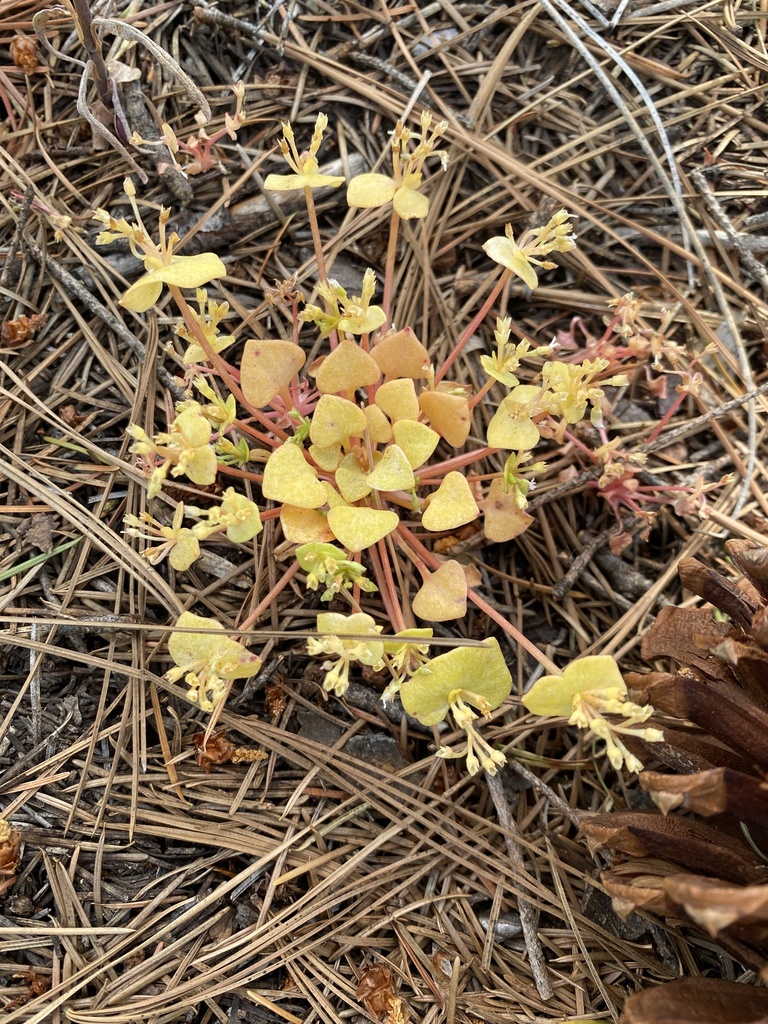
Photo: parent species Claytonia rubra · (c) Daniel Patterson, some rights reserved (CC BY) · licence
Family: Montiaceae · Type: Herb · Native
Claytonia rubra subsp. rubra is a native California herb in the Montiaceae family, recognized by . Diamond-shaped basal leaves with truncate base diagnostic.
Red maids is a California native perennial found in northwestern California (excluding northern coastal regions), the high Cascade Range, Sierra Nevada, Tehachapi Mountains, western Central Western California, Transverse Ranges, Peninsular Ranges, and Great Basin in vernally moist dunes, conifer forest, woodland, and scrub at elevations below 2,500 meters. Flowering from April to July, this plant produces delicate white to pink flowers. Growing with slender stems and a low-spreading habit, it forms compact ground-covering clusters. Its distinctive leaves are basal and diamond-shaped to triangular, with a slightly truncate base, while stem leaves are partially fused or free on one side. The plant creates delicate, ephemeral ground covers in moist seasonal habitats across diverse California landscapes.
Identification and appearance
Key characters: Co-occurs with 20 species. Diamond-shaped basal leaves with truncate base diagnostic.
Habitat and range
Habitat: Vernally moist dunes, conifer forest, woodland, scrub
Elevation: < 2500 m
California counties: Kern, Riverside, San Bernardino, Los Angeles, San Diego, Lassen, Tehama, Tulare, Ventura, San Luis Obispo, Shasta, Mono, El Dorado, Modoc, Trinity, Marin, Amador, Glenn, Humboldt, Inyo, Mariposa, Monterey, Nevada, Placer, Santa Cruz, Sierra, Sutter, Tuolumne, Yuba, Alpine, Butte, Fresno, Lake, Mendocino, Plumas, Siskiyou, Madera, Santa Clara, San Benito, Santa Barbara
Outside California: to British Columbia, South Dakota, Colorado
Bloom period
Claytonia rubra subsp. rubra blooms Apr-Jul.
How to tell it apart
vs Montia: Claytonia has just 2 stem leaves opposite or fused; Montia has multiple stem leaves arranged alternately.; vs Stellaria: Claytonia has 2 broad stem leaves and 5 petals; Stellaria has many narrow opposite leaves and deeply notched petals.; vs Hydrocotyle: Claytonia has 5-petaled flowers above paired stem leaves; Hydrocotyle has round shield-like leaves and tiny flower clusters.; vs Lewisia: Claytonia has thin leaves on upright stems in moist areas; Lewisia forms succulent rosettes on rocky cliffs.; vs Dichondra: Claytonia has upright stems with 5-petaled flowers; Dichondra is a creeping plant with kidney-shaped leaves.
Frequently asked questions
Is Claytonia rubra subsp. rubra native to California?
Yes. Claytonia rubra subsp. rubra is native to California (recorded as native).
When does Claytonia rubra subsp. rubra bloom?
Claytonia rubra subsp. rubra blooms Apr-Jul.
Where in California does Claytonia rubra subsp. rubra grow?
Claytonia rubra subsp. rubra occurs in Kern, Riverside, San Bernardino, Los Angeles, San Diego, Lassen, Tehama, Tulare and other counties, at elevations of < 2500 m.
What plant family does Claytonia rubra subsp. rubra belong to?
Claytonia rubra subsp. rubra is in the Montiaceae family, genus Claytonia.
What habitat does Claytonia rubra subsp. rubra grow in?
Claytonia rubra subsp. rubra grows in Vernally moist dunes, conifer forest, woodland, scrub.
Related species
Other California species in the same genus, family, or bioregion.
Sources: Jepson eFlora · Index of California Plant Names · CalPhotos
Last updated 2026-10-07
Data from The California Species Project — 14,000+ California species with verified data from CNPS, CDFW, USFWS, Cal-IPC, and more.