Claytonia serpenticola
Serpentine spring beauty
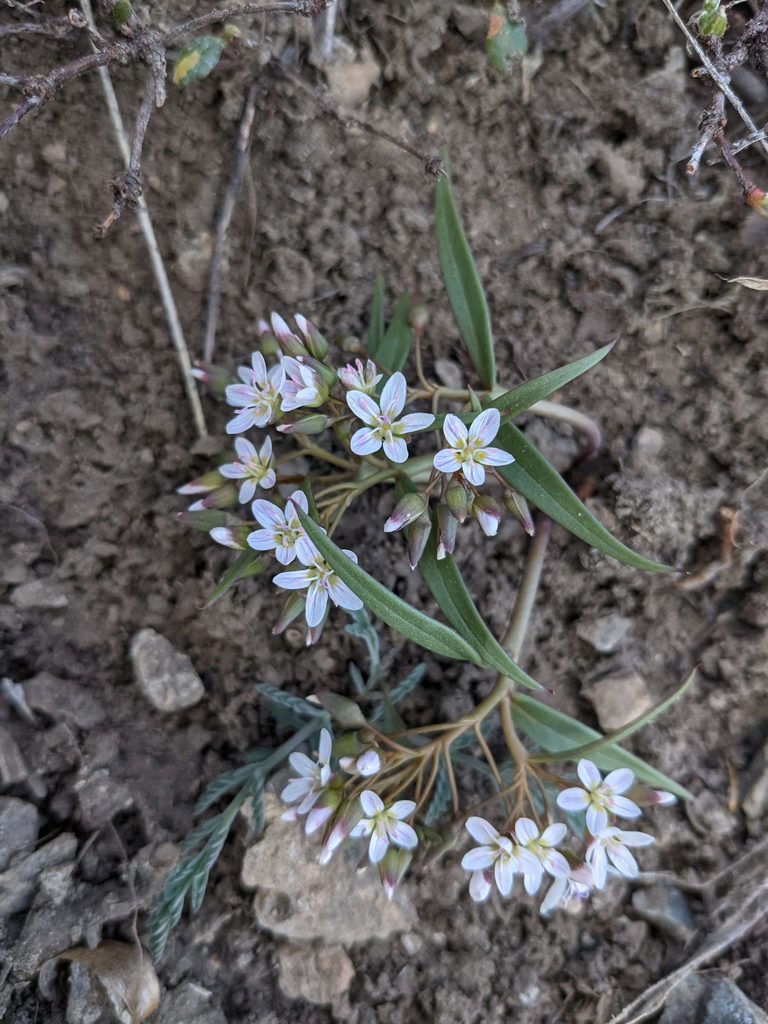
(c) Trevor Van Loon, some rights reserved (CC BY) · licence
Family: Montiaceae · Type: Perennial · Native
Conservation status: CNPS 4.3
Claytonia serpenticola (Serpentine spring beauty) is a native California perennial in the Montiaceae family, recognized by serpentine habitat and uniform leaf color diagnostic.
Serpentine spring beauty is a rare (CNPS 4.3) California native perennial found in mixed-conifer and subalpine forest openings on mafic substrates in xeric, stony north-facing slopes, typically at elevations of 500 to 2,000 meters. Flowering from April to July, this delicate plant produces white to pinkish flowers with faint pink veins and yellow bases, each bloom 5.5 to 8 millimeters long. Growing with thin erect stems 3 to 7 centimeters tall and a spherical brown tuberous root, it develops 2 to 4 alternate or subopposite linear leaves that range from 10 to 34 millimeters long. Its leaves are light to dark green, narrow, and lance-linear to oblanceolate with acute tips, measuring 1 to 5 millimeters wide. The small seeds are approximately 2 millimeters long and either smooth or weakly tubercled.
Identification and appearance
Key characters: Geographically isolated; serpentine habitat and uniform leaf color diagnostic
Habitat and range
Habitat: Openings of mixed-conifer and subalpine forest, on xeric, stony slopes (generally north-facing) of mafic substrates (e.g. gabbro, peridotite, serpentinite), sometimes mixed with sedimentary rocks (e.g. shale) and in substrate-derived soils
Outside California: to southern Oregon
Bloom period
Claytonia serpenticola blooms Apr-Jul.
Conservation status
CNPS 4.3
How to tell it apart
vs Montia: Claytonia has just 2 stem leaves opposite or fused; Montia has multiple stem leaves arranged alternately.; vs Stellaria: Claytonia has 2 broad stem leaves and 5 petals; Stellaria has many narrow opposite leaves and deeply notched petals.; vs Hydrocotyle: Claytonia has 5-petaled flowers above paired stem leaves; Hydrocotyle has round shield-like leaves and tiny flower clusters.; vs Lewisia: Claytonia has thin leaves on upright stems in moist areas; Lewisia forms succulent rosettes on rocky cliffs.; vs Dichondra: Claytonia has upright stems with 5-petaled flowers; Dichondra is a creeping plant with kidney-shaped leaves.
Frequently asked questions
Is Claytonia serpenticola native to California?
Yes. Claytonia serpenticola is native to California (recorded as native).
When does Claytonia serpenticola bloom?
Claytonia serpenticola blooms Apr-Jul.
What plant family does Claytonia serpenticola belong to?
Claytonia serpenticola is in the Montiaceae family, genus Claytonia.
Is Claytonia serpenticola rare or endangered?
Claytonia serpenticola carries California Rare Plant Rank 4.3, state rank S3.
What habitat does Claytonia serpenticola grow in?
Claytonia serpenticola grows in Openings of mixed-conifer and subalpine forest, on xeric, stony slopes (generally north-facing) of mafic substrates (e.g. gabbro, peridotite, serpentinite), sometimes mixed with sedimentary rocks (e.g. shale) and in substrate-derived soils.
Related species
Other California species in the same genus, family, or bioregion.
Sources: Jepson eFlora · CalPhotos · CDFW CNDDB
Last updated 2026-09-30
Data from The California Species Project — 14,000+ California species with verified data from CNPS, CDFW, USFWS, Cal-IPC, and more.