Clematis ligusticifolia
Western virgin's bower, Western Virgin's Bower
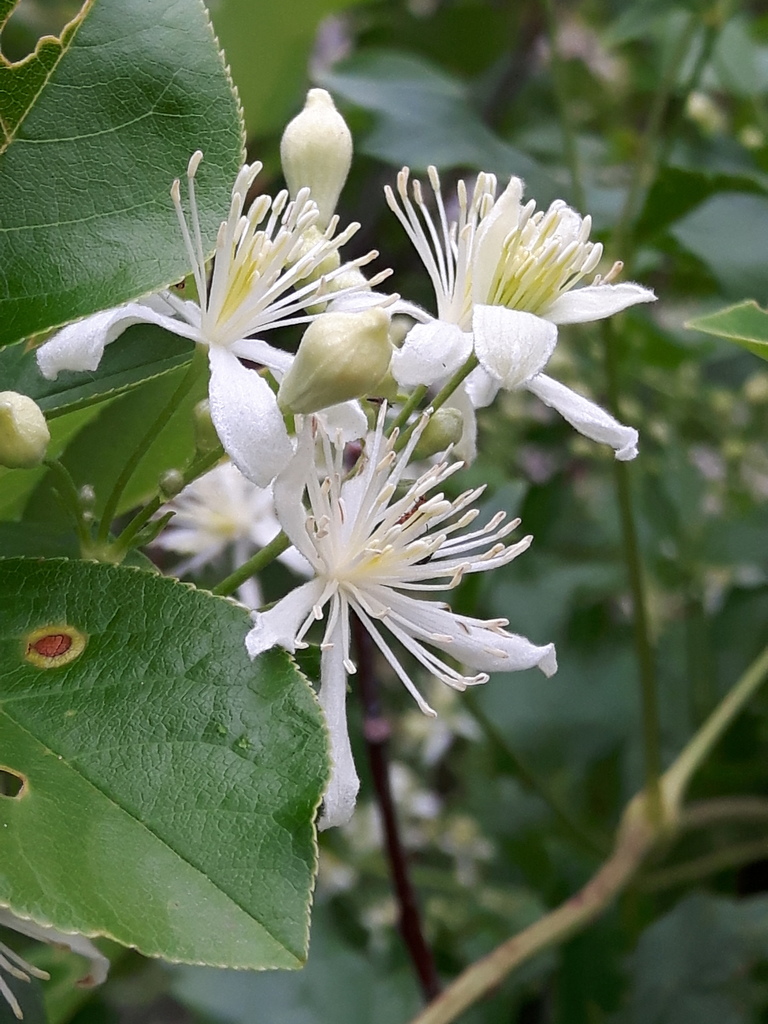
(c) Peter L Achuff, some rights reserved (CC BY), uploaded by Peter L Achuff · licence
Family: Ranunculaceae · Type: Vine · Native
Clematis ligusticifolia (Western virgin's bower) is a native California vine in the Ranunculaceae family, recognized by inflorescence size, leaflet number, and wet habitat preference.
Western virgin's bower is a California native perennial found in wet places and along streams at elevations up to 2,400 meters. Flowering from June to September, this plant produces cream-white flowers in clusters with multiple blooms. Growing with climbing vines that can reach several meters in length, it has slender, flexible stems that wind and intertwine through surrounding vegetation. Its compound leaves feature 5 to 15 leaflets that are irregularly lobed or toothed, with the largest leaflets measuring 2 to 9 centimeters long. The fruit is characterized by hairy seed bodies that aid in wind dispersal.
Identification and appearance
Key characters: 2 sympatric species; key features are inflorescence size, leaflet number, and wet habitat preference
Habitat and range
Habitat: Along streams, wet places
Elevation: < 2400 m
California counties: Trinity, San Bernardino, Colusa, Kern, Orange, Los Angeles, Ventura, Santa Barbara, Riverside, Marin, Siskiyou, Lake, Inyo, Monterey, Santa Clara, Butte, San Diego, Sonoma, Tulare, Santa Cruz, Alameda, Sierra, Shasta, Fresno, Mendocino, Tuolumne, Mono, Sacramento, San Luis Obispo, El Dorado, San Joaquin, Placer, Humboldt, Napa, Solano, San Benito, Mariposa, Amador, Tehama, Del Norte, San Mateo, Contra Costa, Merced, Nevada, Madera, Calaveras, Yolo, Modoc, Stanislaus
Outside California: to British Columbia, South Dakota, New Mexico, northwestern Mexico
Bloom period
Clematis ligusticifolia blooms Jun-Sep.
How to tell it apart
vs Toxicodendron: Clematis has opposite leaves and four showy sepals; Toxicodendron has alternate leaves with three leaflets and tiny greenish flowers.; vs Thalictrum: Clematis is a woody vine with opposite leaves; Thalictrum is an upright herb with alternate compound leaves.; vs Rhus: Clematis is a climbing vine with opposite leaves; Rhus is a shrub with alternate pinnately compound leaves.; vs Baccharis: Clematis has opposite compound leaves and showy white sepals; Baccharis has simple alternate leaves and small fuzzy flower heads.; vs Marah: Clematis has opposite leaves and individual four-sepaled flowers; Marah has alternate palmate leaves, tendrils, and small clustered flowers.
Frequently asked questions
Is Clematis ligusticifolia native to California?
Yes. Clematis ligusticifolia is native to California (recorded as native).
When does Clematis ligusticifolia bloom?
Clematis ligusticifolia blooms Jun-Sep.
Where in California does Clematis ligusticifolia grow?
Clematis ligusticifolia occurs in Trinity, San Bernardino, Colusa, Kern, Orange, Los Angeles, Ventura, Santa Barbara and other counties, at elevations of < 2400 m.
What plant family does Clematis ligusticifolia belong to?
Clematis ligusticifolia is in the Ranunculaceae family, genus Clematis.
What habitat does Clematis ligusticifolia grow in?
Clematis ligusticifolia grows in Along streams, wet places.
Related species
Other California species in the same genus, family, or bioregion.
Sources: Jepson eFlora · Index of California Plant Names · CalPhotos
Last updated 2026-10-07
Data from The California Species Project — 14,000+ California species with verified data from CNPS, CDFW, USFWS, Cal-IPC, and more.