Cleomella arborea var. globosa
Bladderpod
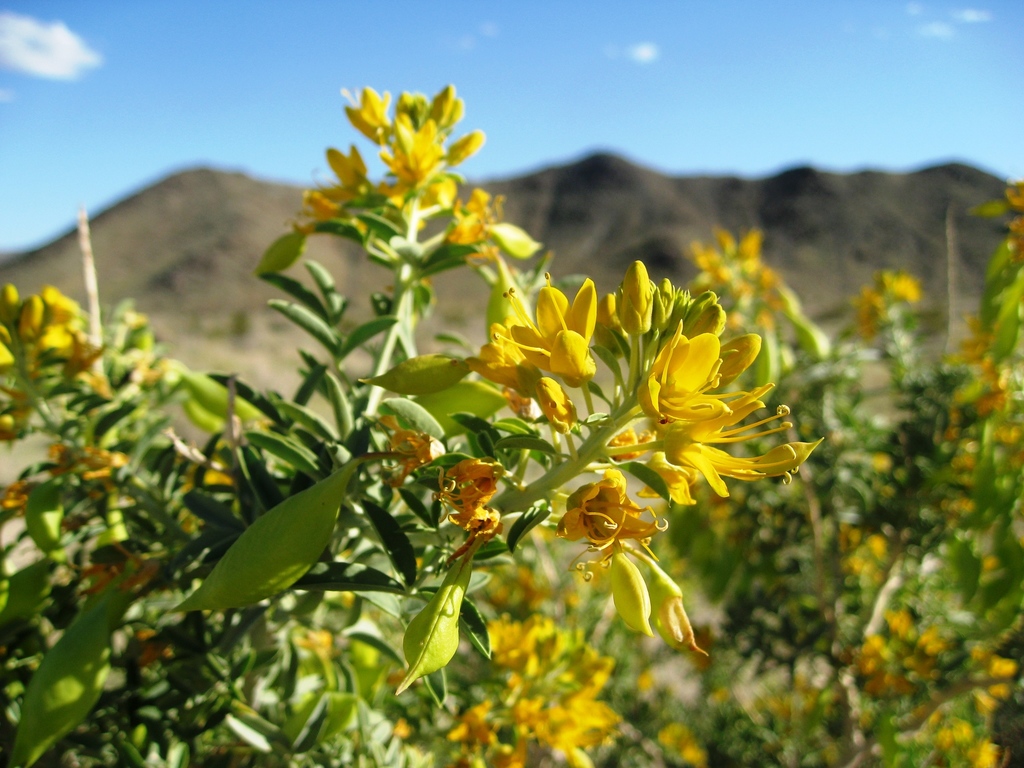
(c) J Brew, some rights reserved (CC BY-SA), uploaded by J Brew · licence
Family: Asteraceae · Type: Shrub · Native
Conservation status: CNPS PPD
Cleomella arborea var. globosa (Bladderpod) is a native California shrub in the Asteraceae family, recognized by unique shrub with spheric inflated fruits.
Bladderpod is a California native shrub found in southern Sierra Nevada Foothills, Tehachapi, southern San Joaquin Valley, south Coast Ranges, southern California Coast, Channel Islands, Transverse Ranges, and western Mojave Desert on slopes, roadcuts, and grasslands at elevations of 15 to 1,830 meters. Flowering from October to July, this plant produces pale yellow to greenish-yellow flowers in small clusters. Growing as a rounded shrub 1 to 2 meters tall with multiple branching stems, it forms a dense, compact structure. Its leaves are compound with small, rounded leaflets that have a distinctive blue-green color and waxy texture. The fruit is a distinctive spherical pod with a rounded base, tapering to a short beak, giving the plant its common name of bladderpod.
Identification and appearance
Key characters: 12 sympatric species; unique shrub with spheric inflated fruits
Habitat and range
Habitat: Slopes, roadcuts, grassland, coastal scrub
Elevation: 15-1830 m
California counties: San Bernardino, Kern, Los Angeles, Monterey, Fresno, San Luis Obispo, Ventura, San Diego, Riverside, San Benito, Butte, Santa Barbara, Merced, Orange
Bloom period
Cleomella arborea var. globosa blooms Oct-Jul.
Conservation status
CNPS PPD
How to tell it apart
vs Physaria: Physaria has inflated bladder-like pods and 4 petals; Cleomella has small flat round capsules and variable petals.; vs Astragalus: Astragalus has compound leaves and pea-shaped flowers; Cleomella has palmately divided leaves and regular flowers.; vs Sesbania: Sesbania has pinnately compound leaves and large pea flowers; Cleomella has palmate leaves and small regular flowers.; vs Atriplex: Atriplex has tiny greenish flowers and simple leaves; Cleomella has showy flowers and palmately divided leaves.; vs Isocoma: Isocoma has yellow composite flower heads; Cleomella has individual flowers with separate petals and prominent stamens.
Frequently asked questions
Is Cleomella arborea var. globosa native to California?
Yes. Cleomella arborea var. globosa is native to California (recorded as native).
When does Cleomella arborea var. globosa bloom?
Cleomella arborea var. globosa blooms Oct-Jul.
Where in California does Cleomella arborea var. globosa grow?
Cleomella arborea var. globosa occurs in San Bernardino, Kern, Los Angeles, Monterey, Fresno, San Luis Obispo, Ventura, San Diego and other counties, at elevations of 15-1830 m.
What plant family does Cleomella arborea var. globosa belong to?
Cleomella arborea var. globosa is in the Asteraceae family, genus Cleomella.
Is Cleomella arborea var. globosa rare or endangered?
Cleomella arborea var. globosa carries California Rare Plant Rank PPD.
Related species
Other California species in the same genus, family, or bioregion.
- Cleomella brevipes — Short-pedicelled cleomella
- Cleomella californica
- Cleomella hillmanii var. hillmanii — Hillman's cleomella
- Cleomella jonesii — Jones' bee plant
- Cleomella lutea — Yellow bee plant
- Cleomella obtusifolia — Mojave stinkweed
- Constancea nevinii — Nevin's woolly sunflower
- Constancea sp.
- Coreopsis lanceolata — Garden coreopsis
- Coreopsis sp.
Sources: Jepson eFlora · Index of California Plant Names · CalPhotos
Last updated 2026-10-06
Data from The California Species Project — 14,000+ California species with verified data from CNPS, CDFW, USFWS, Cal-IPC, and more.