Clinopodium mimuloides
Monkey-flower savory
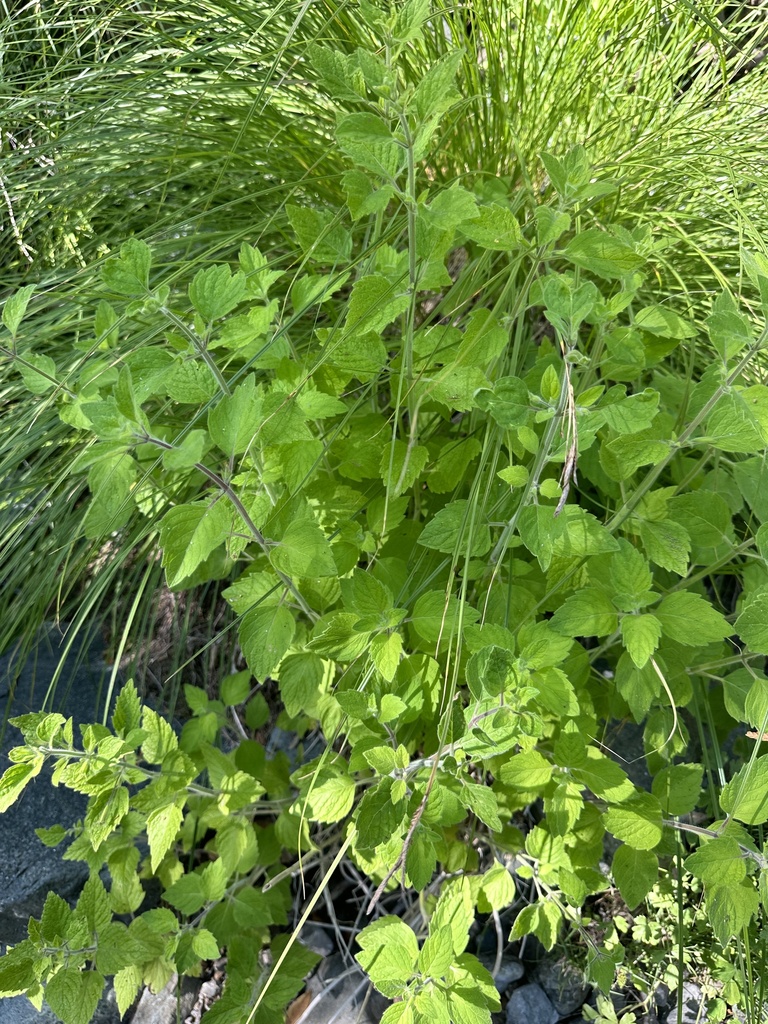
(c) paulexcoff, some rights reserved (CC BY-SA) · licence
Family: Lamiaceae · Type: Subshrub · Native
Conservation status: CNPS 4.2
Clinopodium mimuloides (Monkey-flower savory) is a native California subshrub in the Lamiaceae family.
Monkey-flower savory is a California native perennial herb found in the central coast, southern coastal ranges, western Transverse Ranges, and San Gabriel Mountains in moist places, streambanks, chaparral, and woodland at elevations of 400 to 1,800 meters. Flowering from June to October, this plant produces salmon-orange flowers 15 to 35 millimeters long with purple-veined calyxes, typically fading as they dry. Growing with erect stems up to 2 meters tall and long, spreading hairs, it develops a mostly herbaceous structure with occasional woody base. Its leaves are broadly ovate, 35 to 80 millimeters long, with irregular shallow teeth and white appressed hairs that give the foliage a distinctive textured appearance. Flowers emerge individually or in clusters of up to 6 from leaf axils, with pedicels extending 2 to 3 centimeters.
Identification and appearance
Key characters: 1 sympatric species (douglasii). Key differentiator: large salmon-orange flowers vs small white flowers
Habitat and range
Habitat: Moist places, streambanks, chaparral, woodland
Elevation: 400-1800 m
California counties: Santa Barbara, Monterey, San Luis Obispo, Ventura, Los Angeles
Bloom period
Clinopodium mimuloides blooms Jun-Oct.
Conservation status
CNPS 4.2
How to tell it apart
vs Mentha: Mentha has larger flowers and grows in wet areas; Clinopodium has tiny flowers in drier woodland sites.; vs Stachys: Hedge-nettle has small bracts under flower clusters; Clinopodium has full-sized leaves beneath its clusters.; vs Salvia: Sage has much larger flowers (over 10mm); most Clinopodium flowers are pencil-eraser-tiny.; vs Quercus: Oak is a tree with acorns; Clinopodium is a small herb with tiny tubular flowers.; vs Monardella: Monardella has a bract collar beneath its flower head; Clinopodium has regular leaves under loose clusters.
Frequently asked questions
Is Clinopodium mimuloides native to California?
Yes. Clinopodium mimuloides is native to California (recorded as native).
When does Clinopodium mimuloides bloom?
Clinopodium mimuloides blooms Jun-Oct.
Where in California does Clinopodium mimuloides grow?
Clinopodium mimuloides occurs in Santa Barbara, Monterey, San Luis Obispo, Ventura, Los Angeles, at elevations of 400-1800 m.
What plant family does Clinopodium mimuloides belong to?
Clinopodium mimuloides is in the Lamiaceae family, genus Clinopodium.
Is Clinopodium mimuloides rare or endangered?
Clinopodium mimuloides carries California Rare Plant Rank 4.2, state rank S3.
Related species
Other California species in the same genus, family, or bioregion.
Sources: Jepson eFlora · CNPS Rare Plant Inventory · Index of California Plant Names · CalPhotos · CDFW CNDDB
Last updated 2026-10-07
Data from The California Species Project — 14,000+ California species with verified data from CNPS, CDFW, USFWS, Cal-IPC, and more.