Coleogyne ramosissima
Black brush
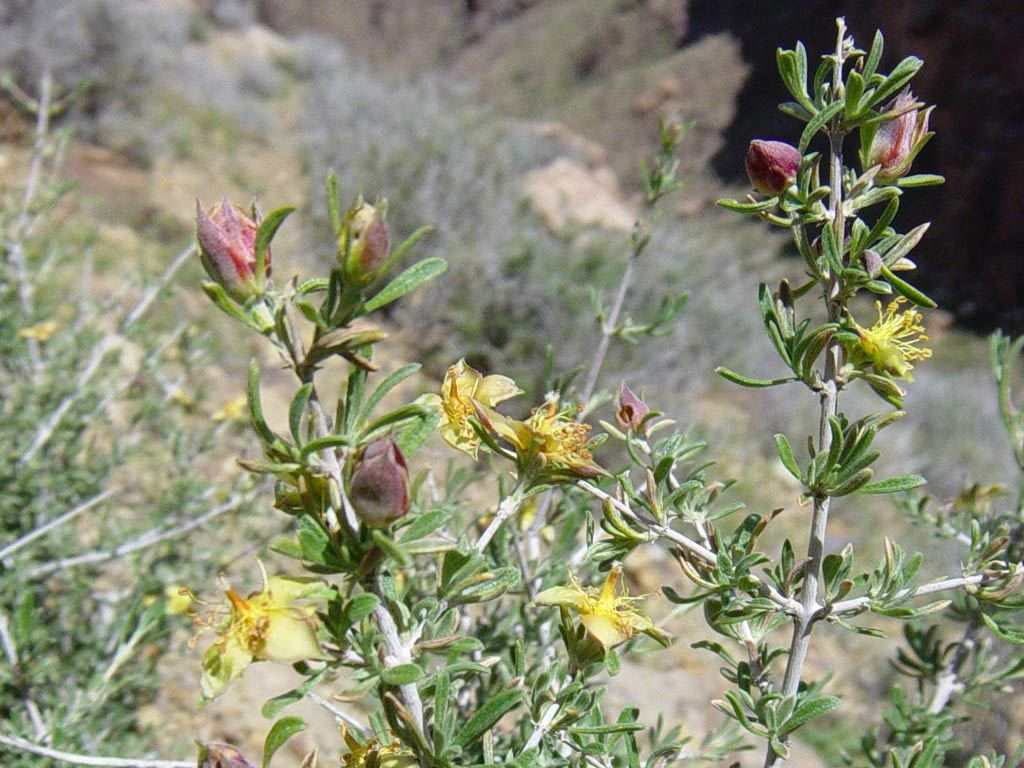
(c) Grand Canyon NPS, some rights reserved (CC BY) · licence
Family: Rosaceae · Type: Shrub · Native
Coleogyne ramosissima (Black brush) is a native California shrub in the Rosaceae family, recognized by Monotypic genus endemic to southwestern North America; represents a unique desert-adapted lineage within the rose family.
Black brush is a California native shrub found in the southern eastern deserts, especially the desert mountains, on dry, open slopes, creosote-bush scrub, and pinyon/juniper woodland at elevations of 600 to 2,000 meters. Flowering from April to June, this plant produces yellow flowers, occasionally with reddish undertones, in single terminal blooms approximately 5 to 8 millimeters long. Growing as a much-branched, thorny shrub 20 to 200 centimeters tall with a strigose appearance, it forms dense, intricate branching patterns. Its leaves grow in opposite clusters, with simple, thick linear-oblanceolate blades 5 to 15 millimeters long, featuring persistent stipules. The fruit is a crescent-shaped, red-brown achene approximately 4 to 6 millimeters long, with a long-hairy style persisting from the ovary.
Identification and appearance
Key characters: Monotypic genus endemic to southwestern North America; represents a unique desert-adapted lineage within the rose family
Habitat and range
Habitat: Dry, open slopes, creosote-bush scrub, pinyon/juniper woodland
Elevation: 600-2000 m
California counties: San Bernardino, Mono, Kern, Inyo, Los Angeles, San Diego, Riverside, Imperial, San Benito
Outside California: to Colorado, New Mexico
Bloom period
Coleogyne ramosissima blooms Apr-Jun.
How to tell it apart
vs Krameria: Coleogyne has flowers with no petals and 20-30 stamens; ratany has irregular purplish flowers with petals.; vs Eriogonum: Coleogyne has individual flowers with sepals; buckwheat has tiny flowers in dense clusters surrounded by bracts.; vs Prunus: Coleogyne has no petals and desert habitat; cherry/plum has showy petals and fleshy fruits.; vs Purshia: Coleogyne has petalless flowers; Purshia has conspicuous white petals 6-8 mm long.; vs Bernardia: Coleogyne has bisexual flowers with 20-30 stamens; Bernardia has separate male and female flowers.
Frequently asked questions
Is Coleogyne ramosissima native to California?
Yes. Coleogyne ramosissima is native to California (recorded as native).
When does Coleogyne ramosissima bloom?
Coleogyne ramosissima blooms Apr-Jun.
Where in California does Coleogyne ramosissima grow?
Coleogyne ramosissima occurs in San Bernardino, Mono, Kern, Inyo, Los Angeles, San Diego, Riverside, Imperial and other counties, at elevations of 600-2000 m.
What plant family does Coleogyne ramosissima belong to?
Coleogyne ramosissima is in the Rosaceae family, genus Coleogyne.
What habitat does Coleogyne ramosissima grow in?
Coleogyne ramosissima grows in Dry, open slopes, creosote-bush scrub, pinyon/juniper woodland.
Related species
Other California species in the same genus, family, or bioregion.
Sources: Jepson eFlora · Index of California Plant Names · CalPhotos
Last updated 2026-10-07
Data from The California Species Project — 14,000+ California species with verified data from CNPS, CDFW, USFWS, Cal-IPC, and more.