Collinsia heterophylla var. heterophylla
Chinese-houses, Chinese-Houses
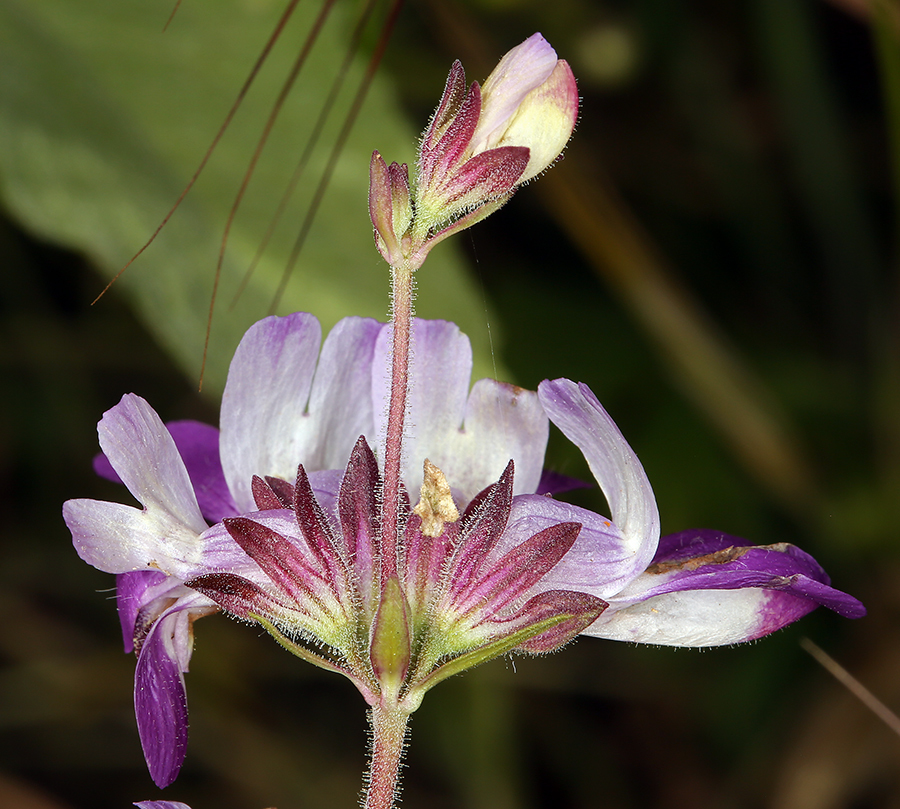
Photo: parent species Collinsia heterophylla · (c) Steve Matson, some rights reserved (CC BY) · licence
Family: Plantaginaceae · Type: Herb · Native
Collinsia heterophylla var. heterophylla (Chinese-houses) is a native California herb in the Plantaginaceae family, recognized by large flowers and equal lips distinctive.
Chinese-houses is a California native annual found in northern coastal ranges, northern inner coast ranges, the Central California Coast Ranges, Sierra Nevada foothills, Tehachapi, Sutter Buttes, central western California, southern California coastal areas, Channel Islands, western Transverse Ranges, and Peninsular Ranges at elevations below 1,300 meters in shady places within chaparral, open mixed woodland, and oak woodland. Flowering from March to June, this plant produces purple and white flowers in distinctive tiered clusters resembling pagoda-like architectural structures. Growing with delicate branching stems 10 to 40 centimeters tall, it forms an elegant and airy growth habit. Its leaves are glabrous underneath, with lower leaves often being broader and more rounded while upper leaves become progressively narrower. The corolla reaches 15 to 20 millimeters long, with upper and lower flower lips approximately equal in length.
Identification and appearance
Key characters: 18 sympatric species; large flowers and equal lips distinctive
Habitat and range
Habitat: Shady places in chaparral, open mixed woodland, oak woodland
Elevation: < 1300 m
California counties: San Luis Obispo, Kern, Tulare, San Diego, Riverside, Santa Clara, Monterey, Fresno, Madera, San Bernardino, Santa Barbara, Orange, Los Angeles, Amador, San Mateo, San Joaquin, Merced, Ventura, Lake, Solano, Napa, Mariposa, Contra Costa
Outside California: northern Baja California
Bloom period
Collinsia heterophylla var. heterophylla blooms Mar-Jun.
How to tell it apart
vs Penstemon: Collinsia has stamens hidden in keeled lower lip; Penstemon has stamens visible with one sterile 'beard.'; vs Stachys: Collinsia has a keeled lower petal hiding stamens; Stachys has square stems and flowers in tight whorls.; vs Lupinus: Collinsia has snapdragon-like flowers; Lupinus has pea-family flowers with banner, wings, and keel.; vs Linaria: Collinsia has keeled lower lip hiding stamens; Linaria has spurred flowers with protruding stamens.
Frequently asked questions
Is Collinsia heterophylla var. heterophylla native to California?
Yes. Collinsia heterophylla var. heterophylla is native to California (recorded as native).
When does Collinsia heterophylla var. heterophylla bloom?
Collinsia heterophylla var. heterophylla blooms Mar-Jun.
Where in California does Collinsia heterophylla var. heterophylla grow?
Collinsia heterophylla var. heterophylla occurs in San Luis Obispo, Kern, Tulare, San Diego, Riverside, Santa Clara, Monterey, Fresno and other counties, at elevations of < 1300 m.
What plant family does Collinsia heterophylla var. heterophylla belong to?
Collinsia heterophylla var. heterophylla is in the Plantaginaceae family, genus Collinsia.
What habitat does Collinsia heterophylla var. heterophylla grow in?
Collinsia heterophylla var. heterophylla grows in Shady places in chaparral, open mixed woodland, oak woodland.
Related species
Other California species in the same genus, family, or bioregion.
Sources: Jepson eFlora · Index of California Plant Names · CalPhotos
Last updated 2026-10-07
Data from The California Species Project — 14,000+ California species with verified data from CNPS, CDFW, USFWS, Cal-IPC, and more.