Collinsia parviflora
Blue-eyed mary, Blue-Eyed Mary
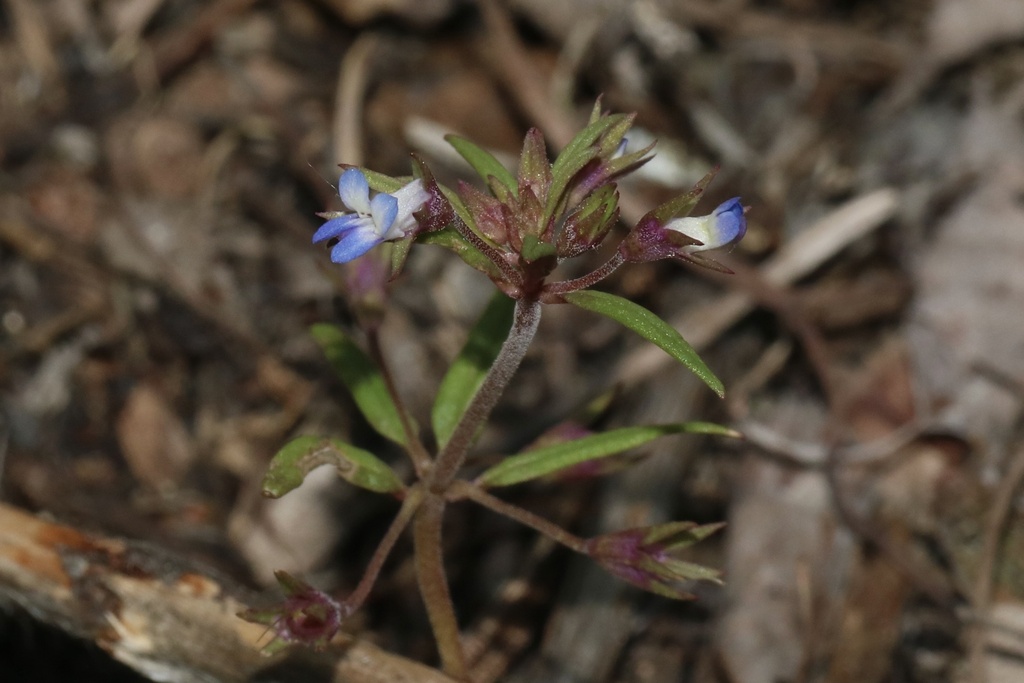
(c) Dustin Snider, some rights reserved (CC BY) · licence
Family: Plantaginaceae · Type: Herb · Native
Collinsia parviflora (Blue-eyed mary) is a native California herb in the Plantaginaceae family, recognized by small flowers hidden by large sepals diagnostic.
Blue-eyed mary is a California native annual found in the Klamath Ranges, northern Coast Ranges, high Cascade Range, Sierra Nevada, San Francisco Bay Area, Transverse Ranges, Peninsular Ranges, and Great Basin in moist, partially shady montane habitats at elevations of 800 to 3,500 meters. Flowering from March to July, this delicate plant produces white and blue flowers with distinctive blue-tipped upper lips in small, open clusters. Growing with slender stems 3 to 40 centimeters tall, it forms an airy, branching structure with lance-linear leaves. Its leaves have narrow, obtuse blades with margins rolled slightly under, creating a subtle, compact appearance. The small flowers feature a white throat and tube with blue or purple main lobes, typically 4 to 8 millimeters long, nestled within slightly larger calyxes.
Identification and appearance
Key characters: 25 sympatric species; small flowers hidden by large sepals diagnostic
Habitat and range
Habitat: Common. Moist, +- shady places, montane
Elevation: 800-3500 m
California counties: Humboldt, Lassen, San Diego, Tuolumne, Contra Costa, Tulare, San Bernardino, Riverside, Mono, Modoc, Monterey, Alpine, El Dorado, Fresno, Mendocino, Plumas, Trinity, Mariposa, Inyo, Los Angeles, Ventura, Nevada, Shasta, Del Norte, Placer, Siskiyou, Butte, Santa Clara, Kern, Madera, Santa Barbara, Orange, Sacramento, Sierra, Calaveras, Lake, Tehama, Glenn, Alameda, San Benito, San Luis Obispo
Outside California: to Yukon Territory, eastern Canada, New Mexico
Bloom period
Collinsia parviflora blooms Mar-Jul.
How to tell it apart
vs Penstemon: Collinsia has stamens hidden in keeled lower lip; Penstemon has stamens visible with one sterile 'beard.'; vs Stachys: Collinsia has a keeled lower petal hiding stamens; Stachys has square stems and flowers in tight whorls.; vs Lupinus: Collinsia has snapdragon-like flowers; Lupinus has pea-family flowers with banner, wings, and keel.; vs Linaria: Collinsia has keeled lower lip hiding stamens; Linaria has spurred flowers with protruding stamens.
Frequently asked questions
Is Collinsia parviflora native to California?
Yes. Collinsia parviflora is native to California (recorded as native).
When does Collinsia parviflora bloom?
Collinsia parviflora blooms Mar-Jul.
Where in California does Collinsia parviflora grow?
Collinsia parviflora occurs in Humboldt, Lassen, San Diego, Tuolumne, Contra Costa, Tulare, San Bernardino, Riverside and other counties, at elevations of 800-3500 m.
What plant family does Collinsia parviflora belong to?
Collinsia parviflora is in the Plantaginaceae family, genus Collinsia.
What habitat does Collinsia parviflora grow in?
Collinsia parviflora grows in Common. Moist, +- shady places, montane.
Related species
Other California species in the same genus, family, or bioregion.
Sources: Jepson eFlora · Index of California Plant Names · CalPhotos
Last updated 2026-10-07
Data from The California Species Project — 14,000+ California species with verified data from CNPS, CDFW, USFWS, Cal-IPC, and more.