Collinsia sparsiflora var. collina
Hillside collinsia
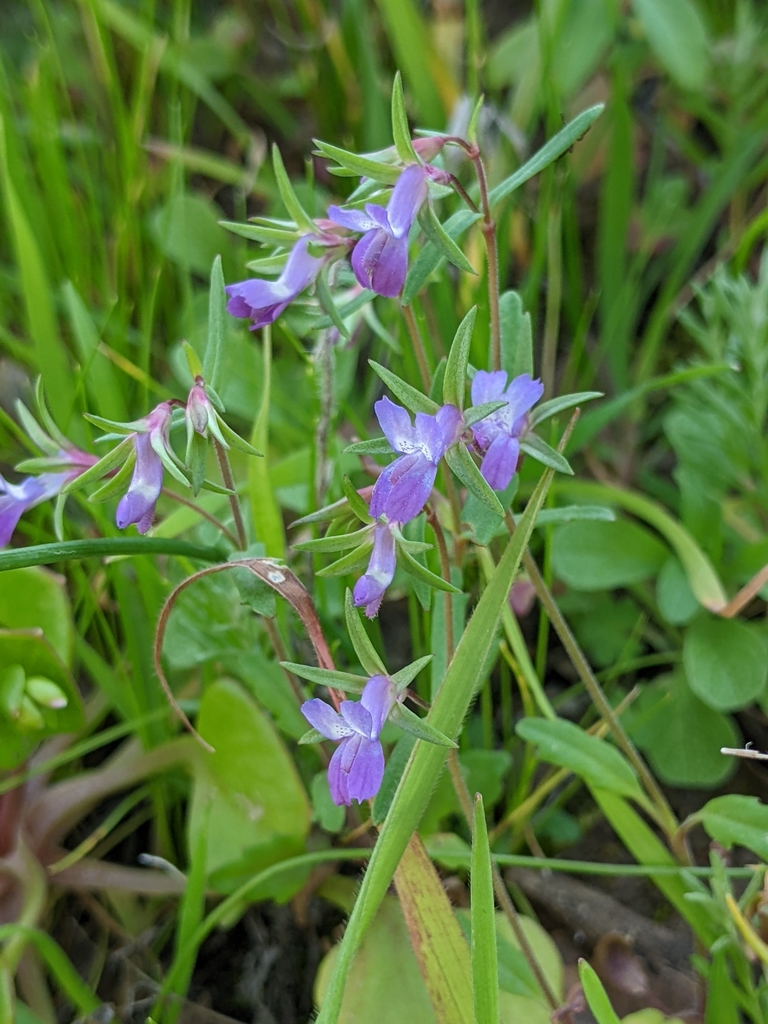
(c) Ken-ichi Ueda, some rights reserved (CC BY), uploaded by Ken-ichi Ueda · licence
Family: Plantaginaceae · Type: Herb · Native
Collinsia sparsiflora var. collina (Hillside collinsia) is a native California herb in the Plantaginaceae family, recognized by small size and hidden pouch diagnostic from var. sparsiflora.
Hillside collinsia is a California native annual found in southern North Coast Ranges, central Sierra Nevada, Great Valley, and northern Coast Ranges in disturbed grassy fields, roadbanks, open chaparral, and oak woodlands at elevations of 100 to 1,200 meters. Flowering from March to April, this plant produces delicate flowers with pale lavender to white corollas 5 to 8 millimeters long. Growing with slender stems 5 to 20 centimeters tall, it forms compact clusters in open sunny areas. Its leaves are arranged oppositely, becoming smaller and more sparse toward the top of the plant. The small flowers have a hidden pouch tucked beneath the calyx, giving the plant a subtle and intricate appearance.
Identification and appearance
Key characters: 22 sympatric species; small size and hidden pouch diagnostic from var. sparsiflora
Habitat and range
Habitat: Disturbed grassy fields, roadbanks, open chaparral, open oak and dry mixed woodland
Elevation: 100-1200 m
California counties: Tulare, Lake, Monterey, Butte, Fresno, Placer, Marin, Contra Costa, Calaveras, El Dorado, Tuolumne, San Luis Obispo, San Francisco, Alameda, San Mateo, Sacramento, Kern, Santa Clara, Napa, San Benito, Mariposa, Nevada, Amador, Stanislaus, Tehama, Merced, Glenn, Colusa, Solano, Madera, Sutter, Sonoma, San Joaquin, Yolo, Humboldt, Siskiyou, Shasta, Yuba, Mendocino, Trinity, Santa Barbara
Bloom period
Collinsia sparsiflora var. collina blooms Mar-Apr.
How to tell it apart
vs Penstemon: Collinsia has stamens hidden in keeled lower lip; Penstemon has stamens visible with one sterile 'beard.'; vs Stachys: Collinsia has a keeled lower petal hiding stamens; Stachys has square stems and flowers in tight whorls.; vs Lupinus: Collinsia has snapdragon-like flowers; Lupinus has pea-family flowers with banner, wings, and keel.; vs Linaria: Collinsia has keeled lower lip hiding stamens; Linaria has spurred flowers with protruding stamens.
Frequently asked questions
Is Collinsia sparsiflora var. collina native to California?
Yes. Collinsia sparsiflora var. collina is native to California (recorded as native).
When does Collinsia sparsiflora var. collina bloom?
Collinsia sparsiflora var. collina blooms Mar-Apr.
Where in California does Collinsia sparsiflora var. collina grow?
Collinsia sparsiflora var. collina occurs in Tulare, Lake, Monterey, Butte, Fresno, Placer, Marin, Contra Costa and other counties, at elevations of 100-1200 m.
What plant family does Collinsia sparsiflora var. collina belong to?
Collinsia sparsiflora var. collina is in the Plantaginaceae family, genus Collinsia.
What habitat does Collinsia sparsiflora var. collina grow in?
Collinsia sparsiflora var. collina grows in Disturbed grassy fields, roadbanks, open chaparral, open oak and dry mixed woodland.
Related species
Other California species in the same genus, family, or bioregion.
- Collinsia sparsiflora var. sparsiflora — Few flowered collinsia
- Collinsia tinctoria — Sticky chinese houses
- Collinsia torreyi — Torrey's blue eyed mary
- Collinsia torreyi var. latifolia — Broad leafed collinsia
- Collinsia torreyi var. torreyi — Torrey's blue eyed mary
- Collinsia torreyi var. wrightii — Wright's blue eyed mary
Sources: Jepson eFlora · Index of California Plant Names · CalPhotos
Last updated 2026-10-07
Data from The California Species Project — 14,000+ California species with verified data from CNPS, CDFW, USFWS, Cal-IPC, and more.