Collinsia tinctoria
Sticky chinese houses
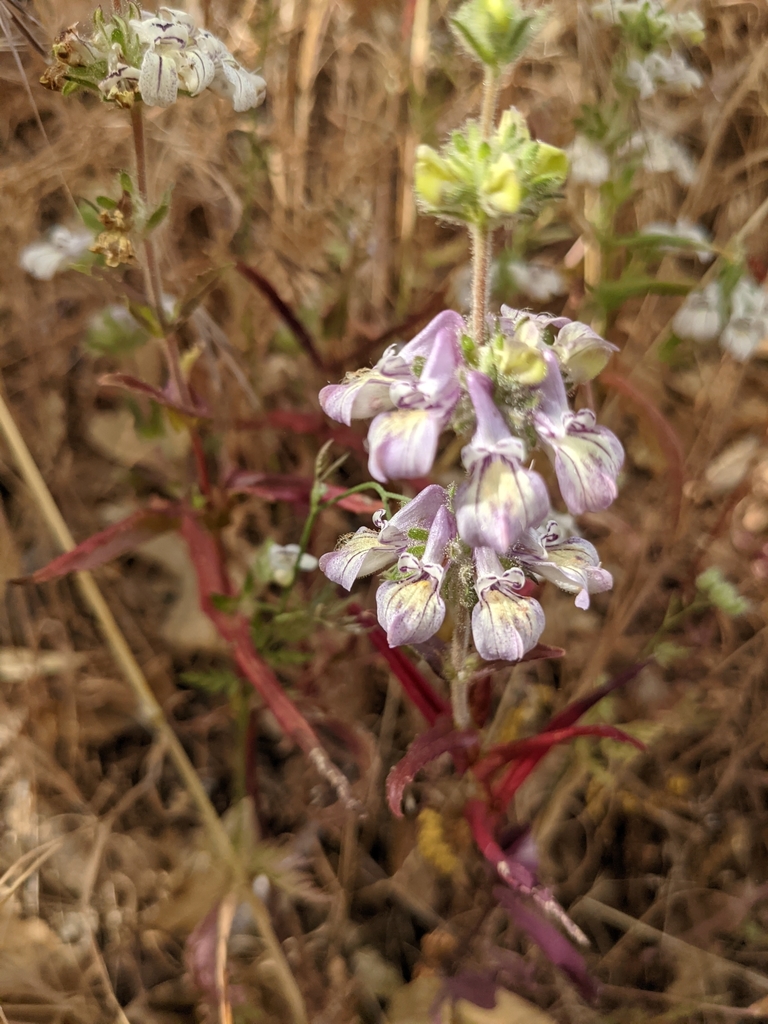
(c) Justin, some rights reserved (CC BY) · licence
Family: Plantaginaceae · Type: Herb · Native
Collinsia tinctoria (Sticky chinese houses) is a native California herb in the Plantaginaceae family, recognized by densely glandular staining inflorescence diagnostic.
Sticky chinese houses is a California native annual found in northern coastal, central, and Sierra Nevada regions in rocky, dry mixed woodland and conifer forest at elevations of 100 to 2,500 meters. Flowering from May to August, this plant produces white to pale lavender or yellow flowers with distinctive red-banded and red-dotted petals, creating complex and eye-catching blooms about 12 to 22 millimeters long. Growing 20 to 60 centimeters tall with robust, often strongly branched stems, it develops an interrupted flowering structure densely covered with glandular hairs that can stain surfaces. Its leaves are lance-shaped, varying from nearly entire to slightly serrate, with a notable mottled appearance and dense hair on the undersides. The plant's unique flower structure features a prominent pouch projecting backward 2 to 4 millimeters from the flower tube, with upper petals partially reflexed and adorned with distinctive red markings.
Identification and appearance
Key characters: 20 sympatric species; densely glandular staining inflorescence diagnostic
Habitat and range
Habitat: Rocky, dry mixed woodland, conifer forest
Elevation: 100-2500 m
California counties: Fresno, Tuolumne, Tulare, El Dorado, Nevada, Calaveras, Mariposa, Butte, Placer, Lake, Contra Costa, Tehama, Shasta, Kern, Madera, Sonoma, Plumas, Los Angeles, Sierra, Yuba, Sutter, San Francisco, Napa, Amador, Mendocino, Inyo, Humboldt, Monterey, Santa Barbara
Bloom period
Collinsia tinctoria blooms May-Aug.
How to tell it apart
vs Penstemon: Collinsia has stamens hidden in keeled lower lip; Penstemon has stamens visible with one sterile 'beard.'; vs Stachys: Collinsia has a keeled lower petal hiding stamens; Stachys has square stems and flowers in tight whorls.; vs Lupinus: Collinsia has snapdragon-like flowers; Lupinus has pea-family flowers with banner, wings, and keel.; vs Linaria: Collinsia has keeled lower lip hiding stamens; Linaria has spurred flowers with protruding stamens.
Frequently asked questions
Is Collinsia tinctoria native to California?
Yes. Collinsia tinctoria is native to California (recorded as native).
When does Collinsia tinctoria bloom?
Collinsia tinctoria blooms May-Aug.
Where in California does Collinsia tinctoria grow?
Collinsia tinctoria occurs in Fresno, Tuolumne, Tulare, El Dorado, Nevada, Calaveras, Mariposa, Butte and other counties, at elevations of 100-2500 m.
What plant family does Collinsia tinctoria belong to?
Collinsia tinctoria is in the Plantaginaceae family, genus Collinsia.
What habitat does Collinsia tinctoria grow in?
Collinsia tinctoria grows in Rocky, dry mixed woodland, conifer forest.
Related species
Other California species in the same genus, family, or bioregion.
- Collinsia torreyi — Torrey's blue eyed mary
- Collinsia torreyi var. latifolia — Broad leafed collinsia
- Collinsia torreyi var. torreyi — Torrey's blue eyed mary
- Collinsia torreyi var. wrightii — Wright's blue eyed mary
- Collinsia wakahlmae — Merced river collinsia
- Collinsia wrightii — Torrey's blue eyed mary
Sources: Jepson eFlora · Index of California Plant Names · CalPhotos
Last updated 2026-10-07
Data from The California Species Project — 14,000+ California species with verified data from CNPS, CDFW, USFWS, Cal-IPC, and more.