Collomia tinctoria
Staining collomia, Staining Collomia
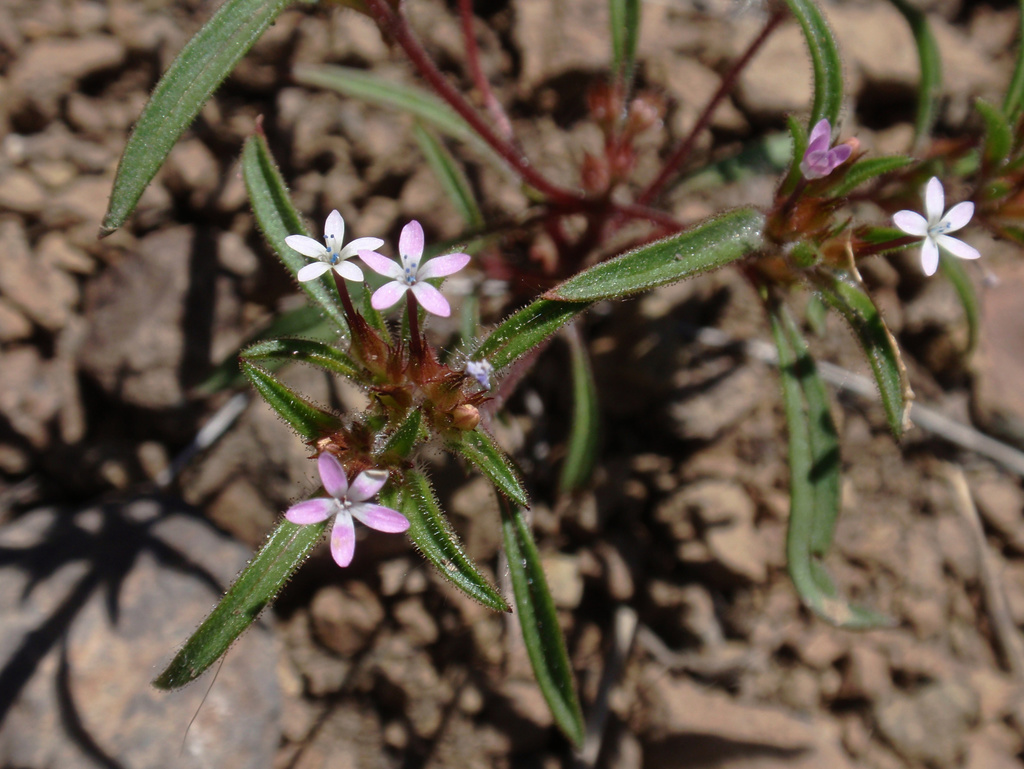
(c) Tom Hilton, some rights reserved (CC BY) · licence
Family: Polemoniaceae · Type: Herb · Native
Collomia tinctoria (Staining collomia) is a native California herb in the Polemoniaceae family, recognized by maroon-violet tube with pink lobes and awned calyx.
Staining collomia is a California native annual found in the Klamath Ranges, northern California Coast Ranges, Sierra Nevada, Transverse Ranges, and Great Basin in gravelly to rocky open areas at elevations of 600 to 3,000 meters. Flowering from June to September, this plant produces delicate pink and maroon flowers with blue pollen in small clusters of two to three blooms. Growing with slender stems 2 to 8 centimeters tall, the plant has distinctive spreading branches covered in long translucent glandular hairs. Its lower leaves are narrow and linear, glandular to the touch, and positioned along the stem with relatively long internodal spaces. The flower's unique color combination of maroon tube, pink lobes, and blue pollen makes this tiny annual a distinctive find in its rocky mountain habitats.
Identification and appearance
Key characters: 7 sympatric species; diagnostic maroon-violet tube with pink lobes and awned calyx
Habitat and range
Habitat: Gravelly to rocky, open areas
Elevation: 600-3000 m
California counties: Mono, Tulare, Inyo, Placer, Plumas, Lassen, Modoc, Mendocino, Siskiyou, Santa Barbara, Tuolumne, Alpine, Trinity, Butte, Colusa, Nevada, Shasta, Amador, Sierra, Fresno, Tehama, Lake, Yuba, Humboldt, El Dorado, Del Norte, Glenn, Ventura
Outside California: to Washington, Idaho, Nevada
Bloom period
Collomia tinctoria blooms Jun-Sep.
How to tell it apart
vs Gilia: Collomia has entire lanceolate leaves and flowers in leafy-bracted terminal heads; Gilia has pinnately lobed or dissected basal leaves and more open inflorescences.; vs Navarretia: Collomia has soft, entire leaves and unarmed bracts; Navarretia (pincushion) has spine-tipped, often pinnately spiny bracts and prickly heads.; vs Allophyllum: Collomia leaves are entire and herbage is not skunky; Allophyllum has lobed to pinnatifid leaves and a skunk-like odor with glandular herbage.; vs Leptosiphon: Collomia has undivided lanceolate leaves; Leptosiphon and Linanthus have palmately dissected, needle-like, finger-whorled leaf lobes.; vs Microsteris: Collomia has funnel-shaped flowers in leafy terminal clusters; Microsteris is a tiny annual with small pink-and-yellow salverform flowers in the leaf axils.
Frequently asked questions
Is Collomia tinctoria native to California?
Yes. Collomia tinctoria is native to California (recorded as native).
When does Collomia tinctoria bloom?
Collomia tinctoria blooms Jun-Sep.
Where in California does Collomia tinctoria grow?
Collomia tinctoria occurs in Mono, Tulare, Inyo, Placer, Plumas, Lassen, Modoc, Mendocino and other counties, at elevations of 600-3000 m.
What plant family does Collomia tinctoria belong to?
Collomia tinctoria is in the Polemoniaceae family, genus Collomia.
What habitat does Collomia tinctoria grow in?
Collomia tinctoria grows in Gravelly to rocky, open areas.
Related species
Other California species in the same genus, family, or bioregion.
- Collomia tracyi — Tracy's collomia
- Collomia diversifolia — Serpentine collomia
- Collomia grandiflora — Large-flowered collomia
- Collomia heterophylla — Variable-leaf collomia
- Collomia larsenii — Talus collomia
- Collomia linearis — Narrow-leaf mountain trumpet
- Eriastrum abramsii — Abrams' woolly-star
- Eriastrum brandegeeae — Brandegee's eriastrum
- Eriastrum calocyanum — Pretty blue woolly-star
Sources: Jepson eFlora · Index of California Plant Names · CalPhotos
Last updated 2026-10-07
Data from The California Species Project — 14,000+ California species with verified data from CNPS, CDFW, USFWS, Cal-IPC, and more.