Conringia orientalis
Hare's ear mustard
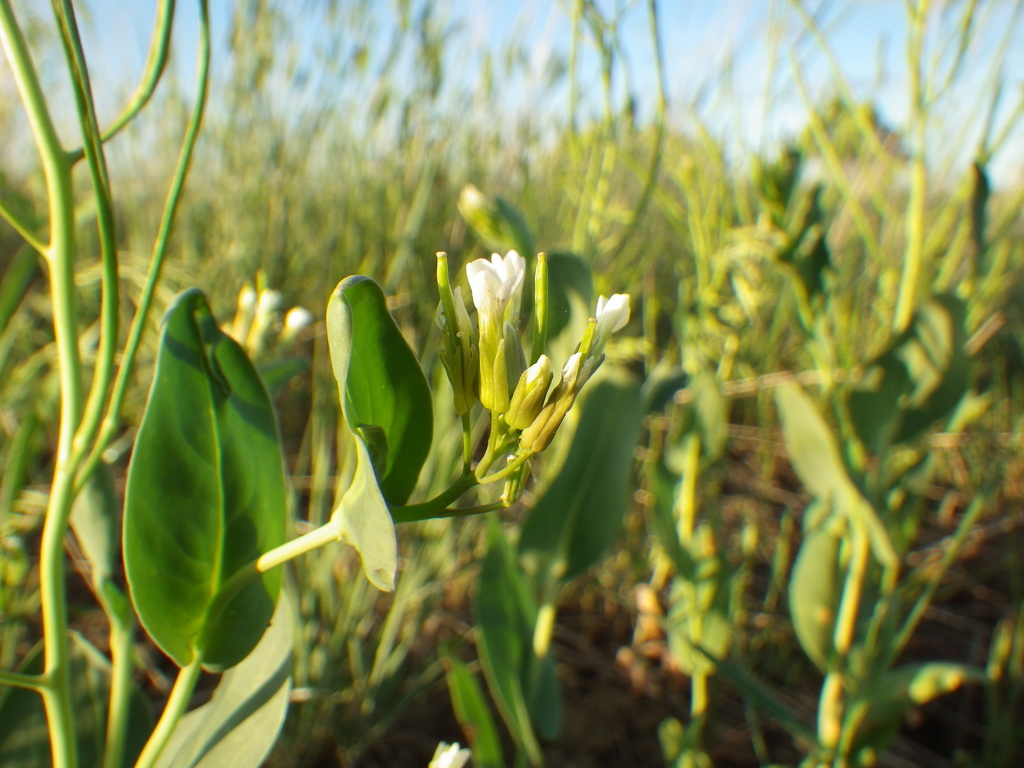
(c) Matt Lavin, some rights reserved (CC BY-SA) · licence
Family: Brassicaceae · Type: Herb · Not Native
Conringia orientalis (Hare's ear mustard) is a non-native California herb in the Brassicaceae family, recognized by Only Conringia in California, representing a small Eurasian genus in the mustard family.
Hare's ear mustard is a naturalized annual found in southern California, the eastern Sierra Nevada, and desert regions of southern California in disturbed areas and fields at elevations below 3,500 meters. Flowering from April to August, this plant produces lemon to pale yellow flowers about 7 to 12 millimeters long with slender petals. Growing with stems 30 to 70 centimeters tall that are simple or branched toward the top, it displays distinctive lance-oblong stem leaves. Its basal leaves are 5 to 9 centimeters long, oblanceolate to obovate, and nearly entire, tapering smoothly to the base. The fruit is an elongated pod 8 to 14 centimeters long, with four-angled or nearly cylindrical shape.
Identification and appearance
Key characters: Only Conringia in California, representing a small Eurasian genus in the mustard family
Habitat and range
Habitat: Disturbed areas, fields
Elevation: < 3500 m
Outside California: widespread in North America, native to Eurasia
Bloom period
Conringia orientalis blooms Apr-Aug.
How to tell it apart
vs Caulanthus: Conringia leaves clasp with heart-shaped bases; Caulanthus leaves don't clasp or clasp differently without the heart shape.; vs Barbarea: Conringia has entire oval leaves clasping the stem; Barbarea has deeply lobed lower leaves.; vs Rorippa: Conringia has smooth-edged leaves clasping with heart-shaped bases; Rorippa has toothed or lobed leaves.; vs Brassica: Conringia's stem leaves wrap around the stem in a heart-shaped clasp; Brassica leaves don't clasp this way.; vs Thelypodium: Conringia leaves are entire and heart-clasping; Thelypodium leaves are typically lobed or divided.
Frequently asked questions
Is Conringia orientalis native to California?
No. Conringia orientalis is not native to California (recorded as not native).
When does Conringia orientalis bloom?
Conringia orientalis blooms Apr-Aug.
What plant family does Conringia orientalis belong to?
Conringia orientalis is in the Brassicaceae family, genus Conringia.
What habitat does Conringia orientalis grow in?
Conringia orientalis grows in Disturbed areas, fields.
Related species
Other California species in the same genus, family, or bioregion.
Sources: Jepson eFlora · CalPhotos
Last updated 2026-10-07
Data from The California Species Project — 14,000+ California species with verified data from CNPS, CDFW, USFWS, Cal-IPC, and more.