Convolvulus simulans
Small-flowered morning-glory
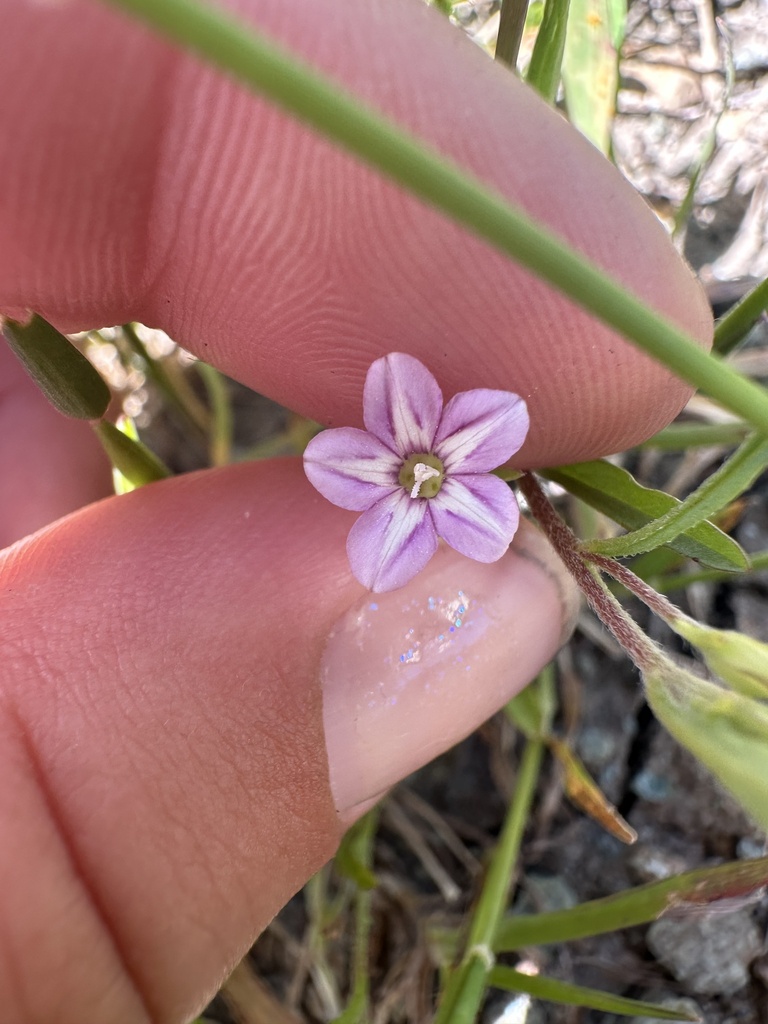
(c) Melanie J. Davis, some rights reserved (CC BY) · licence
Family: Convolvulaceae · Type: Annual · Native
Conservation status: CNPS 4.2
Convolvulus simulans (Small-flowered morning-glory) is a native California annual in the Convolvulaceae family, recognized by very small bell-shaped flowers versus larger funnel flowers.
Small-flowered morning-glory is a California native annual found in southern Sierra Nevada foothills, San Joaquin Valley, San Francisco Bay Area, southern Coast Ranges, southern California, Channel Islands, western Transverse Ranges, and Peninsular Ranges in clay substrates, coastal sage scrub, and annual grasslands at elevations of 30 to 875 meters. Flowering from April to June, this plant produces pale pink to pale blue flowers in small bell-shaped blooms approximately 0.6 centimeters long. Growing with tufted, diffusely branched stems 10 to 40 centimeters tall, it spreads in delicate clusters across its habitat. Its entire leaves are oblanceolate, less than 6 centimeters long, and sessile, narrowing toward the base. The fruit is approximately 7 millimeters long with short, sharply nodding peduncles.
Identification and appearance
Key characters: 2 sympatric species; key feature is very small bell-shaped flowers versus larger funnel flowers
Habitat and range
Habitat: Clay substrates, occasionally serpentine, annual grassland, coastal-sage scrub, chaparral
Elevation: 30-875 m
California counties: Los Angeles, Kern, San Benito, Fresno, Santa Barbara, Ventura, Riverside, Orange, San Diego, San Luis Obispo, Tulare, Stanislaus, San Bernardino, Contra Costa, San Joaquin
Outside California: Arizona, Baja California
Bloom period
Convolvulus simulans blooms Apr-Jun.
Conservation status
CNPS 4.2
How to tell it apart
vs Calystegia: Calystegia has larger flowers and blunt, paddle-shaped stigma lobes; Convolvulus has pointed stigma lobes.; vs Ipomoea: Ipomoea stigma is a single rounded knob; Convolvulus stigma splits into two pointed lobes.; vs Oenothera: Oenothera has four separate petals and cross-shaped stigma; Convolvulus has fused funnel petals.; vs Evolvulus: Evolvulus flowers have separate petals almost to base; Convolvulus petals form clear funnel.; vs Petunia: Petunia has star-shaped throat pattern; Convolvulus flowers lack central star pattern.
Frequently asked questions
Is Convolvulus simulans native to California?
Yes. Convolvulus simulans is native to California (recorded as native).
When does Convolvulus simulans bloom?
Convolvulus simulans blooms Apr-Jun.
Where in California does Convolvulus simulans grow?
Convolvulus simulans occurs in Los Angeles, Kern, San Benito, Fresno, Santa Barbara, Ventura, Riverside, Orange and other counties, at elevations of 30-875 m.
What plant family does Convolvulus simulans belong to?
Convolvulus simulans is in the Convolvulaceae family, genus Convolvulus.
Is Convolvulus simulans rare or endangered?
Convolvulus simulans carries California Rare Plant Rank 4.2, state rank S4.
Related species
Other California species in the same genus, family, or bioregion.
Sources: Jepson eFlora · CNPS Rare Plant Inventory · Index of California Plant Names · CalPhotos · CDFW CNDDB
Last updated 2026-10-06
Data from The California Species Project — 14,000+ California species with verified data from CNPS, CDFW, USFWS, Cal-IPC, and more.