Corallorhiza maculata var. occidentalis
Summer coralroot
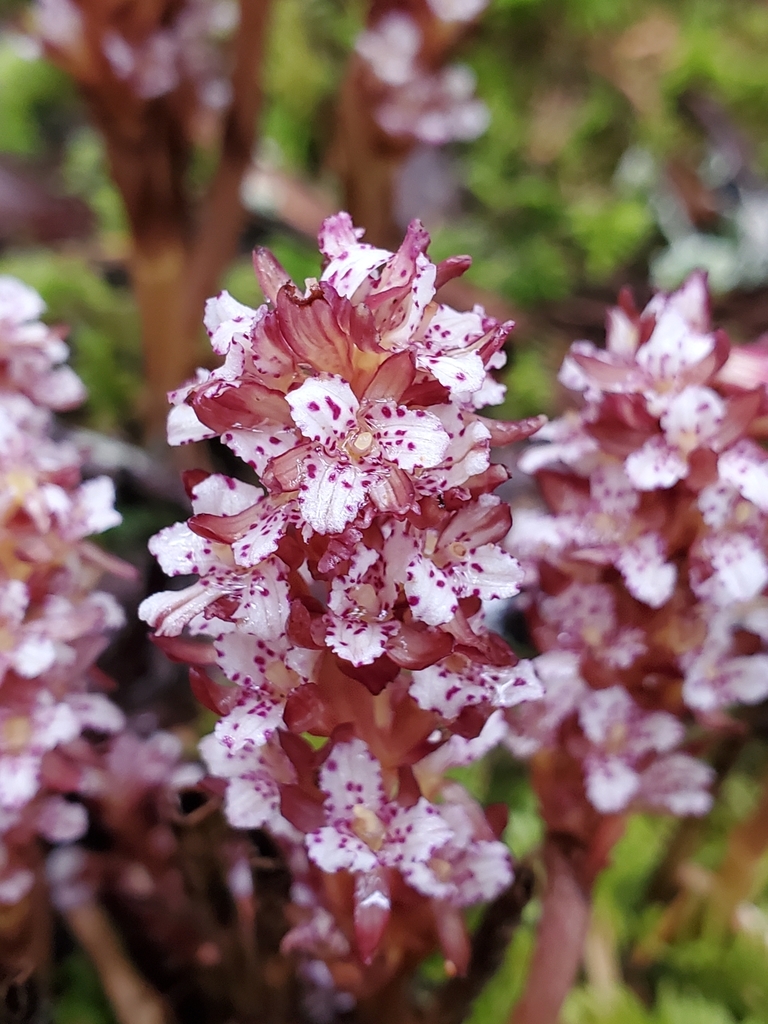
Photo: parent species Corallorhiza maculata · no rights reserved · CC0
Family: Orchidaceae · Type: Herb · Native
Corallorhiza maculata var. occidentalis (Summer coralroot) is a native California herb in the Orchidaceae family, recognized by var. maculata by bract size and lip shape; 4 sympatric species.
Summer coralroot is a native perennial orchid found in northwestern California, the Cascade Range, Sierra Nevada, San Francisco Bay Area, southern Coastal Ranges, San Gabriel Mountains, San Bernardino Mountains, Peninsular Ranges, Modoc Plateau, and White and Inyo Mountains in shaded mixed-evergreen or conifer forests at elevations up to 2,800 meters. Flowering from February to August, this distinctive orchid produces pale pink to cream-colored flowers with reddish-brown markings, often appearing small and intricate among forest leaf litter. Growing as a mycoheterotrophic plant with no chlorophyll, it emerges with pale, translucent stems 10 to 40 centimeters tall that lack traditional leaves. Its flowers feature distinctive bracts that are often forked, with the lip of the flower gradually widening toward its tip, creating a delicate and complex structure. This unusual orchid grows entirely dependent on fungal relationships, emerging briefly to flower in the cool, dark understory of dense forest environments.
Identification and appearance
Key characters: Distinguished from var. maculata by bract size and lip shape; 4 sympatric species
Habitat and range
Habitat: Shaded mixed-evergreen or conifer forest, in decomposing leaf litter
Elevation: < 2800 m
California counties: Tulare, Marin, Santa Cruz, Monterey
Outside California: to British Columbia, southeastern Canada, southeastern United States, New Mexico
Bloom period
Corallorhiza maculata var. occidentalis blooms Feb-Aug.
How to tell it apart
vs Pyrola: Corallorhiza is completely leafless; Pyrola has basal rosette of green evergreen leaves.; vs Pterospora: Corallorhiza has multiple small orchid flowers; Pterospora has urn-shaped flowers and sticky-hairy reddish stems.; vs Sarcodes: Corallorhiza has small distinct orchid flowers; Sarcodes has bright red fleshy bell-shaped flowers.; vs Epipactis: Corallorhiza is entirely brown/purple toned; Epipactis has green leafy stems.; vs Spiranthes: Corallorhiza is brown/pink/purple throughout; Spiranthes has green stems with white flowers in spiral.
Frequently asked questions
Is Corallorhiza maculata var. occidentalis native to California?
Yes. Corallorhiza maculata var. occidentalis is native to California (recorded as native).
When does Corallorhiza maculata var. occidentalis bloom?
Corallorhiza maculata var. occidentalis blooms Feb-Aug.
Where in California does Corallorhiza maculata var. occidentalis grow?
Corallorhiza maculata var. occidentalis occurs in Tulare, Marin, Santa Cruz, Monterey, at elevations of < 2800 m.
What plant family does Corallorhiza maculata var. occidentalis belong to?
Corallorhiza maculata var. occidentalis is in the Orchidaceae family, genus Corallorhiza.
What habitat does Corallorhiza maculata var. occidentalis grow in?
Corallorhiza maculata var. occidentalis grows in Shaded mixed-evergreen or conifer forest, in decomposing leaf litter.
Related species
Other California species in the same genus, family, or bioregion.
Sources: Jepson eFlora · Index of California Plant Names · CalPhotos
Last updated 2026-10-07
Data from The California Species Project — 14,000+ California species with verified data from CNPS, CDFW, USFWS, Cal-IPC, and more.