Corallorhiza striata
Striped coralroot, Striped Coralroot
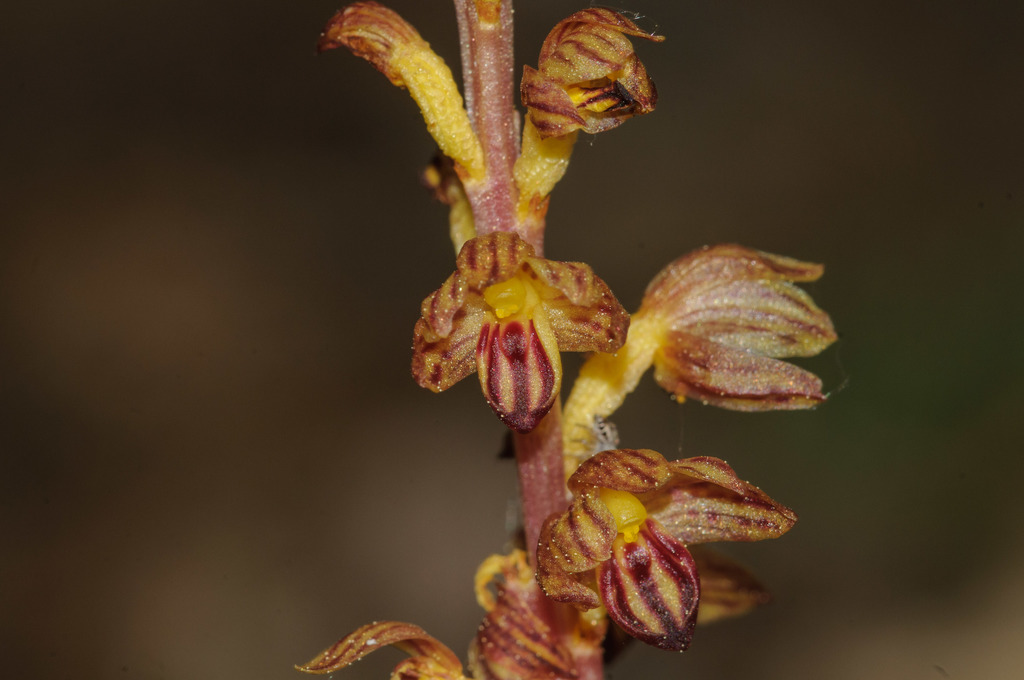
(c) Rolf Lawrenz, some rights reserved (CC BY) · licence
Family: Orchidaceae · Type: Herb · Native
Corallorhiza striata (Striped coralroot) is a native California herb in the Orchidaceae family, recognized by distinctive longitudinal striping pattern and entire lip.
Striped coralroot is a California native orchid found in northwestern California, the Cascade Range, Sierra Nevada, San Francisco Bay Area, and North Coast Ranges in open to shaded mixed-evergreen or conifer forests at elevations of 100 to 2,200 meters. Flowering from February to July, this plant produces pale yellow-brown flowers with distinctive red to purple longitudinal stripes on sepals and petals. Growing 15 to 50 centimeters tall with stems generally red-brown to purplish, this mycoheterotrophic orchid lacks chlorophyll and grows in decomposing leaf litter. Its lip is 8 to 15 millimeters long, entire, and pale yellow-brown, with a column 4 to 7 millimeters tall that is yellow and purple-spotted. The fruit develops 12 to 25 millimeters long, completing its distinctive reproductive cycle.
Identification and appearance
Key characters: 4 sympatric species; distinctive longitudinal striping pattern and entire lip
Habitat and range
Habitat: Open to shaded mixed-evergreen or conifer forest, in decomposing leaf litter
Elevation: 100-2200 m
California counties: Humboldt, Lassen, San Mateo, Lake, Tuolumne, Plumas, Marin, Madera, Mariposa, El Dorado, Trinity, Fresno, Modoc, Placer, Butte, Nevada, Tehama, Contra Costa, Napa, Del Norte, Santa Cruz, Siskiyou, Calaveras, Santa Clara, Mendocino, Sierra, San Diego, Shasta, Sonoma, Monterey
Outside California: to British Columbia, eastern Canada, northern Mexico
Bloom period
Corallorhiza striata blooms Feb-Jul.
How to tell it apart
vs Pyrola: Corallorhiza is completely leafless; Pyrola has basal rosette of green evergreen leaves.; vs Pterospora: Corallorhiza has multiple small orchid flowers; Pterospora has urn-shaped flowers and sticky-hairy reddish stems.; vs Sarcodes: Corallorhiza has small distinct orchid flowers; Sarcodes has bright red fleshy bell-shaped flowers.; vs Epipactis: Corallorhiza is entirely brown/purple toned; Epipactis has green leafy stems.; vs Spiranthes: Corallorhiza is brown/pink/purple throughout; Spiranthes has green stems with white flowers in spiral.
Frequently asked questions
Is Corallorhiza striata native to California?
Yes. Corallorhiza striata is native to California (recorded as native).
When does Corallorhiza striata bloom?
Corallorhiza striata blooms Feb-Jul.
Where in California does Corallorhiza striata grow?
Corallorhiza striata occurs in Humboldt, Lassen, San Mateo, Lake, Tuolumne, Plumas, Marin, Madera and other counties, at elevations of 100-2200 m.
What plant family does Corallorhiza striata belong to?
Corallorhiza striata is in the Orchidaceae family, genus Corallorhiza.
What habitat does Corallorhiza striata grow in?
Corallorhiza striata grows in Open to shaded mixed-evergreen or conifer forest, in decomposing leaf litter.
Related species
Other California species in the same genus, family, or bioregion.
- Corallorhiza trifida — Northern coralroot
- Corallorhiza maculata — Spotted coralroot
- Corallorhiza maculata var. maculata — Summer coralroot
- Corallorhiza maculata var. occidentalis — Summer coralroot
- Corallorhiza mertensiana — Western coralroot
- Corallorhiza sp. — Coralroot
- Cypripedium californicum — California lady's-slipper
- Cypripedium fasciculatum — Clustered lady's-slipper
- Cypripedium montanum — Mountain lady's-slipper
Sources: Jepson eFlora · Index of California Plant Names · CalPhotos
Last updated 2026-10-07
Data from The California Species Project — 14,000+ California species with verified data from CNPS, CDFW, USFWS, Cal-IPC, and more.