Cordylanthus eremicus subsp. eremicus
Desert bird's-beak, Desert Bird's-Beak
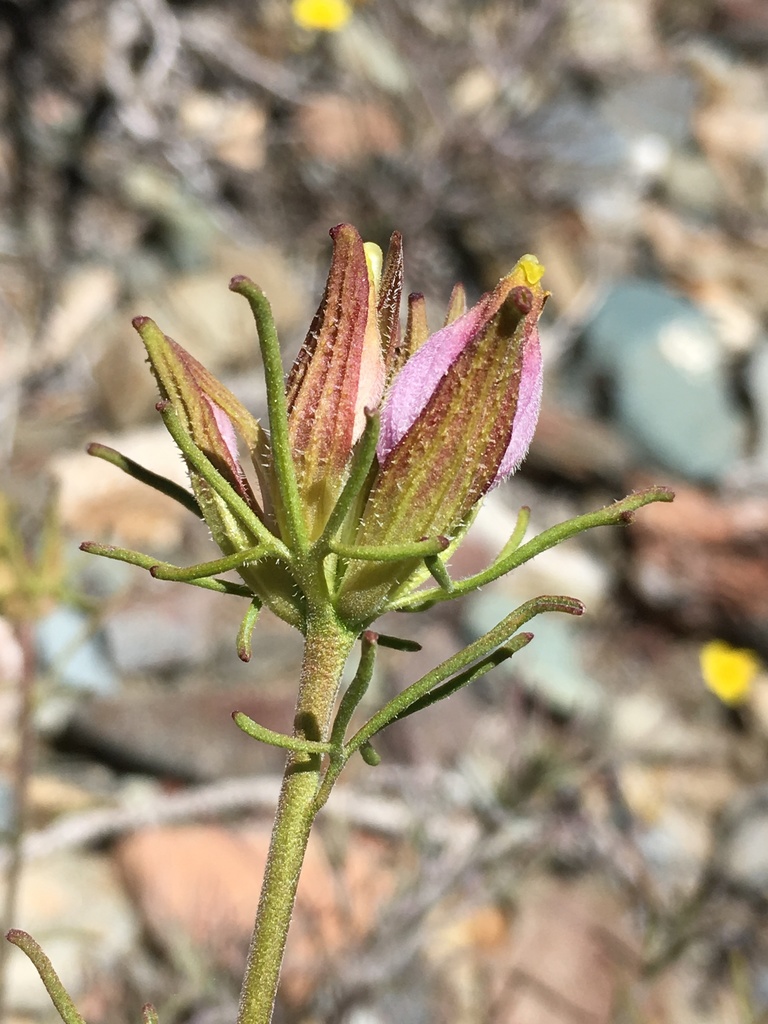
(c) Matt Berger, some rights reserved (CC BY), uploaded by Matt Berger · licence
Family: Orobanchaceae · Type: Herb · Native
Conservation status: CNPS 4.3
Cordylanthus eremicus subsp. eremicus (Desert bird's-beak) is a native California herb in the Orobanchaceae family, recognized by bract tip coloring and texture diagnostic.
Desert bird's-beak is a rare (CNPS 4.3) California native annual found in northern Mojave Desert Mountains and near Cushenbury in sagebrush scrub and pinyon/juniper woodland at elevations of 1,000 to 2,800 meters. Flowering from August to October, this plant produces lavender to pale pink flowers with distinctive purple blotches, with outer bracts featuring maroon-colored thickened tips. Growing with delicate stems that bear sparse scabrous characteristics, it develops a distinctive inflorescence with uniquely shaped bracts. Its leaves and stem structure support the plant's adaptation to harsh desert environments, with intricate surface textures that help minimize water loss. The seed features a complex surface with papillate textures between net-like patterns, contributing to its survival in arid conditions.
Identification and appearance
Key characters: 6 sympatric species; bract tip coloring and texture diagnostic
Habitat and range
Habitat: Sagebrush scrub, pinyon/juniper woodland
Elevation: 1000-2800 m
Bloom period
Cordylanthus eremicus subsp. eremicus blooms Aug-Oct.
Conservation status
CNPS 4.3
How to tell it apart
vs Dicranostegia: Cordylanthus has flowers in short dense spikes under 2cm; Dicranostegia has flowers scattered singly along stem.; vs Castilleja: Cordylanthus has closed hood with rolled lower lip; Castilleja has open beak without rolled lip.; vs Dittrichia: Cordylanthus has tubular two-lipped flowers; Dittrichia has yellow daisy flowers with many ray petals.; vs Chloropyron: Cordylanthus has palmately divided leaves; Chloropyron has succulent undivided leaves in salt marsh habitat.; vs Deinandra: Cordylanthus has tubular two-lipped flowers; Deinandra has yellow daisy flowers with notched ray petals.
Frequently asked questions
Is Cordylanthus eremicus subsp. eremicus native to California?
Yes. Cordylanthus eremicus subsp. eremicus is native to California (recorded as native).
When does Cordylanthus eremicus subsp. eremicus bloom?
Cordylanthus eremicus subsp. eremicus blooms Aug-Oct.
What plant family does Cordylanthus eremicus subsp. eremicus belong to?
Cordylanthus eremicus subsp. eremicus is in the Orobanchaceae family, genus Cordylanthus.
Is Cordylanthus eremicus subsp. eremicus rare or endangered?
Cordylanthus eremicus subsp. eremicus carries California Rare Plant Rank 4.3, state rank S3.
What habitat does Cordylanthus eremicus subsp. eremicus grow in?
Cordylanthus eremicus subsp. eremicus grows in Sagebrush scrub, pinyon/juniper woodland.
Related species
Other California species in the same genus, family, or bioregion.
Sources: Jepson eFlora · CalPhotos · CDFW CNDDB
Last updated 2026-10-07
Data from The California Species Project — 14,000+ California species with verified data from CNPS, CDFW, USFWS, Cal-IPC, and more.