Cordylanthus nidularius
Mount diablo bird's-beak
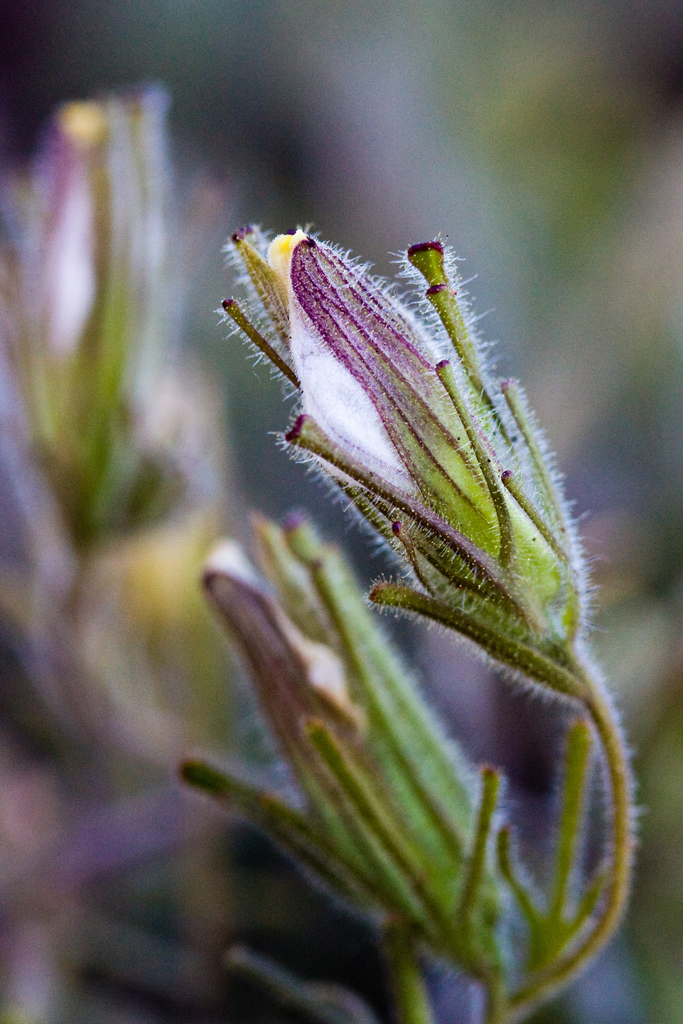
(c) Ken-ichi Ueda, some rights reserved (CC BY) · licence
Family: Orobanchaceae · Type: Herb · Native
Conservation status: CNPS 1B.1
Cordylanthus nidularius (Mount diablo bird's-beak) is a native California herb in the Orobanchaceae family, recognized by no sympatric species.
Mount diablo bird's-beak is a rare (CNPS 1B.1) California native annual found in the eastern slope of Mount Diablo in the San Francisco Bay Area bioregion in dry, open serpentine chaparral at elevations of 600 to 800 meters. Flowering from July to August, this plant produces white flowers with maroon-lined lower lip and throat in loose clusters. Growing less than 15 centimeters tall with decumbent, openly branched stems that are gray-green and maroon-tinged, it has a distinctively glandular-puberulent appearance. Its leaves are narrowly linear, 10 to 30 millimeters long, with zero to three small lobes. The seeds are dark brown, approximately ovoid, and finely wavy-striate, measuring 1.5 to 2 millimeters in length.
Identification and appearance
Key characters: Geographically isolated; no sympatric species
Habitat and range
Habitat: Dry, open serpentine in chaparral
Elevation: 600-800 m
California counties: Contra Costa
Bloom period
Cordylanthus nidularius blooms Jul-Aug.
Conservation status
CNPS 1B.1
How to tell it apart
vs Dicranostegia: Cordylanthus has flowers in short dense spikes under 2cm; Dicranostegia has flowers scattered singly along stem.; vs Castilleja: Cordylanthus has closed hood with rolled lower lip; Castilleja has open beak without rolled lip.; vs Dittrichia: Cordylanthus has tubular two-lipped flowers; Dittrichia has yellow daisy flowers with many ray petals.; vs Chloropyron: Cordylanthus has palmately divided leaves; Chloropyron has succulent undivided leaves in salt marsh habitat.; vs Deinandra: Cordylanthus has tubular two-lipped flowers; Deinandra has yellow daisy flowers with notched ray petals.
Frequently asked questions
Is Cordylanthus nidularius native to California?
Yes. Cordylanthus nidularius is native to California (recorded as native).
When does Cordylanthus nidularius bloom?
Cordylanthus nidularius blooms Jul-Aug.
Where in California does Cordylanthus nidularius grow?
Cordylanthus nidularius occurs in Contra Costa, at elevations of 600-800 m.
What plant family does Cordylanthus nidularius belong to?
Cordylanthus nidularius is in the Orobanchaceae family, genus Cordylanthus.
Is Cordylanthus nidularius rare or endangered?
Cordylanthus nidularius carries California Rare Plant Rank 1B.1, state rank S1.
Related species
Other California species in the same genus, family, or bioregion.
Sources: Jepson eFlora · CNPS Rare Plant Inventory · Index of California Plant Names · CalPhotos · CDFW CNDDB
Last updated 2026-10-07
Data from The California Species Project — 14,000+ California species with verified data from CNPS, CDFW, USFWS, Cal-IPC, and more.