Cordylanthus parviflorus
Small-flowered bird's-beak, Small-Flowered Bird's-Beak
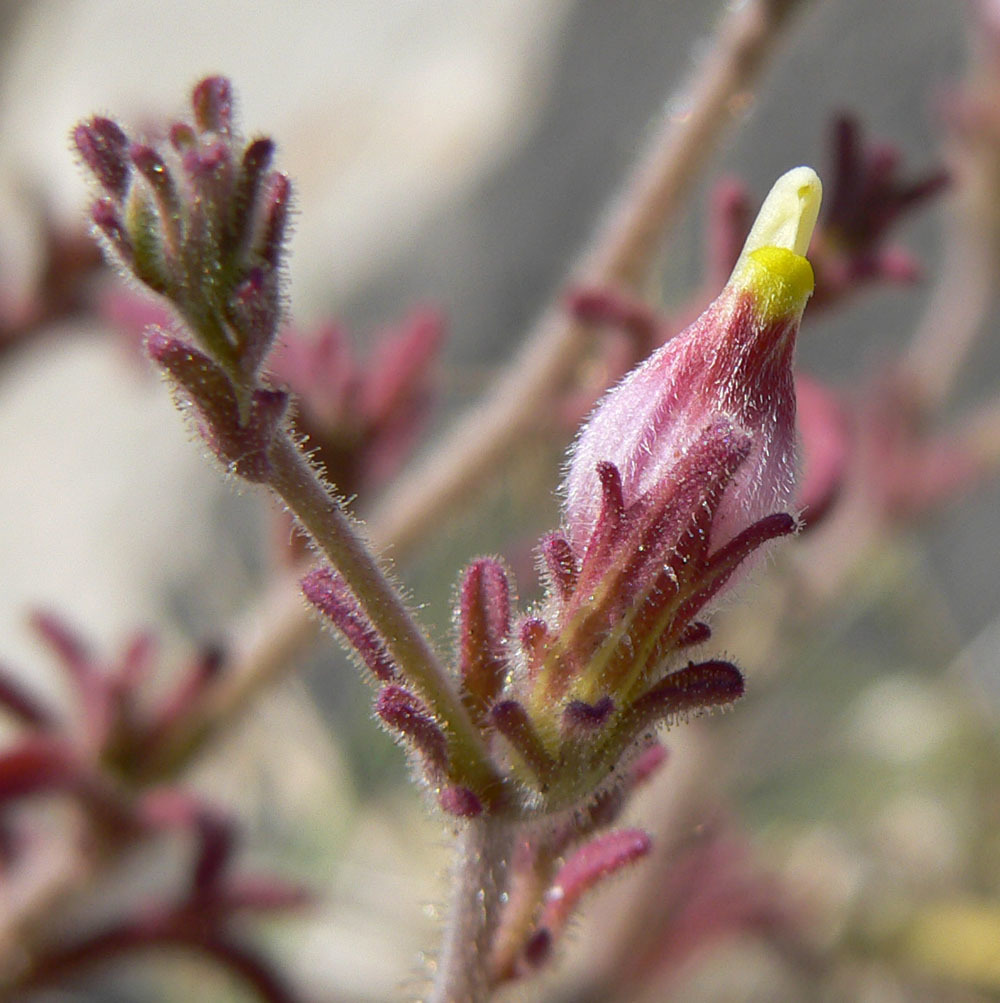
(c) Stan Shebs, some rights reserved (CC BY-SA) · licence
Family: Orobanchaceae · Type: Herb · Native
Conservation status: CNPS 2B.3
Cordylanthus parviflorus (Small-flowered bird's-beak) is a native California herb in the Orobanchaceae family, recognized by pink-lavender flowers and obtuse glandular bracts diagnostic.
Small-flowered bird's-beak is a rare (CNPS 2B.3) California native annual found in the eastern Desert Mountains, including New York and Providence Mountains, in dry sagebrush scrub and pinyon/juniper woodland at elevations of 700 to 2,200 meters. Flowering from August to October, this plant produces pink to lavender flowers with distinctive dark veining, emerging in loose clusters with 1 to 4 blooms. Growing 20 to 60 centimeters tall with a gray-green stem tinged with red, the plant is distinctively glandular-sticky and long-hairy. Its leaves are linear, 5 to 30 millimeters long, with zero to three slender lobes. The flower's outer bracts are 5 to 15 millimeters long, with 3 to 5 obtuse lobes that are densely glandular and ciliate.
Identification and appearance
Key characters: 2 sympatric species; pink-lavender flowers and obtuse glandular bracts diagnostic
Habitat and range
Habitat: dry sagebrush scrub, pinyon/juniper and Joshua-tree woodland
Elevation: 700-2200 m
California counties: San Bernardino
Outside California: to southeastern Nevada, southwestern Utah, northwestern Arizona, also south-central Idaho
Bloom period
Cordylanthus parviflorus blooms Aug-Oct.
Conservation status
CNPS 2B.3
How to tell it apart
vs Dicranostegia: Cordylanthus has flowers in short dense spikes under 2cm; Dicranostegia has flowers scattered singly along stem.; vs Castilleja: Cordylanthus has closed hood with rolled lower lip; Castilleja has open beak without rolled lip.; vs Dittrichia: Cordylanthus has tubular two-lipped flowers; Dittrichia has yellow daisy flowers with many ray petals.; vs Chloropyron: Cordylanthus has palmately divided leaves; Chloropyron has succulent undivided leaves in salt marsh habitat.; vs Deinandra: Cordylanthus has tubular two-lipped flowers; Deinandra has yellow daisy flowers with notched ray petals.
Frequently asked questions
Is Cordylanthus parviflorus native to California?
Yes. Cordylanthus parviflorus is native to California (recorded as native).
When does Cordylanthus parviflorus bloom?
Cordylanthus parviflorus blooms Aug-Oct.
Where in California does Cordylanthus parviflorus grow?
Cordylanthus parviflorus occurs in San Bernardino, at elevations of 700-2200 m.
What plant family does Cordylanthus parviflorus belong to?
Cordylanthus parviflorus is in the Orobanchaceae family, genus Cordylanthus.
Is Cordylanthus parviflorus rare or endangered?
Cordylanthus parviflorus carries California Rare Plant Rank 2B.3, state rank S2.
Related species
Other California species in the same genus, family, or bioregion.
Sources: Jepson eFlora · CNPS Rare Plant Inventory · Index of California Plant Names · CalPhotos · CDFW CNDDB
Last updated 2026-10-07
Data from The California Species Project — 14,000+ California species with verified data from CNPS, CDFW, USFWS, Cal-IPC, and more.