Cordylanthus pilosus subsp. pilosus
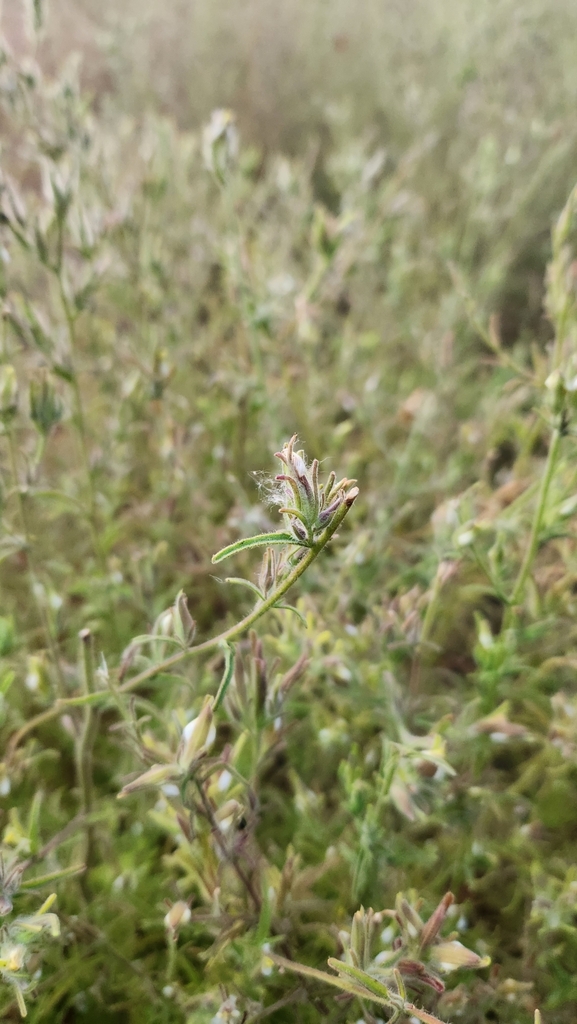
Photo: parent species Cordylanthus pilosus · (c) Chris Conard, some rights reserved (CC BY) · licence
Family: Orobanchaceae · Type: Herb · Native
Cordylanthus pilosus subsp. pilosus is a native California herb in the Orobanchaceae family, recognized by entire bracts and flower length diagnostic.
Hairy owl's-clover is a California native annual herb found in northern Coast Ranges and northern San Francisco Bay Area in open foothill woodlands and chaparral, particularly on serpentine landscapes at elevations generally below 1,500 meters. Flowering from July to September, this plant produces flowers nestled within distinctive bracts with wider, obtuse to slightly notched tips. Growing with slender stems that support delicate floral structures, it displays an intricate branching pattern characteristic of its genus. Its small leaves and bracts create a complex architectural arrangement, with flower structures that are subtly wider at their tips and carefully positioned within the plant's overall form. The plant's adaptation to serpentine soils highlights its specialized ecological niche in California's diverse botanical landscape.
Identification and appearance
Key characters: 7 sympatric species; entire bracts and flower length diagnostic
Habitat and range
Habitat: Open foothill woodland, chaparral, on serpentine
Elevation: generally < 1500 m
California counties: Sonoma, Napa, Lake, Mendocino, Santa Clara, Humboldt, San Mateo, Contra Costa, Butte, Mariposa, Marin, Sutter, Colusa, Solano, Shasta, Sacramento, Alameda, Siskiyou
Bloom period
Cordylanthus pilosus subsp. pilosus blooms Jul-Sep.
How to tell it apart
vs Dicranostegia: Cordylanthus has flowers in short dense spikes under 2cm; Dicranostegia has flowers scattered singly along stem.; vs Castilleja: Cordylanthus has closed hood with rolled lower lip; Castilleja has open beak without rolled lip.; vs Dittrichia: Cordylanthus has tubular two-lipped flowers; Dittrichia has yellow daisy flowers with many ray petals.; vs Chloropyron: Cordylanthus has palmately divided leaves; Chloropyron has succulent undivided leaves in salt marsh habitat.; vs Deinandra: Cordylanthus has tubular two-lipped flowers; Deinandra has yellow daisy flowers with notched ray petals.
Frequently asked questions
Is Cordylanthus pilosus subsp. pilosus native to California?
Yes. Cordylanthus pilosus subsp. pilosus is native to California (recorded as native).
When does Cordylanthus pilosus subsp. pilosus bloom?
Cordylanthus pilosus subsp. pilosus blooms Jul-Sep.
Where in California does Cordylanthus pilosus subsp. pilosus grow?
Cordylanthus pilosus subsp. pilosus occurs in Sonoma, Napa, Lake, Mendocino, Santa Clara, Humboldt, San Mateo, Contra Costa and other counties, at elevations of generally < 1500 m.
What plant family does Cordylanthus pilosus subsp. pilosus belong to?
Cordylanthus pilosus subsp. pilosus is in the Orobanchaceae family, genus Cordylanthus.
What habitat does Cordylanthus pilosus subsp. pilosus grow in?
Cordylanthus pilosus subsp. pilosus grows in Open foothill woodland, chaparral, on serpentine.
Related species
Other California species in the same genus, family, or bioregion.
Sources: Jepson eFlora · Index of California Plant Names · CalPhotos
Last updated 2026-10-07
Data from The California Species Project — 14,000+ California species with verified data from CNPS, CDFW, USFWS, Cal-IPC, and more.