Cordylanthus rigidus subsp. setiger
no rights reserved · CC0
Family: Orobanchaceae · Type: Annual · Native
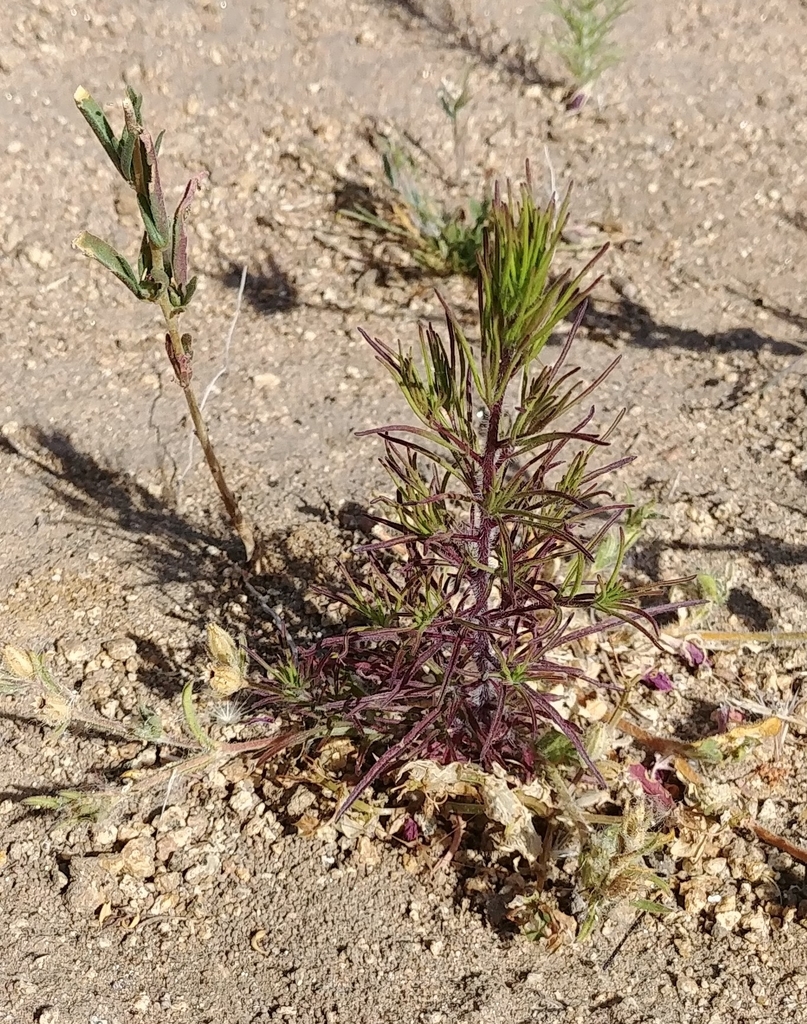
Cordylanthus rigidus subsp. setiger is a native California annual in the Orobanchaceae family, recognized by purple-based bristles and maroon bract tips diagnostic.
Rigid bird's beak is a California native annual found in southern coastal ranges and southwestern California in open coastal-sage scrub, chaparral, oak woodland, and conifer forest at elevations below 2,200 meters. Flowering from June to September, this plant produces flowers with distinctive purple-based bristly bracts surrounding delicate blooms 13 to 17 millimeters long. Growing with slender stems that develop intricate branched inflorescences up to 30 millimeters wide, it forms complex flower clusters with 5 to 13 individual blossoms. Its bracts are particularly notable, with lower sections densely covered in long bristles and a middle lobe that is linear with a wider, notched, thickened maroon tip. The plant's intricate floral structure makes it a fascinating example of the complex adaptations found in California's annual wildflowers.
Identification and appearance
Key characters: 5 sympatric species; purple-based bristles and maroon bract tips diagnostic
Habitat and range
Habitat: Open coastal-sage scrub, chaparral, oak woodland, conifer forest
Elevation: < 2200 m
California counties: San Bernardino, San Diego, Riverside, San Luis Obispo, Orange, Los Angeles, Ventura, Kern, Monterey, San Benito
Outside California: northern Baja California
Bloom period
Cordylanthus rigidus subsp. setiger blooms Jun-Sep.
How to tell it apart
vs Dicranostegia: Cordylanthus has flowers in short dense spikes under 2cm; Dicranostegia has flowers scattered singly along stem.; vs Castilleja: Cordylanthus has closed hood with rolled lower lip; Castilleja has open beak without rolled lip.; vs Dittrichia: Cordylanthus has tubular two-lipped flowers; Dittrichia has yellow daisy flowers with many ray petals.; vs Chloropyron: Cordylanthus has palmately divided leaves; Chloropyron has succulent undivided leaves in salt marsh habitat.; vs Deinandra: Cordylanthus has tubular two-lipped flowers; Deinandra has yellow daisy flowers with notched ray petals.
Frequently asked questions
Is Cordylanthus rigidus subsp. setiger native to California?
Yes. Cordylanthus rigidus subsp. setiger is native to California (recorded as native).
When does Cordylanthus rigidus subsp. setiger bloom?
Cordylanthus rigidus subsp. setiger blooms Jun-Sep.
Where in California does Cordylanthus rigidus subsp. setiger grow?
Cordylanthus rigidus subsp. setiger occurs in San Bernardino, San Diego, Riverside, San Luis Obispo, Orange, Los Angeles, Ventura, Kern and other counties, at elevations of < 2200 m.
What plant family does Cordylanthus rigidus subsp. setiger belong to?
Cordylanthus rigidus subsp. setiger is in the Orobanchaceae family, genus Cordylanthus.
What habitat does Cordylanthus rigidus subsp. setiger grow in?
Cordylanthus rigidus subsp. setiger grows in Open coastal-sage scrub, chaparral, oak woodland, conifer forest.
Related species
Other California species in the same genus, family, or bioregion.
- Cordylanthus sp. — Bird's-beak
- Cordylanthus tenuis — Slender bird's beak
- Cordylanthus tenuis subsp. barbatus — Fresno county bird's-beak
- Cordylanthus tenuis subsp. brunneus — Serpentine bird's-beak
- Cordylanthus tenuis subsp. capillaris — Pennell's bird's-beak
- Cordylanthus tenuis subsp. pallescens — Pallid bird's-beak
Sources: Jepson eFlora · CalPhotos
Last updated 2026-10-07
Data from The California Species Project — 14,000+ California species with verified data from CNPS, CDFW, USFWS, Cal-IPC, and more.